Manipur farmer Chongtham Khogendro Singh earned Rs 59,720 net profit from Arka Mangala yard long bean, harvesting 1,580 kg from a 625-square-metre plot.
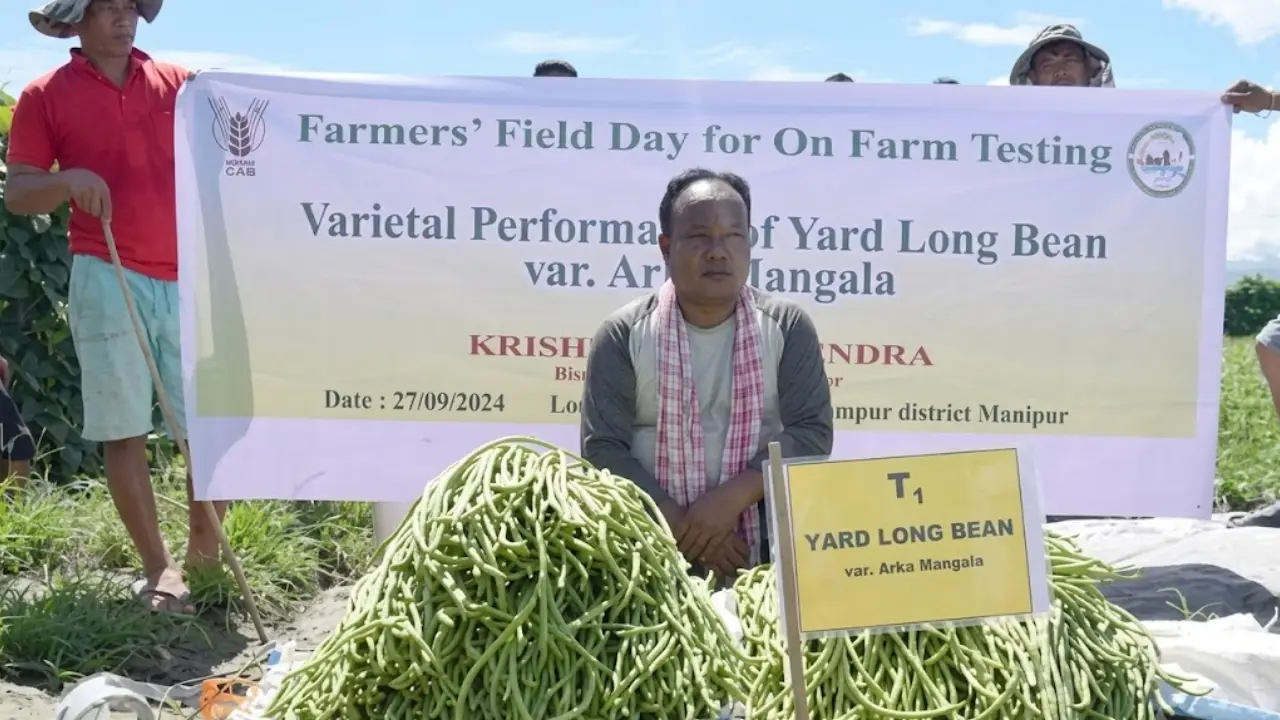
Imphal, August 9: A vegetable farmer from Bishnupur district has recorded strong returns from cultivating Arka Mangala, an improved yard long bean variety developed by the ICAR-Indian Institute of Horticultural Research (ICAR-IIHR), Bengaluru, demonstrating its potential to improve farm incomes in Manipur's vegetable-growing areas.
Chongtham Khogendro Singh, 47, of Khoijuman Mayai Leikai in Bishnupur district, harvested 1,580 kg of yard long beans from a 625-square-metre plot over four months. With a production cost of Rs 9,800, he earned a gross return of Rs 69,520 and a net profit of Rs 59,720.
Khogendro, a graduate by education, is a progressive vegetable farmer who cultivates a range of crops on his one-hectare farm. His work in horticulture was recognised when he received the Best Farmer Award 2025 during the National Horticulture Fair organised by ICAR-IIHR in Bengaluru.
The successful cultivation of Arka Mangala was part of an On-Farm Testing (OFT) initiative undertaken by ICAR-Krishi Vigyan Kendra (KVK), Bishnupur, under its 2024 Action Plan.
Trial aimed at addressing problems with imported varieties
Yard long bean cultivation has become an important source of income for farmers in Khoijuman and other parts of Manipur's vegetable belt.
However, according to ICAR-KVK Bishnupur, many farmers in Bishnupur district traditionally depend on yard long bean varieties imported from Thailand, China and Myanmar.
These varieties are often grown using non-certified seeds and without standardised scientific cultivation practices. Their relatively short shelf life can also create difficulties for farmers, particularly when produce has to reach markets over longer distances.
The lack of access to improved varieties developed through institutional breeding programmes has been another constraint affecting productivity and profitability.
Against this backdrop, KVK Bishnupur initiated an On-Farm Testing programme to assess the performance of Arka Mangala (F1), a variety developed by ICAR-IIHR.
Four farmers from Khoijuman, Bishnupur Ward No. 11 and Leimaram Heinoubok villages were selected for the field trial, including Khogendro Singh.
Farmers trained in scientific cultivation
Before the trial began, KVK Bishnupur conducted a one-day on-campus training programme for participating farmers. The training focused on the recommended scientific cultivation practices for Arka Mangala, including appropriate seed rate, nutrient management and plant spacing.
The recommended package of practices included a seed rate of 25 kg per hectare, application of 5 tonnes of farmyard manure per hectare, and a fertiliser dose of 30:60:50 kg per hectare of NPK. The recommended spacing was 45 cm by 15 cm. Each participating farmer was provided 1 kg of Arka Mangala seeds for the trial.
1,580 kg harvested from 625-square-metre plot
Khogendro Singh cultivated Arka Mangala on a 625-square-metre plot, with sowing carried out on July 28, 2024. The plants began flowering 42 days after sowing, while 50 per cent flowering was recorded by the 49th day.
Harvesting started on the 58th day after sowing and continued at intervals of three to four days. A total of 18 harvests were recorded from the plot. The highest single harvest was 122 kg, recorded on October 31, 2024.
Over a period of four months, the farmer harvested a total of 1,580 kg of yard long beans.
Longer shelf life adds to market advantage
One of the notable characteristics observed during the trial was the shelf life of the Arka Mangala pods.
According to the KVK, the pods remained fresh for around five days, compared with approximately two days for the check variety.
The longer shelf life can provide farmers with greater flexibility in harvesting, storage and marketing, particularly where produce needs to be transported from production areas to distant markets.
Khogendro also reported relatively low pest and disease incidence during the crop cycle. Only mild infestations of aphids and pod borers were observed, and these were effectively managed.
Leaves provided additional income
The farmer also found another source of income from the crop.
Apart from harvesting the pods, Khogendro collected and sold young, fresh leaves of the Arka Mangala plants, which are considered a local delicacy.
He observed that the plants had thicker and denser foliage compared with other varieties, contributing to both pod and leaf production.
The additional sale of young leaves allowed him to generate income beyond the primary harvest of yard long bean pods.
Field Day draws interest from local farmers
The performance of the crop on Khogendro's farm prompted KVK Bishnupur to organise a Field Day on September 27, 2024, to demonstrate the fruiting and yield potential of Arka Mangala.
The programme was coordinated under the guidance of Dr P. Bijaya Devi, SMS (Horticulture), KVK Bishnupur. Around 30 farmers, including 22 men and eight women, attended the programme.
Officials from the Department of Horticulture and Soil Conservation, Bishnupur, also participated. The participants included Smt S. Sushilla Chanu, District Officer of the department.
The field demonstration generated interest among neighbouring farmers, allowing them to directly observe the crop's growth, foliage, fruiting and yield.
The KVK described the demonstration as an example of the extension principle of "Seeing is believing", where farmers can assess a technology directly in a field before considering its adoption.
Rs 59,720 net profit from one plot
The economic performance recorded from Khogendro's trial plot was significant. From the 625-square-metre area, he harvested 1,580 kg of produce over four months. The total production cost was Rs 9,800.
At an average selling price of Rs 44 per kg, the produce generated a gross return of Rs 69,520. After deducting the production cost, the farmer recorded a net profit of Rs 59,720.
The results indicate the potential for Arka Mangala to provide higher returns to vegetable growers when combined with appropriate cultivation practices and market access.
Potential for wider adoption in Manipur
The KVK said the successful field performance of Arka Mangala demonstrated its potential as a high-income crop for vegetable farmers in Bishnupur district.
Its combination of higher yield, longer shelf life, market acceptability and relatively low pest incidence makes the variety a potential candidate for wider demonstration and adoption.
The experience also indicates the importance of institutionally developed crop varieties and scientific cultivation practices in improving the productivity and profitability of vegetable farming.
The KVK has suggested that the variety could be promoted through Front Line Demonstration (FLD) programmes to allow more farmers to assess its performance under local conditions.
The growing interest among farmers following the field demonstration could support wider adoption of the variety in Manipur's established vegetable belts.
For farmers who depend on vegetables as a major source of household income, varieties that combine higher productivity with better post-harvest shelf life can help reduce losses and improve market opportunities.
The experience of Khogendro Singh also illustrates the role of on-farm trials in connecting agricultural research institutions with farmers and allowing improved technologies to be evaluated under actual field conditions.
With Manipur's vegetable farmers facing challenges related to seed quality, productivity, post-harvest losses and market access, the Arka Mangala trial provides a locally tested example of how improved planting material and scientific cultivation practices can potentially raise returns.
The information on the trial and its results was provided by ICAR-Krishi Vigyan Kendra, Bishnupur district, Manipur.