Manipur recorded India’s steepest 68% rise in suicides in 2024 despite a low rate of 1.3 per lakh, with family problems accounting for 35.7% of cases.
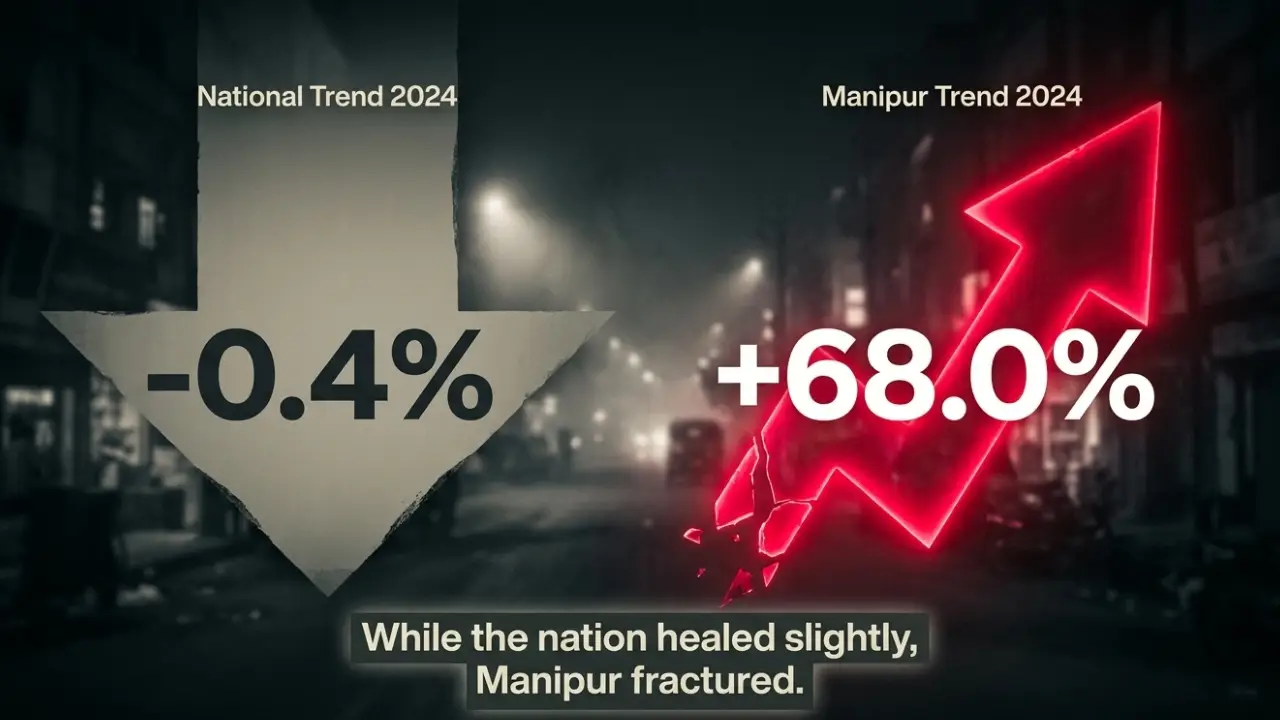
Imphal, August 11: Manipur recorded 42 suicides in 2024, a 68 per cent increase from the previous year, even as the state continued to have one of India’s lowest suicide rates, according to data from the National Crime Records Bureau (NCRB).
The figures present a sharp statistical contrast. Manipur’s suicide rate stood at 1.3 per lakh population in 2024, against the national average of 12.2. Only Nagaland, at 0.5, and Bihar, at 1.0, recorded lower rates among states.
At the same time, the 68 per cent year-on-year increase was the highest recorded among states and Union Territories. Manipur had reported 25 suicides in 2023, meaning the 2024 figure represented an increase of 17 cases.
The rise came against a marginal decline nationally. India recorded 170,746 suicides in 2024, compared with 171,418 in 2023.
Family problems account for more than a third of Manipur cases
The NCRB data shows that family-related problems were the largest identified cause of suicide in Manipur in 2024.
Of the 42 cases recorded in the state, 15 were attributed to family problems, accounting for 35.7 per cent of the total. This was higher than the national share of 33.5 per cent.
The figures place Manipur among the states identified by the NCRB as having a higher-than-national-average share of suicides attributed to family problems and illness.
The data nevertheless needs to be interpreted cautiously. Manipur's absolute number of reported suicides remains very small compared with larger states, meaning that relatively few additional cases can produce a substantial percentage change from one year to another.
No farmer or agricultural labourer suicides reported
Another notable feature of Manipur’s 2024 profile was the absence of reported suicides among farmers, cultivators and agricultural labourers.
Nationally, 10,546 people belonging to the farming sector died by suicide in 2024. This included 4,633 farmers or cultivators and 5,913 agricultural labourers, together accounting for 6.2 per cent of all reported suicides.
The NCRB listed Manipur among states and Union Territories that recorded zero suicides involving both farmers or cultivators and agricultural labourers.
Other northeastern states, including Nagaland, Tripura and Arunachal Pradesh, also reported no suicides in the farming sector.
North-East shows sharply different patterns
The broader Northeast presents a far more varied picture than Manipur’s low rate alone suggests.
Nagaland recorded just 11 suicides in 2024 and had the country’s lowest suicide rate at 0.5 per lakh. It also recorded a 69.4 per cent decline from the previous year, the largest percentage reduction reported nationally.
At the opposite end of the regional spectrum was Sikkim, which recorded 253 suicides and a rate of 36.3 per lakh, the second-highest rate in the country after the Andaman and Nicobar Islands. Illness accounted for 87 cases, or 34.4 per cent of Sikkim’s total.
Tripura recorded 615 suicides, with a rate of 14.7 per lakh. Family problems accounted for 446 cases, or 72.5 per cent of the state's total, the highest share reported in the country. Illness accounted for another 138 cases, or 22.4 per cent.
Assam recorded the largest absolute number of suicides in the region, with 3,203 cases and a rate of 8.9 per lakh. Its total increased by 5 per cent from 2023, while family problems accounted for 43.2 per cent of cases.
Mizoram reported 106 suicides and a rate of 8.5 per lakh, with an 8.2 per cent increase over 2023.
Meghalaya recorded 200 suicides, giving it a rate of 5.9 per lakh. Illness accounted for 19 per cent of its cases.
Arunachal Pradesh reported 93 suicides, also recording a rate of 5.9 per lakh. Its cases declined by 27.3 per cent from the previous year.
The figures show that there is no single suicide pattern across the Northeast. States range from Nagaland’s exceptionally low rate and steep decline to Sikkim’s extremely high population-adjusted rate.
Population size shapes the national picture
Manipur’s 42 cases represented only about 0.025 per cent of the national total. By comparison, five states—Maharashtra, Tamil Nadu, Madhya Pradesh, Karnataka and West Bengal—together accounted for around 49 per cent of all suicides recorded in India in 2024.
Maharashtra reported 22,174 suicides, followed by Tamil Nadu with 19,965, Madhya Pradesh with 15,491, Karnataka with 13,151 and West Bengal with 12,931.
Uttar Pradesh, despite being India’s most populous state, recorded 9,180 suicides and a suicide rate of 3.8 per lakh.
The contrast demonstrates why both absolute numbers and population-adjusted rates are necessary when comparing suicide patterns across states.
Urban centres report higher rates
The NCRB data also points to a higher suicide rate in India’s major urban centres.
The 53 mega-cities covered in the report recorded 26,150 suicides in 2024, with an average rate of 16.3 per lakh—higher than the national rate of 12.2.
Delhi City recorded 2,905 suicides, Bengaluru 2,403, Chennai 1,525 and Mumbai 1,406. Together, the four cities accounted for nearly a third of all suicides reported in the mega-city category.
Family problems and illness remained the leading identified causes in these cities, accounting for 33.6 per cent and 15.3 per cent respectively.
Young adults remain the largest vulnerable group nationally
Nationally, men accounted for 73.5 per cent of suicide victims in 2024, while women accounted for 26.5 per cent.
Young adults formed the largest age groups. People aged 18 to below 30 years accounted for 33.1 per cent of victims, while those aged 30 to below 45 years accounted for another 32.5 per cent.
Economic vulnerability was also prominent. About 62.9 per cent of victims had an annual income below Rs 1 lakh, while another 31.6 per cent earned between Rs 1 lakh and less than Rs 5 lakh.
In terms of education, people educated up to the matriculation or secondary level formed the largest group, accounting for 25.6 per cent of victims. Those with graduate-level education or above accounted for 5.6 per cent.
Hanging remained the most commonly reported means of suicide nationally, accounting for 62.3 per cent of cases, followed by poisoning at 24.5 per cent.
A low rate does not necessarily mean an absence of concern
Manipur’s 2024 figures therefore present two different statistical realities.
The state continues to report one of the lowest suicide rates in India, and its reported farming-sector suicide figure was zero. Yet the number of reported suicides increased from 25 to 42 in a single year.
Because the baseline is small, percentage changes should not be interpreted in isolation. A rise of 17 cases produces a much larger percentage increase in Manipur than a comparable numerical increase would in a high-volume state.
Nevertheless, the increase warrants attention because family problems accounted for more than a third of the cases recorded in the state.
The data suggests that Manipur’s suicide profile cannot be understood simply through its exceptionally low population-adjusted rate. The combination of a low incidence, a sharp year-on-year increase and a relatively high share of family-related cases provides a more nuanced picture of the pressures reflected in the NCRB data.
For policymakers and mental-health services, the figures underline the importance of monitoring changes in small-population states alongside national averages. A low overall rate can coexist with a sudden deterioration in reported cases, making year-on-year trends an important indicator alongside the headline rate.