Parliament data shows Manipur trained 49,211 youth under four Skill India schemes from 2023–26. PMKVY surged while stricter digital monitoring led the Centre to withhold over Rs 400 crore.
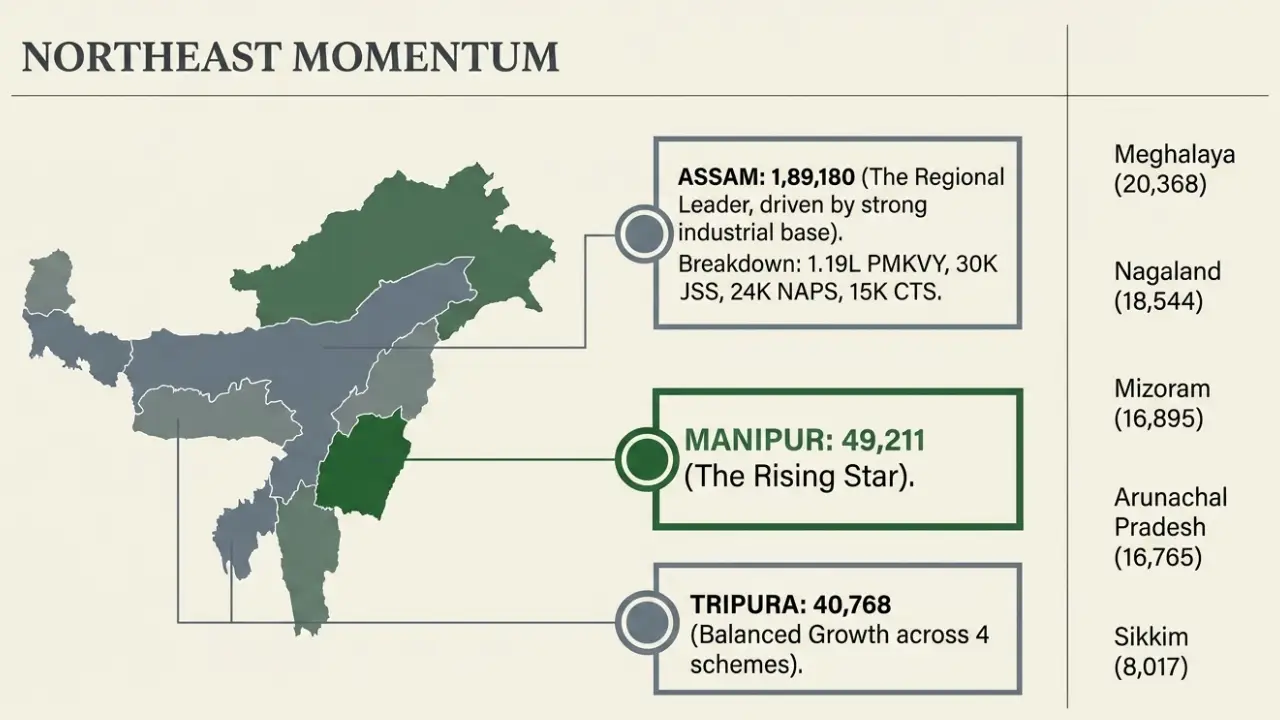
Parliament data shows Northeast gaining momentum while PMKVY 4.0 shifts focus from enrolment volume to verified skill outcomes
Imphal, August 2: India's flagship Skill India Mission (SIM) has continued to expand its reach across the country between FY 2023–24 and FY 2025–26, with more than four major central schemes collectively training millions of young people in vocational, technical and apprenticeship programmes. Fresh data tabled in Parliament also shows that Manipur trained 49,211 candidates during the three-year period, making it one of the leading performers in the Northeast after Assam.
The figures, presented in a written reply in the Rajya Sabha by Minister of State (Independent Charge) for Skill Development and Entrepreneurship Jayant Chaudhary, provide one of the most comprehensive snapshots of India's vocational training ecosystem under the Ministry of Skill Development and Entrepreneurship (MSDE).
The report covers performance under four flagship programmes—the Pradhan Mantri Kaushal Vikas Yojana (PMKVY), Jan Shikshan Sansthan (JSS), National Apprenticeship Promotion Scheme (NAPS) and the Craftsman Training Scheme (CTS) implemented through Industrial Training Institutes (ITIs).
Beyond enrolment figures, the parliamentary reply also highlights a major policy shift under PMKVY 4.0, where the emphasis has moved from expanding training numbers to ensuring transparency, digital verification and accountability in skill delivery.
Digital monitoring reshapes Skill India Mission
The latest phase of PMKVY introduces one of the strictest monitoring systems implemented under any national skilling programme.
The ministry has made Aadhaar-based e-KYC, facial authentication, geo-tagged attendance, QR-coded digital certificates and real-time monitoring through the Skill India Digital Hub mandatory for trainees and training centres.
Training providers and assessors are now accredited under strengthened National Council for Vocational Education and Training (NCVET) norms, while independent monitoring is undertaken through the Kaushal Samiksha Kendra. Performance-linked Key Performance Indicators (KPIs), along with financial penalties and fund recovery provisions, have also been introduced.
The government's tougher oversight has already translated into financial action.
According to the parliamentary reply, although Rs 2,314.09 crore was utilised under PMKVY 4.0 between FY 2023–24 and FY 2025–26, more than Rs 400 crore—around 17.3 per cent of total expenditure—has been withheld for scrutiny because of non-compliance with mandatory trainer attendance requirements.
The ministry said disciplinary measures, including suspension of trainers and centres, blacklisting and recovery of funds, have been initiated wherever violations were detected.
Officials said these reforms are intended to ensure that public spending reflects genuine training activity rather than inflated enrolment figures.
Manipur records over 49,000 trainees
Within this evolving national framework, Manipur recorded a combined 49,211 beneficiaries across all four flagship schemes during the reporting period.
The state's strongest contribution came through PMKVY and Jan Shikshan Sansthan, while apprenticeship training under NAPS also showed encouraging growth from a relatively small base.
PMKVY sees dramatic surge
The most striking trend in Manipur's performance was under the Pradhan Mantri Kaushal Vikas Yojana.
The state trained:
2,879 candidates in FY 2023–24
20,798 candidates in FY 2024–25
1,067 candidates in FY 2025–26
This resulted in a cumulative total of 24,744 trained youth over the three years.
The sharp rise during FY 2024–25 represented nearly a seven-fold increase over the previous year before enrolments fell again in FY 2025–26.
While the parliamentary reply does not specify reasons for the fluctuation, the timing coincides with the implementation of PMKVY 4.0's stricter digital verification and monitoring systems.
The shift suggests that the ministry is increasingly prioritising verified participation over higher enrolment numbers.
JSS emerges as Manipur's most stable programme
Unlike PMKVY, the Jan Shikshan Sansthan scheme demonstrated remarkable consistency.
The programme trained:
7,197 candidates in FY 2023–24
7,219 candidates in FY 2024–25
7,200 candidates in FY 2025–26
The cumulative total reached 21,616 beneficiaries.
The near-identical annual figures indicate a stable institutional delivery system that has remained largely unaffected by changes in policy or implementation frameworks.
JSS primarily focuses on vocational education for rural populations, women, school dropouts and neo-literates, making it one of the government's key community-level skilling initiatives.
Apprenticeship numbers steadily rise
Manipur's performance under the National Apprenticeship Promotion Scheme remained modest in absolute terms but reflected one of the fastest growth trajectories among the state's skill programmes.
The state recorded:
18 apprentices in FY 2023–24
187 apprentices in FY 2024–25
219 apprentices in FY 2025–26
The total stood at 424 apprentices during the reporting period.
The increase points to growing acceptance of industry-based learning models, where trainees gain practical workplace experience while acquiring formal vocational skills.
Although apprenticeship numbers remain far below those of industrialised states, the upward trend suggests expanding engagement between training institutions and employers.
ITIs continue technical training
Through the Craftsman Training Scheme, Manipur's Industrial Training Institutes trained 2,427 students during calendar years 2023 to 2025.
Annual enrolments included:
812 trainees in 2023
721 trainees in 2024
894 trainees in 2025
These programmes continue to provide long-term technical education across multiple industrial trades and remain an important component of the state's vocational training infrastructure.
Assam leads Northeast
Among the northeastern states, Assam emerged as the region's largest skill development hub, recording 1,89,180 trained candidates across the four schemes.
The state reported:
1,19,274 beneficiaries under PMKVY
30,597 under JSS
24,003 apprentices under NAPS
15,306 ITI trainees under CTS
Assam's strong industrial base and comparatively larger institutional network contributed significantly to its leadership position within the region.
Tripura ranks second
Tripura recorded 40,768 beneficiaries, making it the second-largest performer in the Northeast.
Its cumulative figures included:
21,350 under PMKVY
10,647 under JSS
1,365 apprentices under NAPS
7,406 ITI trainees
The state's performance reflected balanced growth across all four schemes.
Other Northeast states
The parliamentary data also outlined performance across the remaining northeastern states.
Meghalaya trained 20,368 beneficiaries, including 11,608 under PMKVY, 5,339 through JSS, 715 apprentices under NAPS and 2,706 ITI trainees.
Nagaland reported 18,544 beneficiaries, led by 11,791 PMKVY trainees, 5,731 under JSS, 943 under CTS and 79 apprentices.
Mizoram trained 16,895 beneficiaries, comprising 11,788 PMKVY trainees, 3,685 JSS beneficiaries, 438 apprentices and 984 ITI students.
Arunachal Pradesh recorded 16,765 beneficiaries, including 14,331 under PMKVY, 2,099 under CTS and 335 apprentices. No JSS data was reported for the state.
Sikkim registered 8,017 beneficiaries, including 5,676 under PMKVY, 1,245 apprentices and 1,096 ITI trainees.
Collectively, the figures indicate that the Northeast continues to expand its participation in central skill development initiatives despite varying levels of industrialisation and institutional capacity.
National leaders dominate volumes
While northeastern states are improving their outreach, India's largest industrial and populous states continue to dominate national training volumes.
Uttar Pradesh remained the country's largest overall contributor, reporting:
5,64,097 PMKVY trainees
2,49,580 JSS beneficiaries
2,56,740 apprentices
10,35,939 ITI trainees
Maharashtra maintained its position as India's apprenticeship leader with 8,43,578 apprentices under NAPS, alongside 3,74,708 ITI trainees, 1,18,832 PMKVY candidates and 1,11,746 JSS beneficiaries.
Other major performers included Rajasthan, Madhya Pradesh, Tamil Nadu, Karnataka, Gujarat, Odisha and Bihar, each recording substantial enrolments under one or more flagship schemes.
From enrolment to employability
The latest parliamentary figures suggest that India's skill development strategy is undergoing a structural transformation.
Earlier phases of PMKVY concentrated largely on expanding enrolment and certification. PMKVY 4.0 instead places greater emphasis on verified participation, industry relevance and long-term career pathways.
The government's decision to withhold more than Rs 400 crore because of compliance failures demonstrates a stronger focus on accountability than in previous programme phases.
For Manipur, the data reflects both opportunity and transition.
The state has shown its capacity to rapidly scale training under PMKVY while maintaining consistent community-based delivery through JSS and gradually expanding apprenticeships. The next challenge will be translating these training numbers into sustainable employment, entrepreneurship and long-term economic opportunities.
As India continues to modernise its vocational education ecosystem, Parliament's latest figures indicate that future success will increasingly be measured not only by the number of certificates issued but by the quality, credibility and employment outcomes of the skills imparted.