Takhellambam Rani Devi of Manipur and five others from Assam and Sikkim received the National Handloom Award from President Droupadi Murmu. Rani received the award for her award-winning 'Shaphee Lanphee in Silk Innaphi', bringing national recognition to the state's weaving tradition.
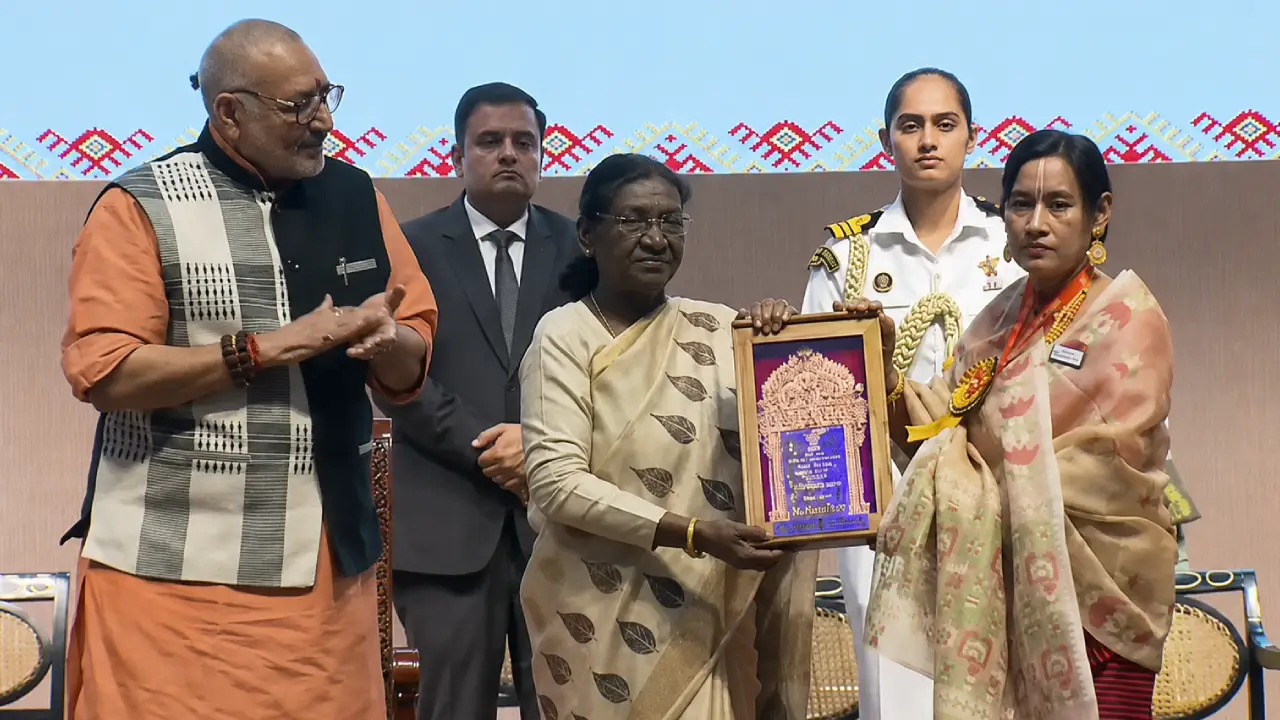
New Delhi/Imphal, August 7: President Droupadi Murmu on Friday presented the Sant Kabir Handloom Awards and National Handloom Awards 2025 at a ceremony held at the Rashtrapati Bhavan Cultural Centre (RBCC), with Takhellambam Rani Devi of Manipur emerging as one of this year's National Handloom Award recipients.
Rani Devi, a resident of Kakching Khunao, Awang Keithel Leikai in Kakching district, received the honour under the Women's Weaving category for her creation "Shaphee Lanphee in Silk Innaphi", a work that blends two iconic traditions of Manipuri textile heritage.
The award ceremony, organised as part of the 12th National Handloom Day celebrations, recognised outstanding handloom weavers from across the country for their craftsmanship, innovation and contribution to preserving India's traditional weaving heritage.
President highlights importance of handloom sector
The ceremony was attended by Union Textiles Minister Giriraj Singh, Minister of State for External Affairs and Textiles Pabitra Margherita, Secretary (Textiles) Neelam Shami Rao, Development Commissioner (Handlooms) Dr. M. Beena, award recipients, weavers and senior government officials.
Presenting the awards, President Murmu conferred three Sant Kabir Handloom Awards and 19 National Handloom Awards for the year 2025.
RELATED NEWS: Manipur’s Rani, Assam, Sikkim Weavers Among Northeast Artisans to Receive National Handloom Awards
Addressing the gathering, she said the handloom sector has been an integral part of India's civilisation for centuries and reflects the country's extraordinary cultural diversity while preserving regional identities.
She observed that the sector contributes significantly to employment generation, women's empowerment, art, culture and environmentally sustainable livelihoods.
The President stressed the need for greater use of technology to ensure sustainable growth of the handloom sector and said digital platforms can improve market access for artisans.
She also noted that many young entrepreneurs are entering the sector with innovative ideas and technological expertise, calling for stronger institutional support to encourage the next generation of weavers and designers.
Award recognises Manipuri weaving tradition
Rani Devi's award-winning creation combines the intricate motifs of Shaphee Lanphee, one of Manipur's most culturally significant ceremonial textiles, with the elegance of the traditional Silk Innaphi, a finely woven wrap widely worn by Manipuri women.
The recognition places Manipur's indigenous weaving traditions on the national stage while acknowledging the contribution of women artisans in preserving and promoting the state's rich handloom heritage.
Congratulations to Takhellambam Rani Devi of Kakching District, Manipur, on being conferred the National Handloom Award 2026 by the Hon'ble President of India, Smt. Droupadi Murmu, for her outstanding craftsmanship in 'Shaphee Lanphee in Silk Innaphi' under the Women's Weaving… pic.twitter.com/u0Ia5tVeJT
— LOK BHAVAN MANIPUR (@LokBhavManipur) August 7, 2026
Congratulating the awardee, Lok Bhavan, Manipur, described the honour as a proud moment for the state. In a message shared on social media, Lok Bhavan congratulated Takhellambam Rani Devi on receiving the National Handloom Award, stating that the recognition reflects Manipur's rich weaving traditions and exceptional craftsmanship.
Assam artisans receive multiple recognitions
Assam has received several recognitions in the 2025 National Handloom Awards, with weavers representing different categories of traditional textiles and emerging handloom enterprises.
Runima Chetiya Choudhury — Sant Kabir Handloom Award
Runima Chetiya Choudhury from Assam has been selected for the prestigious Sant Kabir Handloom Award, the highest national honour in the handloom sector.
She has been recognised for her work in Muga Silk Saree weaving. The award acknowledges exceptional craftsmanship, sustained contribution and dedication towards preserving India’s weaving traditions.
Muga silk, known for its natural golden colour and durability, is one of Assam’s most significant traditional textile identities. The craft has historically been associated with skilled weaving communities of the state.
Jyoti Bhuyan — Natural Dyed Eri Silk Saree
Jyoti Bhuyan of Assam is among the National Handloom Award recipients under the women’s weaving category for her work on a Natural Dyed Eri Silk Saree.
Her work represents the growing importance of sustainable textile practices, particularly the use of natural fibres and traditional dyeing methods in handloom production.
Riti Doley — Silk Gero
Assam weaver Riti Doley has been selected under the Divyang Weaver category for her creation “Silk Gero.”
Doley, from Majuli district, represents the contribution of artisans from Assam’s river island region, where traditional weaving continues to remain closely linked with local culture and livelihoods.
Marvella Associates — Handloom Enterprise Recognition
Assam-based M/S Marvella Associates has been recognised under the Start-up Ventures / Producer Company category for its contribution to the handloom sector.
The recognition reflects the growing role of organised enterprises in promoting handloom products, market access and new opportunities for traditional weavers.
Sikkim’s Shital Tamang honoured for Lepcha Daree
From Sikkim, Shital Tamang has been selected for the National Handloom Award under the Tribal Weaves category for “Lepcha Daree.”
Tamang, from Upper Gom in South District of Sikkim, represents the traditional weaving practices of the Lepcha community. Lepcha textiles are known for their distinct patterns, cultural symbolism and connection with indigenous identity.
Stamps, publication released
A major highlight of the ceremony was the release of four commemorative postage stamps showcasing Indian handloom weaves by President Murmu.
She also released "Earth. Root. Thread – Aal Dyed Handloom Textiles of Central India," a publication by the Office of the Development Commissioner for Handlooms under the Ministry of Textiles documenting India's diverse weaving traditions.
An exhibition featuring award-winning handloom products was organised alongside the ceremony. Visitors also witnessed live demonstrations of traditional Kani weaving and Wall Hanging weaving, highlighting the diversity and artistic excellence of India's handloom traditions.
Speaking on the occasion, Union Textiles Minister Giriraj Singh reaffirmed the Centre's commitment to strengthening the handloom sector through policy support, technology adoption, design innovation, skill development, market promotion and welfare initiatives.
Minister of State Pabitra Margherita highlighted the importance of innovation, youth participation and expanding global opportunities to strengthen India's handloom sector while preserving its traditional knowledge systems.
National Handloom Day is observed annually on August 7 to commemorate the launch of the Swadeshi Movement in 1905, which encouraged the use of indigenous products and gave fresh impetus to India's handloom industry. Since its formal observance began in 2015, the day has recognised the contribution of handloom weavers to the country's cultural heritage, livelihoods and sustainable development.