Parliament’s Monsoon Session ends after 25 days with 12 Bills passed by both Houses, covering public exams, MSMEs, banking, tribunals, mining and Kerala’s name change.
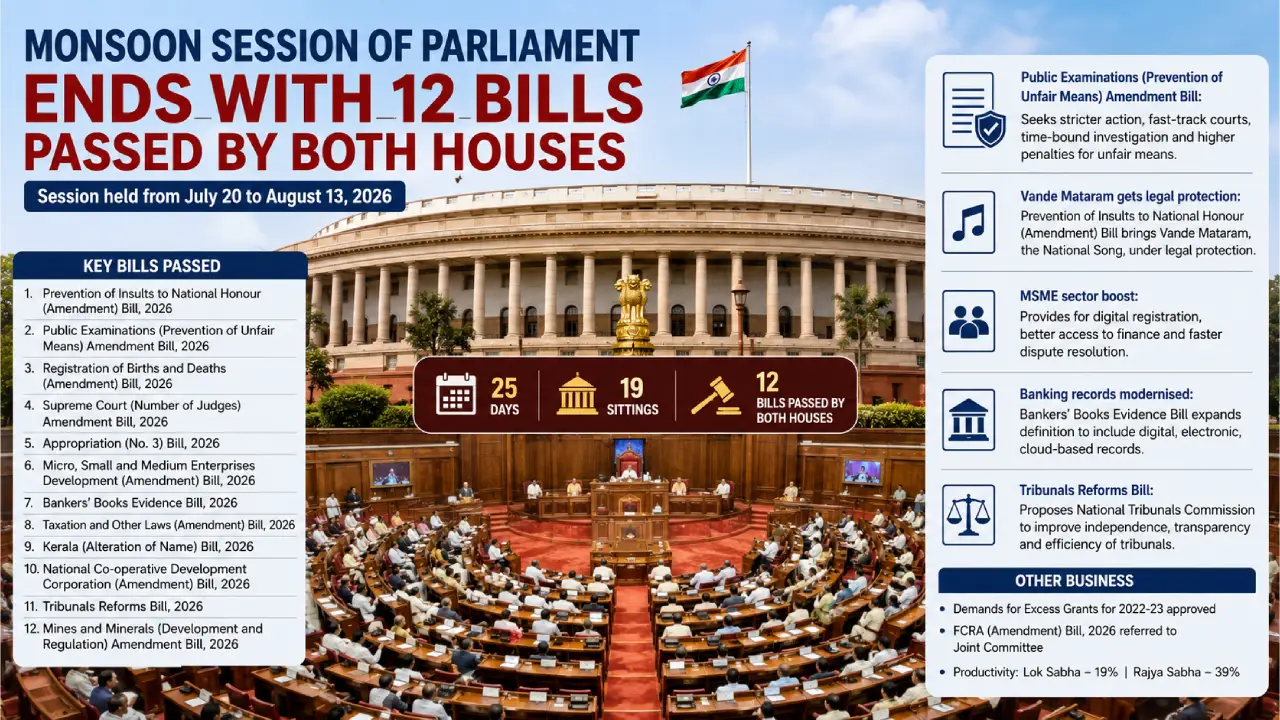
New Delhi, August 13: The Monsoon Session of Parliament concluded on Thursday with both Houses being adjourned sine die after 25 days and 19 sittings, during which 12 Bills were passed by both the Lok Sabha and Rajya Sabha.
The session, which commenced on July 20, 2026, saw 11 Bills introduced in the Lok Sabha and two Bills introduced in the Rajya Sabha. While 12 Bills were passed by the Lok Sabha and an equal number by the Rajya Sabha, 12 Bills were ultimately passed by both Houses.
The session also saw the consideration and passage of two Bills replacing and incorporating the provisions of ordinances promulgated by the President before the Monsoon Session. These were the Supreme Court (Number of Judges) Amendment Ordinance, 2026 and the Income-Tax (Amendment) Ordinance, 2026.
Public examinations Bill seeks stricter action against unfair means
Among the major legislative measures was the Public Examinations (Prevention of Unfair Means) Amendment Bill, 2026, introduced in response to concerns surrounding the integrity of public examinations.
The Bill amends the 2024 parent legislation and seeks to strengthen the examination system by providing for speedy investigation and time-bound trials of offences.
It empowers State Governments and Union Territory Administrations to designate Special Fast Track Courts and appoint Special Public Prosecutors for offences under the Act. Investigations are to be completed within two months, while trials are to be completed within three months.
The legislation also provides for the constitution of Special Task Forces by the Central Government for investigation wherever necessary. It enhances penalties for offences and introduces a time-bound appellate mechanism before a Division Bench of the High Court.
The Bill was passed by both Houses and has received the President’s assent.
Vande Mataram brought under proposed legal protection
The Prevention of Insults to National Honour (Amendment) Bill, 2026 was another major measure passed by both Houses.
The Bill seeks to amend the Prevention of Insults to National Honour Act, 1971, to bring Vande Mataram, recognised as the National Song, within the ambit of Section 3 of the legislation.
It proposes to make it an offence to intentionally prevent the singing of Vande Mataram or cause disturbance to an assembly engaged in its singing. The measure is intended to extend statutory protection to the National Song and make such acts punishable under the Act.
Changes proposed in registration of births and deaths
The Registration of Births and Deaths (Amendment) Bill, 2026 seeks to make delayed registration of births and deaths more stringent through a streamlined verification mechanism.
Under the provisions outlined in the Bill, registration after one year and up to two years would require approval from the competent Executive Magistrate. Registration after two years would require approval from a Judicial Magistrate of the First Class.
The legislation was passed by both Houses during the session.
MSME legislation seeks digital registration and faster dispute resolution
The Micro, Small and Medium Enterprises Development (Amendment) Bill, 2026 seeks to strengthen the MSME sector through a national digital platform for free and voluntary registration of enterprises.
The amendments are aimed at improving access to finance and ensuring faster adjudication of delayed-payment disputes involving micro and small enterprises.
The legislation also seeks to promote ease of doing business by decriminalising offences relating to contravention of certain provisions. Instead of conviction-based fines, it proposes graded penalties, including a warning for a first instance of contravention.
The Bill was introduced in the Rajya Sabha and subsequently passed by both Houses.
Bankers’ Books Evidence Bill expands definition to digital records
The Bankers’ Books Evidence Bill, 2026 seeks to modernise the legal framework governing banking records by expanding the definition of “bankers’ books”.
The proposed definition encompasses records maintained by banks in physical, electronic, digital, virtual, cloud-based or other forms, creating a technology-neutral framework for banking evidence.
The Bill standardises certificates and recognises manual, digital and electronic authentication. It also allows electronic records to be produced either physically or electronically.
The legislation further empowers the Central Government to extend its coverage across the financial sector and defines the circumstances constituting “special cause” for judicial production of records.
Kerala name change Bill passed
Parliament also passed the Kerala (Alteration of Name) Bill, 2026, which seeks to amend the First Schedule to the Constitution by changing the name of the State of Kerala to Keralam under Article 3 of the Constitution.
The Bill was passed by both Houses during the session.
Cooperative sector legislation widened
The National Co-operative Development Corporation (Amendment) Bill, 2026 seeks to expand the definition of “foodstuffs” under the National Co-operative Development Corporation Act, 1962, to include other food items that may be notified by the Central Government.
It also proposes removing the geographical restriction applicable to industrial goods, updating statutory references, removing obsolete provisions and providing the Corporation with necessary incidental powers.
According to the government, the amendments are intended to facilitate the collection and sharing of credit and other relevant information with authorised institutions while providing greater flexibility, legal clarity and operational efficiency.
The changes are also intended to enable timely, direct and responsive financial assistance for cooperative development.
Tribunals Reforms Bill proposes National Tribunals Commission
The Tribunals Reforms Bill, 2026 seeks to improve the efficiency and functioning of tribunals while ensuring greater independence, transparency and uniformity in the qualifications, appointments, terms and conditions of service of tribunal chairpersons and members.
A key proposal is the establishment of a National Tribunals Commission to oversee aspects of the administration and functioning of various tribunals.
The Bill also provides for consequential amendments in related laws and other matters connected with tribunal reforms.
Mines and Minerals Bill seeks greater fiscal certainty
The Mines and Minerals (Development and Regulation) Amendment Bill, 2026 seeks to amend the 1957 legislation governing the mineral sector.
The stated objective is to provide greater certainty, stability and predictability in the fiscal regime for minerals. The government has linked the proposed changes to giving further impetus to national economic growth, supporting the objectives of Atmanirbhar Bharat and contributing to the vision of Viksit Bharat 2047.
Other legislative business
The session also dealt with the Demands for Excess Grants for 2022-23. The related Appropriation Bill was introduced, considered and passed by the Lok Sabha on August 4 and returned by the Rajya Sabha on August 6.
The Foreign Contribution (Regulation) Amendment Bill, 2026 was referred to a Joint Committee of both Houses for examination and report.
The Indian Statistical Institute Bill, 2026 and the Taxation and Other Laws (Amendment) Bill, 2026 were among the other Bills introduced in the Lok Sabha. The Appropriation (No. 3) Bill, 2026 was also introduced.
The complete list of legislative business shows that the Lok Sabha introductions included the Supreme Court (Number of Judges) Amendment Bill, Public Examinations (Prevention of Unfair Means) Amendment Bill, Registration of Births and Deaths Amendment Bill, Indian Statistical Institute Bill, Bankers’ Books Evidence Bill, Taxation and Other Laws Amendment Bill, Appropriation (No. 3) Bill, Tribunals Reforms Bill, Mines and Minerals (Development and Regulation) Amendment Bill, Kerala (Alteration of Name) Bill and National Co-operative Development Corporation Amendment Bill.
Two Bills were introduced in the Rajya Sabha: the Prevention of Insults to National Honour (Amendment) Bill and the Micro, Small and Medium Enterprises Development (Amendment) Bill.
Twelve Bills passed by both Houses
The 12 Bills passed by both Houses during the Monsoon Session were:
1. Prevention of Insults to National Honour (Amendment) Bill, 2026
2. Public Examinations (Prevention of Unfair Means) Amendment Bill, 2026
3. Registration of Births and Deaths (Amendment) Bill, 2026
4. Supreme Court (Number of Judges) Amendment Bill, 2026
5. Appropriation (No. 3) Bill, 2026
6. Micro, Small and Medium Enterprises Development (Amendment) Bill, 2026
7. Bankers’ Books Evidence Bill, 2026
8. Taxation and Other Laws (Amendment) Bill, 2026
9. Kerala (Alteration of Name) Bill, 2026
10. National Co-operative Development Corporation (Amendment) Bill, 2026
11. Tribunals Reforms Bill, 2026
12. Mines and Minerals (Development and Regulation) Amendment Bill, 2026.
The Supreme Court (Number of Judges) Amendment Bill and the Income-Tax (Amendment) measure also represented the legislative response to ordinances promulgated before the session, with the former explicitly listed among the Bills passed by both Houses.
Productivity of both Houses
The session concluded with reported productivity of approximately 19% in the Lok Sabha and 39% in the Rajya Sabha, according to the Ministry of Parliamentary Affairs.
With the adjournment sine die on August 13, the 2026 Monsoon Session ended after 19 sittings spread over 25 days, leaving behind a legislative record that included 12 Bills passed by both Houses, a Bill referred to a Joint Committee and several measures covering public examinations, national honour, civil registration, MSMEs, banking records, cooperative development, tribunals, mining and constitutional changes.