Assam leads Northeast tourism and Sikkim tops foreign arrivals, while Arunachal, Meghalaya, Mizoram, Nagaland and Tripura see varied trends; Manipur records poor footfall.
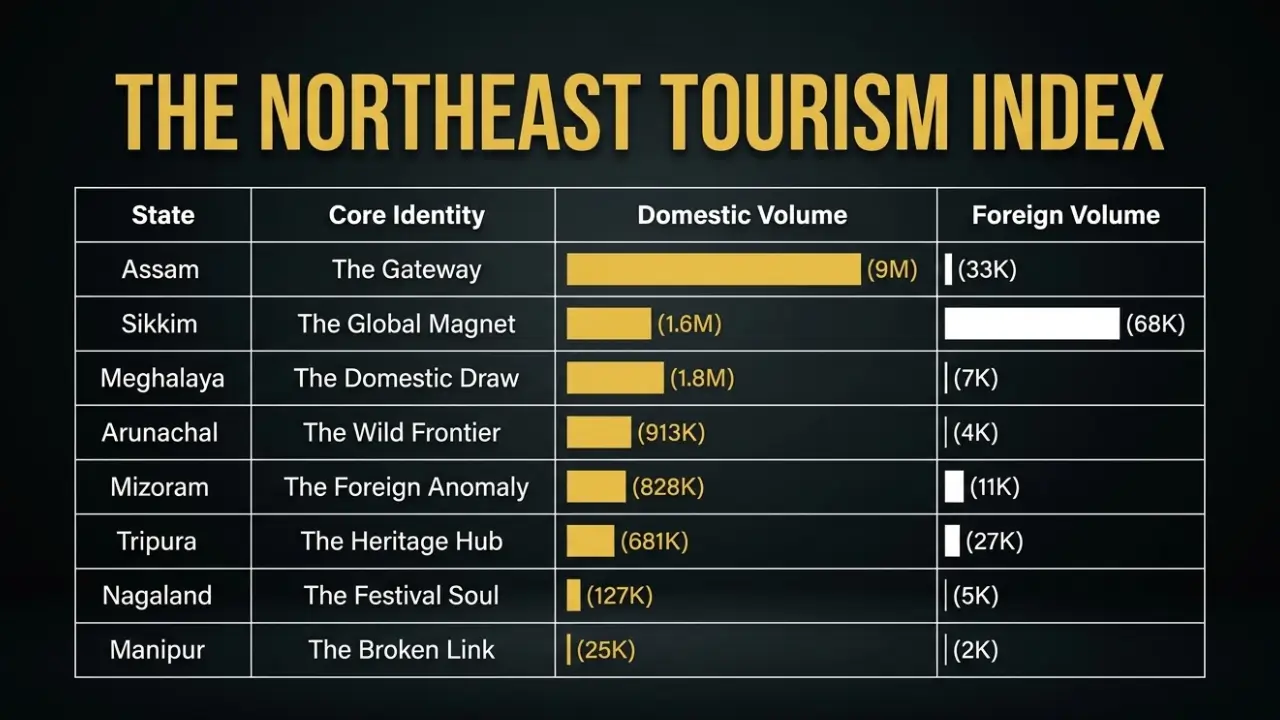
Imphal, August 10: Tourism across Northeast India continues to show a wide variation in visitor numbers among the region’s eight states, with Assam recording the highest domestic tourist visits and Sikkim emerging as the region’s strongest destination for foreign tourists, according to data placed by the Ministry of Tourism in the Lok Sabha on Monday.
The figures released by the Ministry show that the eight Northeastern states collectively attracted more than 15 million domestic tourist visits during 2025, while foreign tourist visits crossed 1.2 lakh. During the first six months of 2026, the region recorded more than 9.4 million domestic tourist visits and over 1 lakh foreign tourist visits.
The Ministry said it has been promoting tourism destinations and products in the Northeast through promotional campaigns, financial assistance for fairs and festivals, tourism infrastructure schemes, digital platforms and improved air connectivity.
The government’s tourism initiatives include Swadesh Darshan 2.0, the PRASHAD scheme, assistance to central agencies for tourism infrastructure, Special Assistance to States for Capital Investment and Challenge Based Destination Development. The Ministry has also been supporting cleanliness and awareness programmes and working with the regional air-connectivity framework under RCS-UDAN.
The state-wise figures, however, show very different tourism profiles across the region.
Assam: Northeast’s largest domestic tourism market
Assam remained the biggest tourism market in the Northeast by a substantial margin.
The state recorded 90,55,943 domestic tourist visits in 2025, along with 33,858 foreign tourist visits. During January-June 2026, Assam recorded 46,04,112 domestic visits and 32,471 foreign visits.
Assam’s position reflects its role as one of the principal entry points to the Northeast as well as its established tourism destinations. The state combines wildlife, riverine landscapes, religious destinations, cultural attractions and access to other Northeastern states.
The Centre has also supported festivals in Assam through its financial assistance framework. The festivals listed in the Ministry’s reply include the Rass Mahotsav in Majuli, Bodo National Festival, Rongali Festival, International Buddhist Conference and Bhogali Festival.
The government has also included Dibrugarh-Dimapur, Dimapur-Dibrugarh, Dibrugarh-Imphal, Imphal-Dibrugarh and Hollongi-Guwahati-Guwahati-Hollongi among Tourism RCS routes aimed at improving access to tourism destinations in the Northeast.
Arunachal Pradesh: Tourism rises around nature and adventure
Arunachal Pradesh recorded 9,13,383 domestic tourist visits and 4,582 foreign tourist visits in 2025.
In the first half of 2026, the state recorded 6,27,084 domestic visits and 2,372 foreign visits, indicating continued demand for the state’s nature, adventure and cultural tourism offerings.
Central financial assistance has been extended over the years to a wide range of festivals and tourism events in Arunachal Pradesh. These include the Nyokum Festival, Kameng River Eco-Tourism Festival, Menchuka Adventure Festival, Orange Festival at Dambuk, Tawang Festival, Basar Confluence, River Tribe’s Angling Festival, Butterfly Meet at Miao, Pedal to Pakke, Orange Festival of Music and Adventure, Si Donyi Festival, Aroma of Arunachal Festival, Eco Harmony and Fest of Arunachal.
The Ministry’s festival assistance data shows that Arunachal received Rs 50 lakh each for the Aroma of Arunachal Festival in 2024-25 and Fest of Arunachal in 2025-26, while Rs 30 lakh was sanctioned for Eco Harmony in 2025-26.
The figures indicate that the state’s tourism promotion is closely tied to its natural environment, indigenous cultural events and adventure-based experiences.
Manipur: Tourism remains sharply below pre-crisis regional levels
Manipur recorded 25,281 domestic tourist visits and 2,892 foreign tourist visits in 2025, considerably lower than the visitor numbers reported by most other Northeastern states.
During January-June 2026, the state recorded 12,744 domestic visits and 1,219 foreign visits.
The figures come against the backdrop of the prolonged disruption caused by the violence that began in 2023, which has affected movement, tourism activity and the wider economy.
The Ministry’s data also shows that central assistance for tourism-linked festivals in Manipur was provided over several years, including the Manipur Sangai Festival and Youth Adventure and Water Sports Festival.
The Sangai Festival received Rs 50 lakh in each of the 2014-15, 2015-16, 2016-17 and 2017-18 financial years, followed by Rs 25 lakh for the festival in 2019-20. The Youth Adventure and Water Sports Festival also received financial support in the years listed by the Ministry.
Air connectivity remains an important component of the Centre’s tourism strategy for the state. Dimapur-Imphal and Imphal-Dimapur, as well as Dibrugarh-Imphal and Imphal-Dibrugarh, have been included among Tourism RCS routes.
For Manipur, therefore, the tourism challenge extends beyond destination promotion. Restoring visitor confidence, connectivity and the broader tourism ecosystem will be important for rebuilding the sector. The official data reflects the scale of the gap when compared with the region’s leading destinations.
Meghalaya: Strong domestic base, but 2026 data is only partial
Meghalaya recorded 18,48,239 domestic tourist visits and 7,116 foreign tourist visits in 2025.
For January-June 2026, the Ministry reported 5,15,320 domestic visits and 2,516 foreign visits. However, the Ministry specifically noted that the Meghalaya figures for 2026 were received from the state for January to March only, meaning they cannot be directly compared with the six-month figures of the other states.
Meghalaya has also received sustained central support for its cultural festivals.
The list includes the Wangala Dance Festival, Nongkrem Dance Festival, Lasubon Festival and the 100 Drums Wangala Dance Festival. In 2025-26, Rs 40 lakh each was sanctioned for the 100 Drums Wangala Dance Festival and the Nongkrem Dance Festival.
The state’s tourism profile combines its cultural traditions with its natural landscapes, giving festivals an important role in destination promotion.
The partial 2026 data means that a full-year assessment of Meghalaya’s tourism performance will have to wait until complete state-level figures become available.
Mizoram: Foreign tourist visits stand out
Mizoram recorded 8,28,223 domestic tourist visits and 11,484 foreign tourist visits in 2025. During January-June 2026, the state recorded 4,94,362 domestic visits and 7,389 foreign visits.
The foreign tourist numbers are notable in the context of Mizoram’s overall visitor base. While its domestic footfall is considerably smaller than Assam’s, the state recorded more foreign visits in 2025 than Arunachal Pradesh, Nagaland and Meghalaya.
Mizoram has received central assistance for a range of cultural and tourism events, including the Anthurium Festival, Thalfavang Kut, Winter Festival and Chapchar Kut.
More recently, the Ministry sanctioned Rs 30 lakh for the Mizoram Travel Fest in 2025-26, along with Rs 25 lakh each for the Leitlanpui Music Festival and Winter Festival.
The combination of cultural festivals and destination promotion forms a significant part of the Centre’s approach to expanding tourism in the state.
Nagaland: Festival tourism remains a major draw
Nagaland recorded 1,27,428 domestic tourist visits and 5,425 foreign tourist visits in 2025. In January-June 2026, the state recorded 27,305 domestic visits and 1,131 foreign visits.
The Hornbill Festival remains the most prominent event in the Centre’s list of tourism festivals supported in Nagaland. Financial assistance has also been extended for the Sekrenyi Festival, Rengma’s Ngadah Festival, Thuwu-Ni Festival, Sukhrunye Festival, Ahuna Festival, Runa Festival, Autumn Festivals and other cultural events.
In 2025-26, Rs 25 lakh was sanctioned for the Autumn Fest, Rs 25 lakh for Naga Wrestling and Rs 30 lakh for a Cultural Folk and Music Festival.
The Ministry has also supported food, music and cultural events, including the Traditional Food and Folk Music Festival at Dimapur and the Cuisine and Music Festival at Naga Heritage Village, Kisama.
Nagaland’s tourism strategy therefore places considerable emphasis on cultural identity, festivals, traditional sports, food and music as tourism products.
Sikkim: Northeast’s leading foreign-tourist destination
Sikkim stands out in the Ministry’s data for its exceptionally high foreign tourist footfall. The state recorded 16,54,838 domestic tourist visits and 68,992 foreign tourist visits in 2025, making it the Northeast’s leading state for foreign tourist visits.
Its performance strengthened further in the first half of 2026, when Sikkim recorded 23,52,725 domestic visits and 43,734 foreign visits.
The January-June 2026 domestic figure is already substantially higher than Sikkim’s full-year domestic figure for 2025, although the two periods are not directly comparable because one covers six months and the other covers an entire year.
The Ministry has supported several tourism events in Sikkim, including World Tourism Day programmes, the Red Panda Winter Festival, Jorethang Maghey Mela, Pelling Winter Tourism Festival, Cherry Temi Tea and Tourism Festival, Khangchendzonga Winter Carnival and, most recently, the Lampokhri Festival.
The latest International Tourism Mart was also held in Gangtok from November 13 to 16, 2025, bringing together tourism stakeholders from all eight Northeastern states.
Tripura: Tourism supported by heritage and cultural festivals
Tripura recorded 6,81,103 domestic tourist visits and 27,320 foreign tourist visits in 2025. During January-June 2026, the state recorded 3,84,453 domestic visits and 9,424 foreign visits.
Tripura’s tourism promotion has received central support for events including the Neermahal Festival, Kharchi Mela, Diwali Festival, Chabimura Festival, Bharat Bangla Festival, Chabimura and Tirthamukh Festival and Ashokastami Festival.
In 2025-26, Rs 30 lakh each was sanctioned for the Neermahal Festival and Diwali Festival, while Rs 20 lakh was sanctioned for the Chabimura and Tirthamukh Festival.
The state’s tourism portfolio consequently combines heritage sites, cultural festivals and religious traditions.
Connectivity and digital promotion form part of wider strategy
Beyond state-specific festival support, the Centre has outlined a broader strategy for tourism development in the Northeast.
The Ministry of Tourism revamped the Incredible India website as the Incredible India Digital Platform in September 2024, with tourism destinations in the Northeastern states featured on the platform. The Ministry also promotes destinations through social media content, live sessions and other digital campaigns.
Infrastructure development is being pursued through schemes including Swadesh Darshan 2.0, PRASHAD, assistance to central agencies, SASCI and Challenge Based Destination Development.
Swadesh Darshan was revamped as Swadesh Darshan 2.0 with a stated focus on sustainable and responsible tourism and a destination-centric approach.
Cleanliness has also been incorporated into the tourism strategy. During 2025-26, the Ministry said 200 Swachhta Action Plan activities were organised through tourism and hospitality institutions under tourist, student and stakeholder awareness categories. In 2025, 277 Swachhta Pakhwada activities and 244 Swachhta Hi Sewa activities were conducted across India, including the Northeast.
Air connectivity remains another focus. Under Tourism RCS, the Centre has included routes linking major Northeastern hubs such as Dibrugarh, Dimapur, Imphal, Agartala, Aizawl, Hollongi and Guwahati.
A region with very different tourism trajectories
The state-wise data shows that there is no single tourism story for the Northeast.
Assam operates at a substantially larger domestic tourism scale, while Sikkim has established itself as the region’s leading destination for foreign visitors. Arunachal Pradesh combines nature and adventure tourism with cultural festivals, Meghalaya has a strong domestic visitor base, and Mizoram records a comparatively notable foreign-tourist share.
Nagaland’s tourism promotion is strongly linked to its cultural festivals and indigenous traditions, while Tripura relies on a mix of heritage, religious and cultural attractions.
Manipur presents a different picture, with tourist numbers remaining far below those of most neighbouring states. Its 2026 figures also show that tourism recovery remains a significant challenge.
At the regional level, the Centre’s approach combines destination development, festival funding, digital promotion, cleanliness initiatives and air connectivity. The effectiveness of that strategy, however, will ultimately depend on how consistently these measures translate into easier access, better visitor facilities, stronger local tourism enterprises and sustained tourist confidence across individual destinations.
The latest data suggests that the Northeast has substantial tourism potential, but the benefits are not distributed evenly. The next phase of tourism development will therefore require state-specific approaches alongside the broader regional promotion strategy.