PAPPM has urged PM Modi and Amit Shah to order an NRC in Manipur, audit Myanmar migration records and investigate possible cross-border links to the 2023 violence.
Imphal, August 22: The People’s Alliance for Peace and Progress, Manipur (PAPPM) has submitted a memorandum to Prime Minister Narendra Modi and Union Home Minister Amit Shah seeking a comprehensive National Register of Citizens (NRC/NRIC) exercise in Manipur, along with a historical audit of migration from Myanmar and an independent national-security investigation into the factors surrounding the ethnic violence that began on May 3, 2023.
The memorandum, signed by PAPPM president Mayanglambam Bobby Meetei, argues that decades of unresolved questions over the nationality and documentation of people who entered Manipur from Burma, now Myanmar, have created what the organisation describes as a long-standing administrative and demographic problem.
PAPPM has based its appeal on what it says are archival records of the Government of India and the Manipur government dating back to the late 1960s. The organisation claims these records show that successive governments provided humanitarian assistance and rehabilitation to migrants while failing to establish their legal nationality in individual cases.
The group has called for the Union government to examine the records of migration from 1967, the subsequent influx in 1988 and movement following the 2021 military coup in Myanmar. It has also sought an investigation into whether organised cross-border or militant networks played any role in the 2023 violence.
PAPPM, however, has framed the proposed security investigation as an evidence-based inquiry into specific individuals, communications, financial transactions and operational links, rather than an attribution of collective responsibility to any ethnic community.
PAPPM cites 1967 influx and unresolved nationality records
According to the memorandum, one of the earliest documented cases concerns an influx from Burmese territory in late 1967.
PAPPM cited a Ministry of Home Affairs file noting dated June 4, 1973, prepared by Under Secretary R. C. Iyer, which recorded that a substantial number of Kuki families had crossed into Manipur from Burmese territory.
The file, identified as File No. 11/30/71-HMT, reportedly stated that 500 families, comprising about 2,400 people, had entered India and required immediate rehabilitation.
The memorandum points to an observation in the Home Ministry's records that establishing the nationality of the migrants was difficult and that efforts to stop the influx had not succeeded.
The Government of India nevertheless provided emergency relief. According to PAPPM, Rs 1 lakh was sanctioned for immediate assistance, calculated at Rs 100 per person. The Manipur administration was also asked to consider rehabilitation measures, including a proposed loan of Rs 725 per family for settlement on agricultural land.
PAPPM argues that the central issue was not the provision of humanitarian relief but the absence of a subsequent, comprehensive determination of citizenship or nationality.
Rehabilitation department questioned repatriate status
The memorandum also refers to records showing a disagreement between government departments over how the migrants should be classified.
According to PAPPM, the Department of Rehabilitation declined to treat the 1967 arrivals as repatriates from Burma. Its records described them as Kuki migrants of “doubtful nationality”.
The organisation argues that the distinction was significant because government rehabilitation rules applied specifically to recognised repatriates.
PAPPM contends that while the migrants received assistance and were settled, the underlying question of their legal status remained unresolved. It says this created an administrative gap that continued for subsequent decades.
PAPPM raises discrepancy over number of families
The organisation has also drawn attention to a discrepancy in official and parliamentary records concerning the number of families involved.
A June 20, 1973 letter by then Lok Sabha member P. Paokai Haokip to Union Minister of State for Home Affairs R.C. Pant reportedly stated that 1,500 families had fled Burma.
This figure was substantially higher than the 500 families recorded in the Home Ministry's earlier documentation.
According to the memorandum, Haokip's representation stated that only 499 of the 1,500 families had received agricultural assistance, leaving around 1,001 families without such support.
PAPPM has asked the Union government to determine whether the difference represented a subsequent influx, an earlier administrative undercount or another explanation.
The organisation argues that resolving the discrepancy is necessary to establish how many people entered Manipur during the period, how they were registered and what rehabilitation or citizenship records were created.
Questions raised over later reclassification of migrants
PAPPM has further cited government records concerning 23 Kuki families in Senapati district who were subsequently recognised as genuine repatriates.
According to the memorandum, a 1982 verification report by the Superintendent of Police, Manipur, stated that the families had entered India by land through Tengnoupal in December 1967.
The report reportedly acknowledged that the families did not possess refugee cards. Their status was instead supported through their reported association with the Burma Kuki Refugee Association.
The Manipur government subsequently declared the 23 families genuine repatriates and sought central assistance for their rehabilitation.
PAPPM says the Union government later questioned the verification process, particularly because the state administration had not conducted separate investigations into each family.
The memorandum cites a 1985 central government file noting that authorities sought details of any documentary proof of repatriation and questioned the absence of the families from earlier rehabilitation records.
PAPPM argues that these records demonstrate the need to examine how citizenship and repatriate claims were verified over the years.
Organisation points to warning over ancestral verification
The memorandum also refers to an observation by the Home Ministry concerning the verification of people claiming rehabilitation benefits.
According to PAPPM, the ministry had noted that claimants might need to be examined to determine whether they were bona fide residents of Manipur at the time of the state's accession to the Indian Union or had entered the state subsequently.
The organisation says the government itself had recognised that such verification would be difficult and labour-intensive.
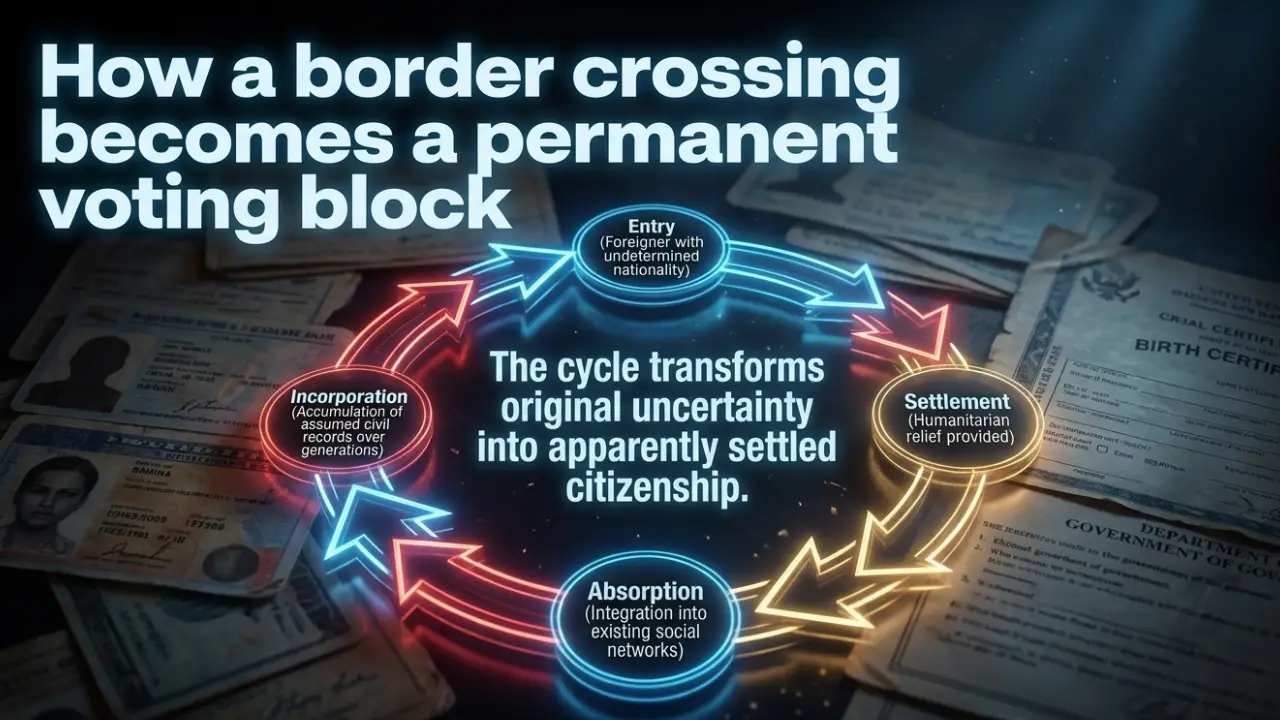
PAPPM contends that the absence of such comprehensive verification allowed undocumented or insufficiently documented claims to become embedded in subsequent civil records.
The organisation now argues that any future citizenship verification should examine not only current certificates but also the evidence and circumstances under which earlier documents were issued.
1988 Myanmar crisis cited as another turning point
PAPPM's memorandum also examines the influx following Myanmar's 1988 pro-democracy uprising and military crackdown.
The organisation acknowledges that people fleeing political persecution required humanitarian protection. It nevertheless argues that the absence of a systematic registration mechanism made it difficult to distinguish temporary refugees from people who subsequently remained in India.
The memorandum claims that migrants arriving after 1988 were able to enter existing social and family networks connected with earlier Burma-origin populations.
PAPPM argues that, over time, distinctions between foreign nationals and Indian citizens became increasingly difficult to establish where birth certificates, residence records and electoral entries were created without comprehensive nationality verification.
Post-2021 influx cited in support of NRC demand
The memorandum places particular emphasis on migration following the February 2021 military coup in Myanmar.
PAPPM cites the Meta International Migration Flows dataset available through the UN Humanitarian Data Exchange and refers to a 2025 study published in the Proceedings of the National Academy of Sciences.
According to the figures cited by the organisation, long-term movement from Myanmar to India increased sharply after the coup:
2019: 3,920 recorded moves
2020: 4,637
2021: 32,461
2022: 29,162
The memorandum puts the total recorded movement from Myanmar to India during 2019–2022 at 70,180, compared with 15,596 movements in the opposite direction.
PAPPM calculates the net movement at 54,584 people and argues that the dataset represents only a partial measure of the actual population movement because it is based on Facebook users and does not capture all age groups.
The organisation estimates that the actual number of people involved in the movement could have been around one lakh after accounting for family members not represented in the dataset.
The memorandum does not establish that all such migrants entered Manipur, and PAPPM itself acknowledges that the country-to-country dataset does not identify individual Indian states of entry. The organisation nevertheless argues that Manipur's location along the international border makes the state particularly vulnerable to undocumented cross-border movement.
2023 verification drive identified 2,480 Myanmar immigrants
PAPPM has also cited the Manipur government's efforts to identify Myanmar-origin migrants before the May 2023 violence.
On February 16, 2023, the Governor of Manipur constituted a Cabinet Sub-Committee to assist the Manipur State Population Commission in identifying and documenting Myanmarese immigrants and refugees.
The committee comprised Letpao Haokip as chairperson, Awangbow Newmai as member and Th. Basanta Kumar Singh as member.
According to the memorandum, the committee conducted a field verification exercise at Gamphazol in Chandel district on March 29, 2023. The exercise identified 628 people as illegal immigrants along the concerned stretch of the border, including 250 at Gamphazol.
The committee subsequently directed authorities to conduct detailed population surveys, regulate border movement and strengthen monitoring through police and Assam Rifles personnel.
A report compiled by the Inspector General of Police (INT/NAB), Imphal, in June 2023 recorded 2,480 Myanmar immigrants detected during verification exercises across five hill districts.
The memorandum lists 1,147 people in 13 locations in Tengnoupal and 1,175 in 10 locations in Chandel. It also records 154 people in six locations in Churachandpur and four in 24 locations in Kamjong. No cases were recorded in Pherzawl in the cited verification exercise.
PAPPM says the government had planned temporary identification cards and shelter arrangements, with deportation to follow when conditions in Myanmar permitted.
PAPPM seeks investigation into possible links with 2023 violence
A central part of the memorandum is the organisation's call for a national-security investigation into the violence that began on May 3, 2023.
PAPPM acknowledges the immediate political circumstances preceding the violence, including the Tribal Solidarity March and the controversy surrounding the Manipur High Court's direction concerning Scheduled Tribe status for the Meitei community.
However, the organisation argues that these factors alone should not be assumed to explain the full scale and subsequent trajectory of the conflict.
PAPPM points to the timing of the violence, which followed the government's efforts to identify and biometrically document Myanmar-origin migrants.
The organisation has asked the Union government to investigate whether any organised network sought to obstruct or exploit the verification process.
It has specifically called for examination of possible operational, financial and logistical links involving Myanmar-origin migrants, Kuki militant organisations, Myanmar-based armed groups and affiliated political or social organisations.
The memorandum stresses that such an investigation should focus on evidence and individual responsibility rather than assigning collective guilt to an ethnic community.
PAPPM questions SIR 2026's reliance on 2005 electoral rolls
The organisation has also criticised the proposed State-wide Institutional Registry (SIR) 2026, particularly its reliance on the 2005 electoral roll as a reference point.
PAPPM argues that a person's presence on a 2005 electoral roll does not necessarily establish the legality of the documents or records that preceded the electoral entry.
According to the organisation, if an earlier birth, residence or citizenship-related document was issued without adequate nationality verification, relying on that document to validate a later electoral entry would reproduce the original administrative error.
The memorandum describes this as a “Circular Verification Problem”.
PAPPM argues that verification should therefore examine the evidence on which the original document was issued rather than merely checking whether the document exists today.
Organisation seeks ancestry-based NRC exercise
PAPPM has asked the Union government to initiate an NRC/NRIC process that traces citizenship claims through successive generations.
The organisation proposes a verification chain covering identity, parents, grandparents, place of birth, ancestral residence, migration history and the legal basis of citizenship.
Among its specific demands are reconciliation of the 500-family figure in the 1973 Home Ministry records with the 1,500-family figure cited by MP P. Paokai Haokip; an audit of records relating to the 23 families later recognised as genuine repatriates; and a historical review of the 1988 influx.
It has also sought integration of biometric records from the 2023 verification exercises into future citizenship and immigration checks.
Finally, PAPPM has urged the Union government to order an independent investigation into whether organised militant or cross-border networks played a role in the May 2023 violence.
The organisation maintains that its objective is not to challenge the citizenship of genuine Indian citizens but to establish, through a lawful and evidence-based process, the citizenship status of residents and the circumstances surrounding foreign migration into a sensitive border state.
The memorandum ultimately places the demand within a broader call for stronger border management, historical record reconciliation and a formal determination of citizenship status in Manipur.