A critical review by Jiangampou Kamei explores Northeast India's ancient petroglyphs, with special focus on Manipur's living traditions, rituals and conservation challenges.
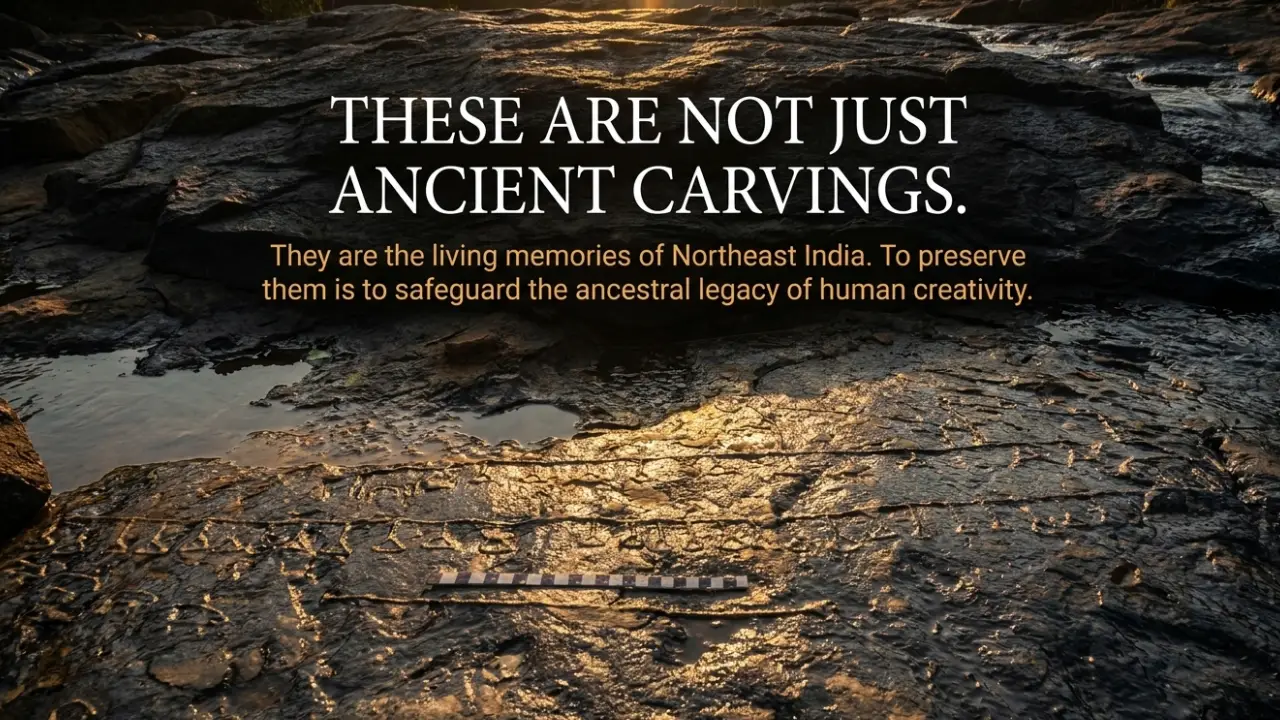
Imphal, Aug 18: The ancient petroglyphs scattered across the hills, forests and riverbeds of Northeast India offer more than a record of prehistoric artistic expression. They preserve traces of migration, ritual practices, social organisation, warfare, feasting, death and community memory, according to a critical review by Jiangampou Kamei of the Department of Anthropology, Gauhati University.
Published in the March 2026 issue of Rock Art Research, the paper titled “Petroglyphs of Northeast India with Special Reference to Manipur: A Critical Review” brings together reported evidence from Assam, Mizoram, Nagaland, Manipur and Meghalaya. The review gives particular attention to Manipur, where Kamei’s ethnoarchaeological work connects engraved stones with oral traditions and continuing cultural practices among indigenous communities.
The study places the region's rock art within a broader archaeological context. While more than 1,500 rock art sites and around 2,500 painted shelters have been documented across India, Northeast India has historically received comparatively limited archaeological attention. Difficult terrain, dense vegetation, physical inaccessibility and inadequate archaeological infrastructure have contributed to the region remaining relatively unexplored.
Kamei's review argues that the petroglyphs of the Northeast should not be treated simply as isolated archaeological objects. Their interpretation can also benefit from the knowledge preserved within communities that continue to associate particular stones, symbols and motifs with ancestral stories and customary practices.
Ethnoarchaeology provides a link between stones and living traditions
A central feature of Kamei's approach is ethnoarchaeology, which uses contemporary cultural practices, oral traditions and community memories to help interpret archaeological remains.
In several parts of Northeast India, local communities continue to remember particular rock engravings as works of their ancestors. Stories, songs, rituals and explanations passed down through generations can therefore provide context that may not be available from the physical engravings alone.
The review draws on accounts from village elders and local custodians to examine the possible social and ritual purposes behind particular motifs. This approach is particularly significant in Manipur, where several petroglyph traditions remain connected to festivals, youth institutions, hunting, warfare and beliefs about the afterlife.
Assam's petroglyphs reflect religion, monuments and historical change
Assam presents a different archaeological landscape. Many reported petroglyphs occur close to early medieval temple ruins, rock-cut sculptures and ancient quarries, broadly associated with the period between the eighth and 13th centuries CE.
The review discusses the Kasomari-Jamuguri site, where monoliths carry representations of lions, elephants, weapons and floral designs. Earlier observations by anthropologist J.H. Hutton in 1923 placed these monuments within a later and more developed stage of stone monument traditions compared with the ruins of Dimapur.
At Dirgheswari and Kanai Boroshi Bowa in North Guwahati, natural rock surfaces carry sacred foot impressions, floral motifs, female figures and labyrinth-like designs. The carvings have been considered in relation to ceremonial and ritual practices.
Kasosila contains a Dharmachakra, or Wheel of Dharma, along with other spiritual and defensive imagery, pointing towards Buddhist influences. At Rajaduar Chowk, a boulder contains a sequence of engravings depicting a sword, mask, dancing figure, running figure carrying a shield and a boat. The review notes that the panel has been interpreted as possibly representing an epic or historical event.
In Dima Hasao, the sites of Dubungling and Kobak contain stone jars and fragments with geometric, zoomorphic, floral and celestial designs. The celestial motifs at Kobak have also prompted interpretations relating to astronomical or calendrical observations.
Mizoram's stones record status, feasting and folklore
In Mizoram, particularly in Champhai district along the Indo-Myanmar border, petroglyphs are closely associated with megalithic traditions.
The review connects many of these carvings with the Feast of Merit, elaborate community feasts through which wealthy individuals demonstrated generosity and acquired social prestige.
At Vangchhia, anthropomorphic figures appear on megalithic stones, including a central figure carrying a spear and wearing a ceremonial headdress. Animals such as mithun, birds and fish are also represented.
Khawbung contains human figures arranged in a chain, with a central leader holding a harpoon, alongside representations of snakes and deer.
At Lianpui, so-called hero stones contain imagery of decapitated heads, hornbills and mithun. Weapons, gongs and ornaments carved into the stones are associated with military achievement, hunting success and social standing.
The Zote site illustrates another function of rock art: storytelling. Its Chawngchhilhi Rul Ngaihna petroglyph depicts the Mizo folklore surrounding Chawngchhilhi and her snake lover, demonstrating how stone surfaces could preserve elements of oral tradition.
Nagaland's carvings reflect warfare and social achievement
Nagaland's petroglyph traditions reveal another set of cultural priorities. The review identifies themes associated with warfare, bravery, fertility and traditional social values.
The carved sandstone monoliths of Dimapur include animals such as tigers attacking elephants, along with sun and moon symbols and zigzag patterns. Hutton interpreted some of the zigzag designs as representations of enemies' teeth, connecting them with motifs used on ceremonial wooden posts.
At Kigwema in Kohima district, engravings include warriors in ceremonial attire, mithun heads and weapons such as spearheads. Oral traditions associate some of these motifs with warriors' achievements.
Phek contains a carved human head linked to headhunting victories, while the Intuma site in Peren features dancing human figures, tooth-like marks, lozenges and spirals.
Manipur's petroglyphs preserve community memory
Manipur occupies a particularly important place in Kamei's review. His fieldwork focuses substantially on western Manipur, especially areas inhabited by the Zeliangrong communities—the Zeme, Liangmai, Rongmei and Inpui—and Zo communities.
At Tharon in Tamenglong district, numerous engravings occur on streambeds and megaliths. The motifs include human figures, footprints, buffalo and mithun heads, traditional trumpets, spears, billhooks and garments.
Kamei's ethnoarchaeological findings indicate that some of these carvings were produced by members of traditional youth dormitories. The engravings could document aspects of community life. Vertical lines, for example, represented the height achieved by young people attempting to jump and catch a mithun's horn during festivals. Gridded squares functioned as counting symbols associated with the distribution of meat, while house motifs represented youth dormitories.
At Khoupum in Noney district, more than 50 engraved stones feature footprints, gongs, weapons and animal figures. Local accounts associate some of the carvings with the Matui Ngai festival and successful hunting and feasting.
The site also illustrates the spiritual dimension of the carvings. A traditional sitting platform known as a bamduan was built outside the village gate for people who died unnatural deaths. Deeply carved footprints and animal figures were placed on such platforms in connection with beliefs about guiding the deceased person's soul towards the ancestral realm.
At Phalong and Tamenglong Khunjao, engraved stones contain figures arranged around a central chief together with swords, spears and shields. Known as tathuan taosuam, or victory tributes, these stones commemorated acts of bravery, including successful hunts of dangerous animals and headhunting raids.
Salangthel in Churachandpur district, surveyed in detail in 1989, contains eight engraved stones featuring fertility or sexual symbols, stone circles, footprints and parallel counting lines.
Recent studies from areas along the Indo-Myanmar frontier, including Singat, Chassad Kholui and Hiangtam Kul, have recorded hunting scenes, ponies and firearms. The presence of firearms provides evidence of changing patterns of contact and exchange. Research has also documented the continuation of rock-art practices among Zo communities as a living tradition.
Meghalaya adds a mortuary dimension
Meghalaya's East Jaintia Hills provide another distinctive example. At Mualsei Neng Seng, petroglyphs have been documented on large stone jars and associated slabs.
The carvings include human faces, squatting anthropomorphic figures, birds and horned Bos species. The stone jars are believed to have been used in mortuary practices, giving the engravings a ritual significance connected with burial and ancestral beliefs.
A shared visual language with different local meanings
Despite considerable differences between the communities and landscapes of Northeast India, Kamei's review identifies recurring motifs and ideas.
Human figures, animals—particularly the mithun—and geometric forms appear across several states. Yet their meanings vary according to local social and cultural settings.
In Assam, rock art is associated with folk traditions, temple landscapes and Hindu-Buddhist influences. Mizoram's carvings are strongly connected with feasting, prestige and community leadership. Nagaland's examples emphasise warfare, bravery and headhunting traditions. In Manipur, petroglyphs are closely connected with youth institutions, festivals, hunting, community organisation and beliefs surrounding death. Meghalaya's examples demonstrate a direct connection between rock art and mortuary practices.
Conservation remains a major challenge
The review also draws attention to the vulnerability of Northeast India's petroglyph heritage.
One major problem is chronological uncertainty. Precise dating remains difficult, leaving many engravings without secure chronological placement.
Documentation methods also need improvement. Hand tracing and conventional photography remain important, but Kamei points to modern technologies such as 3D laser scanning, Structure-from-Motion photogrammetry and Reflectance Transformation Imaging (RTI) as tools that could document faint and deteriorating carvings with greater accuracy.
The sites are also vulnerable to urbanisation, road construction, residential expansion, natural weathering and vandalism. Many remain outside adequate heritage protection systems.
Kamei proposes stronger institutional collaboration involving organisations such as the Indira Gandhi National Centre for the Arts, IIT Guwahati and the Archaeological Survey of India. A systematic geospatial database, he argues, could help establish a comprehensive record of the region's rock art.
The review also advocates carefully managed rock-art tourism through site museum-cum-parks, while emphasising that local communities should remain central to conservation efforts.
Involving indigenous communities, particularly local youth, in surveying, monitoring and safeguarding sites could connect academic research with community stewardship.
The study ultimately presents Northeast India's petroglyphs as both archaeological evidence and living cultural heritage. Their significance lies not only in the images carved into stone but also in the stories, rituals and memories that communities continue to associate with them. Preserving these sites, therefore, requires both scientific documentation and sustained participation by the communities whose histories they represent.