Supreme Court seeks a comprehensive plan to reopen blocked highways in Manipur, impleads NHAI and asks for details of all affected routes.
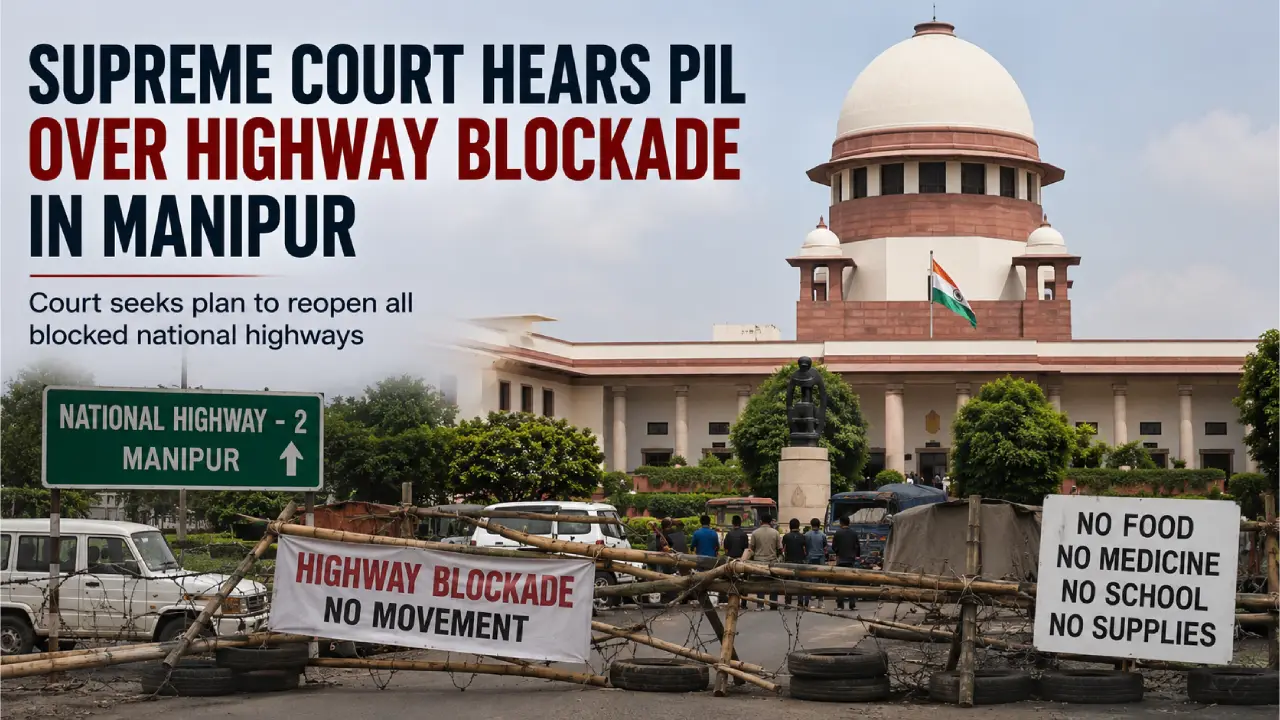
New Delhi, August 14: The Supreme Court on Friday expanded the scope of a public interest litigation concerning the blockade of National Highway-2 in Manipur, asking for details of other blocked highways and a comprehensive proposal for restoring movement on all affected routes.
A Bench comprising Chief Justice of India Surya Kant and Justices Joymalya Bagchi and J V Mohana was hearing a PIL filed by the Kuki Women Organization for Human Rights concerning the blockade and disruption of essential supplies in the state.
Senior Advocate Anand Grover, appearing for the petitioner, told the court that the situation was urgent and that the blockade had affected access to food and schooling. He described the situation as tragic and maintained that the petitioner was opposed to violence.
Grover also submitted that Kuki militant groups had lifted their blockade on the day of the hearing, while contending that the disruption had resulted in shortages and affected normal life. He argued that the state could not remain inactive while essential services were affected.
The Bench, however, cautioned that broad judicial directions had to be considered carefully because intervention by the state in a tense situation could potentially trigger violence against civilians.
Chief Justice Surya Kant observed that the petitioner's concern over the blocking of a national highway was genuine, but noted the risk that sweeping directions could have unintended consequences in a conflict-affected environment.
Justice Bagchi asked why organisations alleged to have blocked essential services had not been made parties to the petition. Grover responded that such groups were unlikely to appear and reiterated that the petitioner was against violence.
Counsel appearing for the International Meitei Organization opposed the petition, describing it as a mischievous application. The counsel also alleged that the petitioner itself was involved in blocking highways and sought that the petitioner's position on the issue be recorded.
Grover responded that the petitioner condemned violence. The Chief Justice then urged the parties to consider a way forward rather than treating the proceedings as adversarial.
The Chief Justice questioned why both sides could not agree to allow the national highways to function, observing that highway blockades did not serve the interests of either group. He suggested that an appropriate agency could facilitate the reopening of the routes and stressed the need to work towards peace.
The Bench also indicated that the issue could not be confined to NH-2 alone. Justice Bagchi noted that other highways were reportedly blocked and said the matter should be considered more comprehensively rather than reopening one highway while leaving others closed.
The Chief Justice described highways as a lifeline for ordinary people. Justice Bagchi also pointed out that Naga communities were another stakeholder in the situation but were not represented before the court. He asked the International Meitei Organization to file a separate writ petition setting out details of highways blocked in Manipur by different organisations.
The court subsequently impleaded the International Meitei Organization as a respondent and issued notice. The National Highways Authority of India (NHAI) was also impleaded.
In its order, the court recorded that the larger public-interest issue concerned removal of the blockade of NH-2 and restoration of supplies and services in the affected district of Manipur. During the hearing, the court was informed that several more highways in the state had also been blocked.
The newly added respondent was directed, instead of filing a counter at this stage, to provide details of other national highways and highways lying blocked in Manipur, along with a proposal explaining how all the blocked routes could be made functional. The petitioner was also directed to submit a comprehensive proposal on the issue.
The order broadens the proceedings from the status of NH-2 to the wider question of restoring highway connectivity across Manipur. The court's observations also place emphasis on ensuring the movement of essential supplies while avoiding measures that could aggravate tensions on the ground.