The 248th Heikru Hidongba, tracing back to King Irengba (984 CE) and revived under King Bhagyachandra, was celebrated with sacred rituals, boat race and Governor Ajay Kumar Bhalla in attendance.
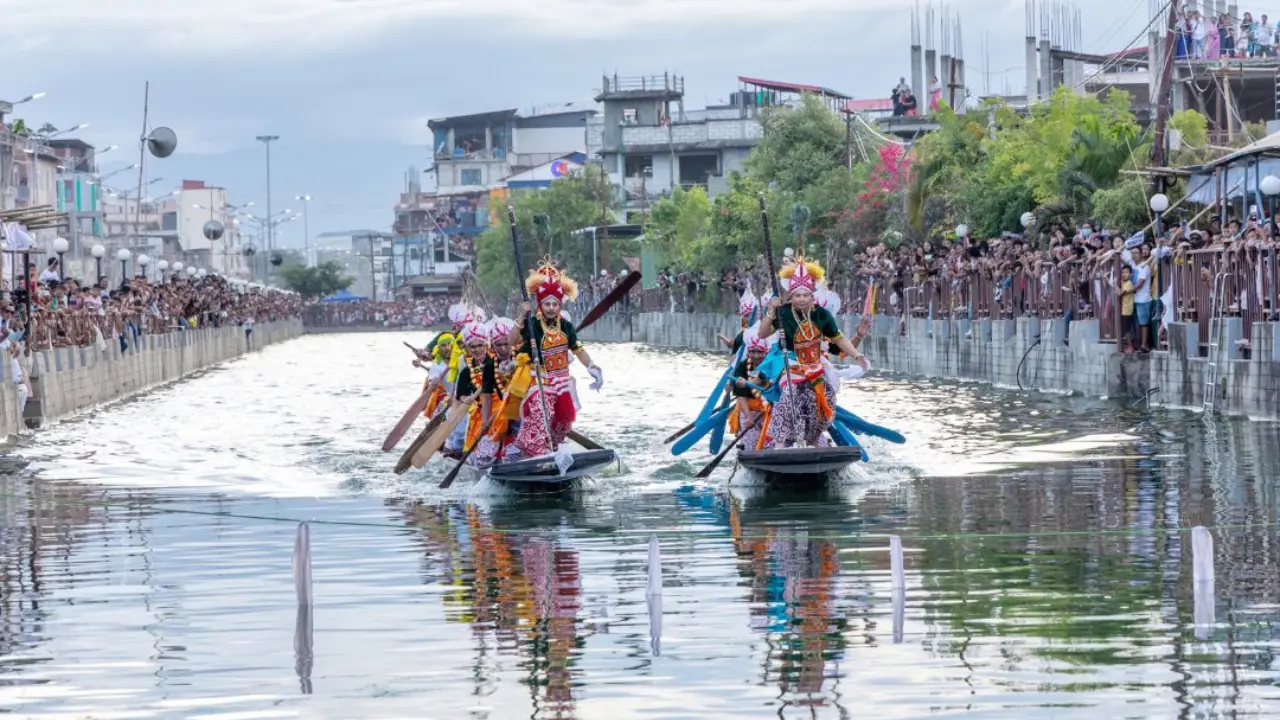
Imphal, Sept. 22: The 248th Heikru Hidongba, Manipur's traditional socio-religious boat-racing festival, was observed at the Shri Shri Bijoy Govindaji Thangapat in Sagolband, Imphal West, on Tuesday with customary rituals, devotional activities and the ceremonial boat race. Organised by the Bijoy Govinda Sevayet Committee, the annual festival is observed on the eleventh day of Langban, the sixth month of the Meitei lunar calendar, corresponding to late August or September in the Gregorian calendar. The occasion is traditionally associated with prayers for peace, prosperity, agricultural abundance and the well-being of the community, and functions in Meitei tradition as a rite of ritual purification and agrarian thanksgiving rather than a standalone sporting event.
The boat race, known as Heiyang Tanaba, remained the central attraction of the celebration. The boats are traditionally sanctified before the race through religious rituals, prayers, Sankirtana and aarti, a ceremony that links the sporting contest with the wider religious character of Heikru Hidongba and makes the race part of a larger ritual observance rather than a standalone competition. The festival's name itself is rooted in Meitei terms: heikru, the Indian gooseberry, hi, meaning boat, and dongba, meaning to ride or sail, a linguistic link that ties the celebration to the seasonal ripening of fruit across the Imphal Valley.
Ceremonial offerings form another important part of the observance. Garlands made from 108 Indian gooseberries, known as heikru, and 108 hand-husked rice grains are prepared and offered to Shri Shri Bijoy Govindaji as part of the traditional rituals associated with the festival. In Meitei custom, the gooseberry garland is regarded as representing the human soul, while the rice garland is associated with earthly sustenance, and the outcome of the contest between the two garlands has traditionally been read by temple priests as an omen for the community's fortunes in the year ahead. Custom also holds that the season's new gooseberry crop may not be consumed until it has been ceremonially offered during the festival, tying the community's harvest calendar directly to the rhythm of the rite.
Manipur Governor Ajay Kumar Bhalla, accompanied by First Lady Jyoti Bhalla, attended the celebration and witnessed the ritual boat race at the Bijoy Govinda moat. Sagolband MLA Rajkumar Imo Singh and other dignitaries were also present, along with a large gathering of devotees and spectators who travelled from different parts of Imphal to take part in the observance. At the conclusion of Tuesday's boat race, Governor Bhalla presented the Governor's Trophy and a cash award to the winning team, a closing ceremony that has become part of the festival's modern-day protocol. The event also featured devotional chanting and cultural performances that ran alongside the ritual proceedings, drawing large crowds to the banks of the moat through the day.
The scale of Tuesday's gathering reflected the festival's enduring pull on the community. Devotees and spectators lined the embankments of the Bijoy Govinda Thangapat throughout the day, taking in both the religious rites performed on the water and the competitive sprint between the racing crews that has come to define the occasion in the public imagination.
Accounts published in connection with this year's celebration trace the origins of Heikru Hidongba to the reign of King Irengba of the Ningthouja dynasty (984 CE), placing the earliest observance of the water ritual more than a thousand years in Manipur's past. In its early form, the festival was associated with indigenous Meitei deities rather than the Vaishnavite worship now linked with the occasion, and it was held without a fixed annual date, with the reigning king proclaiming the observance according to the season and the needs of the kingdom.
The Sagolband canal on which Heikru Hidongba is held was not always known by that name. It was originally called Tubi Irel before being rededicated as Moirang Leima Thangapat, a renaming tied to a specific episode in Manipur's royal history. According to local accounts, Meidingu Nongpok Leirikhomba, who oversaw the eighteenth-century reorganisation of the festival alongside King Bhagyachandra, had once been captured and held in iron fetters in the rival principality of Moirang. He managed to escape through a covert plan organised by the daughter of a Moirang nobleman, Khelei Nungnang Telheiba. In gratitude for her role in his escape, the moat was renamed in her honour as Moirang Leima Thangapat, turning the waterway into a lasting site of royal memory and thanksgiving. Since that eighteenth-century reorganisation, Heikru Hidongba has been observed exclusively on the waters of this same moat, making the venue itself as much a part of the festival's history as the rituals performed there each year.
The present-day form and venue of the festival are associated with the reign of King Bhagyachandra (1779 CE), whose rule is credited with reorganising Heikru Hidongba and establishing its lasting connection with Sagolband. It was during this period that the sacred seva of Shri Shri Bijoy Govindaji was established, with the deity's image placed in a temple complex at Sagolband under royal patronage. The revival of Heikru Hidongba at the Sagolband canal under King Bhagyachandra marked the beginning of the festival's continuous annual observance on the eleventh day of Langban, a practice that has been carried forward through the generations and continues at the same venue today.
Local tradition holds that King Bhagyachandra had a divine vision directing him to have the image of the deity carved from a sanctified jackfruit tree, and the resulting image of Shri Shri Bijoy Govindaji was installed at Sagolband, where the temple complex still stands today. The Sagolband canal on which the race is held also carries its own layer of royal history, having been renamed in earlier centuries to honour an act of loyalty connected to the royal family, a story that continues to be recounted alongside the festival's religious traditions.
This layered history, stretching from the early dynastic period associated with King Irengba to the reorganisation credited to King Bhagyachandra, has shaped Heikru Hidongba into both a religious rite and a marker of Manipur's cultural continuity. The Bijoy Govinda Sevayet Committee, which organised Tuesday's proceedings, has continued to serve as custodian of the rituals associated with the festival, ensuring that the sequence of purification, offerings and the boat race is carried out according to established custom each year.
The festival has been carried forward through generations and remains closely associated with community participation and the preservation of traditional practices. Beyond its religious character, Heikru Hidongba has long served as an occasion that draws together different sections of the community around the Sagolband moat, with the gathering itself, as much as the rituals performed, forming part of the festival's social significance. The date of the observance is fixed according to the Meitei lunar calendar, falling each year on the eleventh day of Langban, the month that marks the end of the monsoon season and the beginning of the early autumn harvest in the Imphal Valley, which is why the festival has long been tied to the community's agricultural rhythms as much as to its religious calendar.
Generations of Manipuris have grown up attending the festival at Sagolband, and the occasion has traditionally been remembered as a gathering that brings together households from across the community, with the crowd along the moat forming as much a part of the day's significance as the rituals performed on the water. That continuity was again visible on Tuesday, as families and spectators gathered together at Sagolband to watch the boat race and take part in the devotional atmosphere surrounding it.
The 2026 observance once again brought together religious rituals, traditional boat racing and collective participation, keeping one of Manipur's long-standing cultural festivals at the centre of the state's annual cultural calendar. The presence of Governor Bhalla and First Lady Jyoti Bhalla, alongside elected representatives such as Sagolband MLA Rajkumar Imo Singh, underscored the festival's continuing significance as both a religious observance and a civic occasion that draws official participation each year.
For the devotees and spectators who gathered at the Bijoy Govinda moat on Tuesday, the festival offered an opportunity to take part in rituals passed down through generations while also witnessing the spectacle of the ceremonial boat race and the cultural performances that accompanied it. The combination of the sanctification rites, the garland offerings of 108 gooseberries and 108 hand-husked rice grains, the Sankirtana and aarti performed ahead of the race, and the competitive sprint itself reflected the festival's continuing identity as a socio-religious observance carried out through the medium of a boat race rather than as a purely sporting contest.
As the 248th Heikru Hidongba concluded with the presentation of the Governor's Trophy and cash award to the winning team, the Bijoy Govinda Sevayet Committee and the community of Sagolband once again ensured that the festival's customary rituals, devotional activities and traditional boat race were carried out in keeping with practices associated with the observance since the reigns of King Irengba and King Bhagyachandra. The celebration reaffirmed Heikru Hidongba's place as one of Manipur's enduring cultural and religious traditions, observed annually on the eleventh day of Langban at the Shri Shri Bijoy Govindaji Thangapat in Sagolband, Imphal West.