Nearly a fifth of rural households remain without tap water five years after the flagship scheme's deadline, with auditors also flagging fabricated connection data and Rs 153.59 crore in unverified contractor payments.
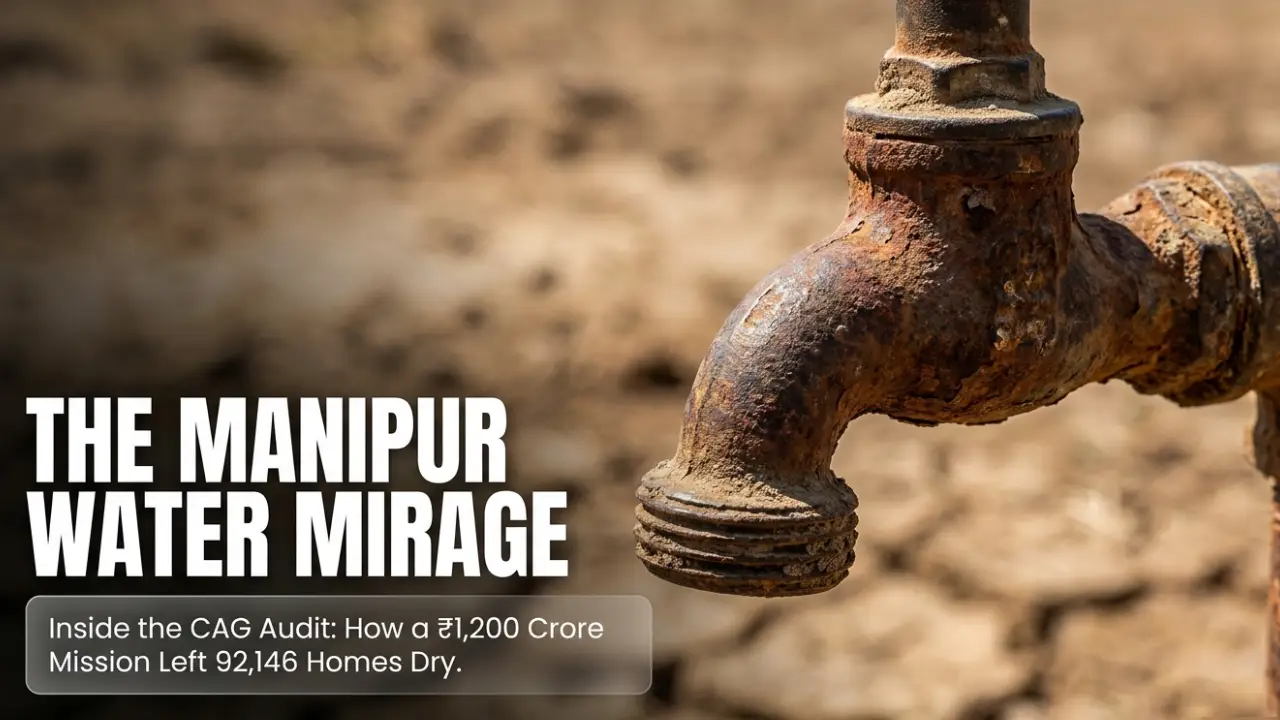
Imphal, Sept. 15: A performance audit by the Comptroller and Auditor General has found that Manipur's Public Health Engineering Department fell short of the Jal Jeevan Mission's universal tap water coverage target by 20.41%, leaving 92,146 rural households without piped drinking water even after the scheme's original 2024 deadline had passed.
The findings are part of Chapter III of CAG Report No. 2 of 2026, which examined the five years of implementation between 2019-20 and 2023-24. The Jal Jeevan Mission, launched by the prime minister in August 2019, had set out to provide Functional Household Tap Connections to all 4,51,566 rural households across the state's 2,556 villages by the end of 2024.
According to the report, the state made rapid early progress, installing 1,96,153 tap connections in 2020-21 alone — a single-year jump that pushed cumulative coverage past 50%. But that pace did not hold. New connections fell to 69,908 the following year, then to 48,767, and collapsed further to just 7,868 in 2023-24. By December 2024, total coverage stood at 79.59%, with 3,59,420 households connected.
The CAG noted that had the 2020-21 rate of progress continued, the state would have achieved universal coverage by 2021-22, in line with its own Annual Action Plan. Instead, implementation stalled well short of the goal.
Coverage also varied sharply by district. Thoubal recorded the highest rate at 88.63%, while Jiribam lagged at 37.68%, the report showed.
Villages left with no connections at all
Data from the Centre's Integrated Management Information System showed that 39 villages across Manipur had not received a single functional tap connection as of December 2024, directly affecting 3,112 households. The sampled villages with zero connections included Kumbi in Bishnupur; Sonapur, Mullargao and Jirimukh in Jiribam; Khongtal, L. Chengvol, Pamtuyang and P. Thumphajol in Chandel; and Tonglon in Churachandpur, along with villages in Kangpokpi, Noney and Pherzawl.
The department attributed the gaps to pending court cases, local disputes, and communities relying on traditional spring sources. The CAG did not accept this as a full explanation, stating that the exclusions pointed to weaknesses in ground-level needs assessments and in the Village Action Plans drawn up for each settlement.
Portal records showed connections that did not exist
A separate strand of the audit examined whether the connections reported on the national IMIS portal matched what auditors found on the ground. Investigators cross-checked records for nine villages in Imphal East, Imphal West and Kakching districts against registers maintained by local Village Water and Sanitation Committees.
Of 4,859 connections reported as complete in these villages, only 1,531 could be verified as actually installed — a gap of 3,328 connections, or 68% of the sampled total, according to the report.
In three villages — Changamdabi, Nongren and Top Dusara West, all in Imphal East — portal records showed 1,890 households with functional connections. Physical verification by audit teams found none. Not one household in these three villages had a working tap connection, the report said.
The state government told auditors the discrepancy arose from a "communication gap" between committee members and PHED staff. The CAG rejected this explanation, saying the scale of the mismatch pointed to breakdowns in internal checks rather than a communication issue, and that it undermined confidence in official reporting. Once these 3,328 inflated entries are accounted for, the CAG said, the state's real shortfall in unserved households rises from 92,146 to 95,474.
Central funding stopped entirely in 2023-24
The Jal Jeevan Mission is funded on a 90:10 basis between the Centre and the state. Between 2019 and 2024, Manipur received Rs 1,219.49 crore in combined funding and spent Rs 1,185.48 crore, the report said.
But the audit found that the PHED failed to submit mandatory Utilisation Certificates and audited accounts for the first installment of Rs 256.03 crore released by the Ministry of Jal Shakti in 2022-23. As a result, the ministry withheld the second installment of the same amount and released no Central funds at all in 2023-24.
That funding freeze, the CAG said, effectively halted the state's approved 2023-24 work plan, leaving rural water infrastructure activities worth Rs 335.18 crore unexecuted. Separately, the audit found that the State Finance Department took between 19 and 145 days to transfer Central funds into the designated nodal account, and that unutilised balances sitting idle in bank accounts peaked at Rs 182.32 crore in March 2023.
Contractors paid Rs 153.59 crore with no independent inspection
Under the mission's quality control framework, every water supply work is required to be physically inspected and certified by an independent Third-Party Inspection Agency before contractors are paid. The state's inspection agency, EGIS India Consulting, completed its 30-month term in June 2023. The PHED did not engage a replacement.
Despite the absence of any third-party inspection mechanism, the department paid out Rs 153.59 crore to contractors across multiple divisions between July 2023 and June 2024, the report found. The CAG described this as a serious lapse in financial propriety that left the state exposed to paying for substandard or incomplete work without any independent check.
One case examined in detail involved the Nungaipokpi water supply scheme in Imphal East, meant to serve Changamdabi village, sanctioned at Rs 5.98 crore. Departmental records showed Rs 5.71 crore had been spent, or 95% of the project cost. But a joint physical verification in September 2024 found that several billed components were missing on site altogether: an approach road and site levelling worth Rs 18.93 lakh, a compound wall worth Rs 22.33 lakh, household tap connections worth Rs 16.19 lakh, and a pump set worth Rs 19.03 lakh — a combined Rs 76.48 lakh. The CAG said misappropriation of this amount could not be ruled out.
In Nongren village, also in Imphal East, auditors found the existing water supply infrastructure abandoned and overgrown, with settling tanks choked by plant growth, while planned augmentation works under an externally funded project had not begun.
The audit also flagged pipe stock left unused for months after procurement. In Imphal West division, 18,997 running metres of pipe worth Rs 5.10 crore remained in storage 11 months after purchase. In Kakching division, pipe stock worth Rs 2.19 crore sat unissued eight months after receipt. A separate overpayment of Rs 32,745 to a pipe supplier in Imphal East was also recorded, made before the full quantity had been received.
Households report shortages every lean season
Beyond the financial and data findings, the audit surveyed how the scheme was functioning for the people it was meant to serve. Of 469 beneficiaries surveyed, 351 had functional tap connections. All 351 reported severe water shortages during the lean season from February to May, when supply became irregular — ranging from once a week to unpredictable — forcing families to buy water from tankers or draw it from ponds and rivers.
None of the 351 connections tested had a water meter installed, despite a national requirement for full metering to manage demand and fund operation and maintenance. The state government told auditors metering had been deferred to a "future scope." In its absence, local committees were found to be collecting informal cash charges of Rs 100 to Rs 250 a month from households, money that was never deposited into any official account, the report said.
The audit also found major gaps in water quality monitoring. In 2021-22, 192 of 293 sampled villages, or 65.53%, did not conduct a single water quality test despite having received testing kits. Over-procurement of 7,000 test kits led to 284 kits and 1,269 testing vials expiring unused, a loss of Rs 7.88 lakh. Test results, where they existed, were never shared with communities or panchayats. In Lamjaotongba in Imphal West, residents refused to drink tap water sourced from the Nambul River over contamination concerns linked to nearby sewerage discharge.
The CAG also pointed to National Health Mission data showing a rising trend in acute diarrheal disease and typhoid cases in the state between 2019-20 and 2022-23, while noting that the PHED kept no records tracking waterborne illness on its own.
Village committees bypassed, foreign-funded projects stalled
The audit found that the department did not conduct baseline surveys before planning schemes, and that Gram Sabhas were not convened to approve Village Action Plans in the villages sampled. Seven of the state's 2,556 villages had not even formed the local water and sanitation committees required under the scheme, and in six of seven sampled committees, women's representation fell below the mandatory 50% threshold.
Agencies hired to support implementation were paid a flat Rs 75,000 a month regardless of output, the report noted. Skilling programmes for local plumbers and pump operators reached only 180 of 2,556 villages, about 7%, despite Rs 1.26 crore in spending, leaving most villages without trained maintenance personnel. A committee meant to identify water sources for schemes was set up only in January 2024, years after the scheme began; of 1,171 state water schemes, 955 had no source augmentation provisions at all, which the CAG linked to the lean-season shortages reported by beneficiaries.
Separately, a $312 million loan from the New Development Bank was signed to help close funding gaps, of which $259.79 million had been spent by March 2024, including $91.66 million on rural water packages. Physical progress on these projects ranged between 27.95% and 57.85%, and two major packages covering Imphal East, Kamjong, Ukhrul, Bishnupur, Imphal West, Noney and Tamenglong saw their contracts revoked in July 2024 and March 2025 over non-performance. Overall completion of the bank-funded rural schemes stood at just 9.71%, the report said.
What the CAG has recommended
The audit closes with a set of recommendations to the state government: investigate the Rs 76.48 lakh in unexecuted work under the Nungaipokpi scheme and recover excess pipe payments; re-engage a third-party inspection agency to review all work carried out since July 2023 before further payments are released; conduct a state-wide physical verification of reported connections to correct the IMIS database; introduce household metering and a formal operation and maintenance policy; expedite Rs 116.85 crore in pending source augmentation proposals and incorporate rainwater harvesting; and reconvene Gram Sabhas, formally empower village committees, and expand local skilling programmes across all 2,556 villages.