Bank unions plan strikes on September 11, September 28-30 and an indefinite strike from October 26 over the delayed implementation of five-day banking.
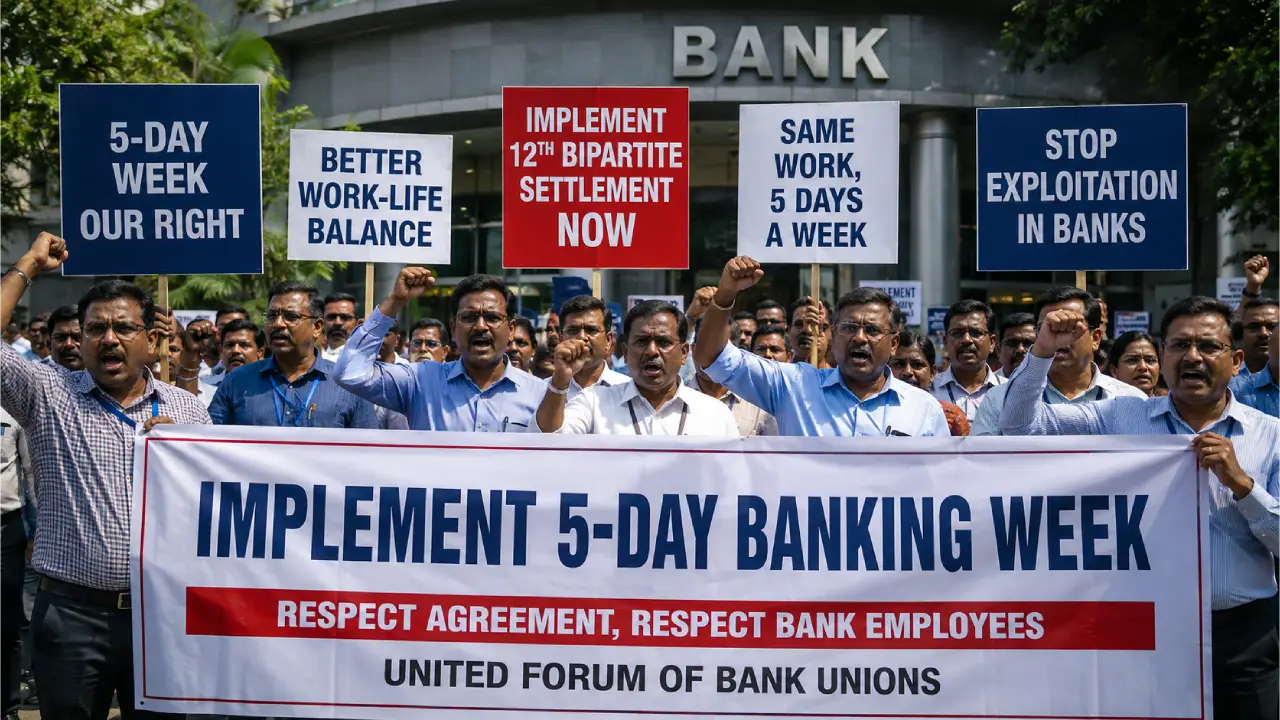
Imphal, Sept 4: Bank employees and officers are set to launch a series of strikes from September 11 over the prolonged delay in implementing the five-day working week agreed under the 12th Bipartite Settlement, according to former All-India Bank Officers’ Confederation (AIBOC) General Secretary Thomas Franco.
The United Forum of Bank Unions has announced a one-day strike on September 11, followed by a three-day strike from September 28 to 30, and an indefinite strike from October 26, Franco stated in an article on the long-running demand for a five-day banking week.
The strikes come more than two years after the 12th Bipartite Settlement was signed on March 8, 2024, under which the implementation of a five-day week was agreed upon. The settlement also provided for an additional 40 minutes of work on working days to compensate for the reduction in working days.
Franco criticised the continued delay in implementing the agreement, stating that strikes and negotiations have not resulted in the industry-level settlement being put into effect.
He argued that five-day banking has been a longstanding demand of bank employees and officers, arising partly from prolonged staff shortages, late working hours, holiday duties and difficulties in securing leave.
According to Franco, the demand for a five-day working week became a key component of the Charter of Demands for the 10th Bipartite Settlement, effective from November 1, 2012.
He traced the issue to years of reduced recruitment following banking-sector reforms and the introduction of voluntary retirement schemes. The shortage of staff, he stated, increased pressure on employees and contributed to demands for improved work-life balance.
The demand was subsequently pursued through negotiations, parliamentary interventions and strikes. Franco recalled that a 2015 agreement resulted in employees receiving two Saturdays off each month after the Finance Ministry was approached.
He stated that there was an oral assurance at the time that the arrangement could eventually be extended to a full five-day working week if the two-Saturday-off system worked successfully.
“Eleven years have passed,” Franco wrote, noting that two further bipartite settlements have since been completed.
The 12th Bipartite Settlement in 2024 formally provided for the five-day week, but its implementation remains pending, according to Franco.
He claimed that bank managements were not opposed to the proposal, while some industrialists had objected to implementation. He also stated that the Finance Ministry had informed the unions that its recommendation had been sent to the Prime Minister’s Office.
Franco argued that technological changes in banking, including ATMs, online banking and digitisation, have strengthened the case for a five-day working week.
He also pointed to the adoption of five-day weeks across government, public sector undertakings, the private sector and international financial institutions.
The United Forum of Bank Unions, he stated, has now decided to intensify its agitation through the three phases of industrial action, culminating in an indefinite strike from October 26 if the agreement is not implemented.
Franco also criticised the National Organisation of Bank Workers and National Organisation of Bank Officers for remaining outside the United Forum of Bank Unions.
He concluded that the announced strikes would be total and questioned whether the government would act to enable implementation of the 2024 agreement.
Thomas Franco is the former General Secretary of the All-India Bank Officers’ Confederation and a Steering Committee Member of the Global Labour University.