Brahmaputra–Chao Phraya Dialogue in Guwahati and Shillong brings India and Thailand together on youth, education, enterprise, health and regional connectivity.
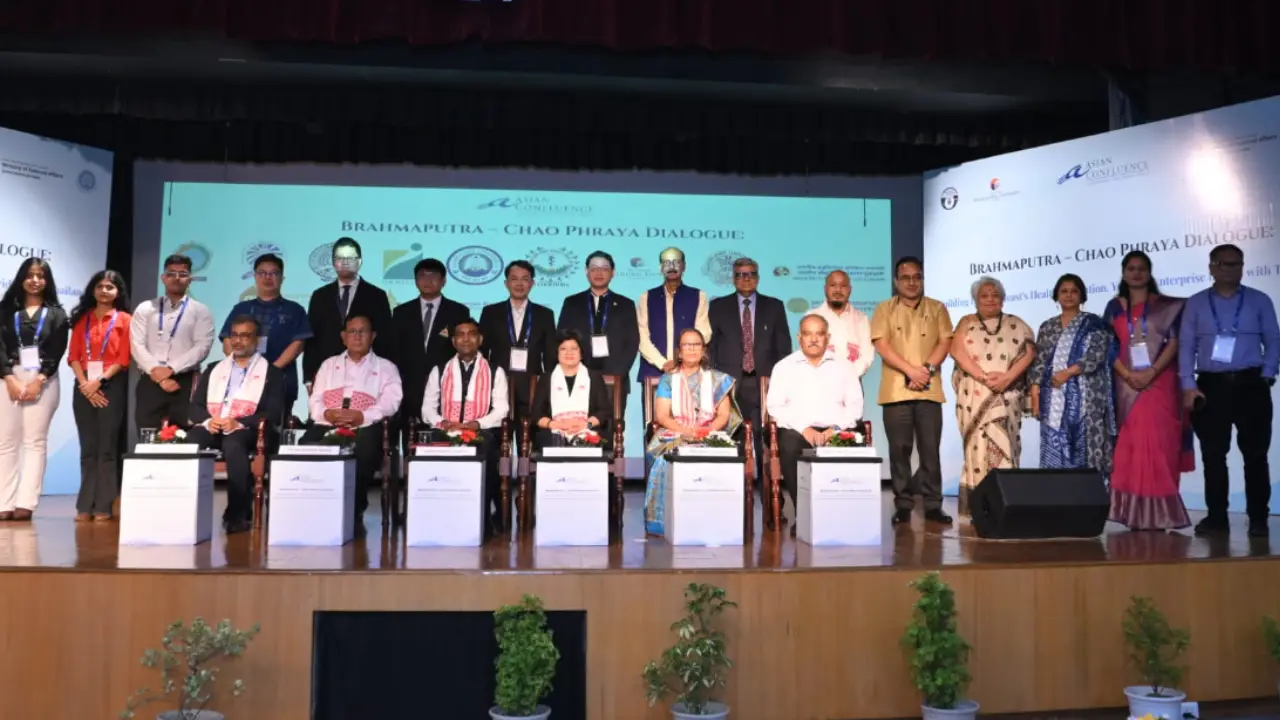
Guwahati, Sept. 22: A two-day Brahmaputra–Chao Phraya Dialogue began in Guwahati on Tuesday, bringing together policymakers, diplomats, academics, healthcare experts and youth representatives from India and Thailand to explore stronger cooperation between Northeast India and Thailand.
The dialogue, convened by Asian Confluence in collaboration with The Assam Royal Global University and the Policy Planning & Research Division of the Ministry of External Affairs, is being held across Guwahati and Shillong on September 22 and 23.
The first day at The Assam Royal Global University focused on building cooperation in health, education, youth and enterprise, while the second day at the Asian Confluence Centre in Shillong is scheduled to examine India–Thailand relations, the Bay of Bengal and the evolving strategic partnership between the two countries.
Asian Confluence said the dialogue is intended to connect existing policy-level cooperation with practical partnerships involving universities, entrepreneurs, healthcare institutions and young people in the Northeast. The organisation has described the initiative as an effort to develop a sustained Track-2 platform for India–Thailand engagement in the region.
Northeast positioned as link between India and Southeast Asia
The dialogue comes amid the elevation of India–Thailand relations to a Strategic Partnership in April 2025. According to the concept note for the dialogue, bilateral trade reached approximately USD 15 billion in 2023–24, while cooperation has expanded into areas including digital technology, creative industries and startups.
The North Eastern Region has been given a specific place in the framework of the partnership, with areas such as tourism, culture, education and vocational and technical cooperation identified for closer engagement.
Asian Confluence said the Northeast’s geographical proximity to ASEAN and its position within the Bay of Bengal region give it potential to serve as a link between India and Southeast Asia. The organisation also pointed to existing initiatives involving digital technology, handicrafts and handlooms, entrepreneurship, tourism and academic exchanges.
Among the initiatives highlighted are a memorandum of understanding between Thailand’s Ministry of Digital Economy and Society and India’s Ministry of Electronics and Information Technology on digital technology cooperation.
Another institutional agreement links the North Eastern Handicrafts and Handloom Development Corporation with Thailand’s Creative Economy Agency, while a government-to-government memorandum connects the Ministry of Development of North Eastern Region with Thailand’s Ministry of Foreign Affairs.
Interest in direct air connectivity between Guwahati and Bangkok was also cited as part of the broader effort to improve people-to-people and commercial links.
Connectivity must include people, former minister says
Former Union Minister of State for External Affairs and Education and Asian Confluence adviser Dr R.K. Ranjan Singh delivered a special address at the opening session in Guwahati.
Referring to India’s Act East Policy, Dr Ranjan spoke about the importance of physical connectivity between Northeast India and Southeast Asia, including the India–Myanmar–Thailand Trilateral Highway.
The highway is intended to connect Moreh in Manipur with Mae Sot in Thailand through Myanmar. Dr Ranjan noted that the project has faced delays and logistical challenges, including those arising from the prolonged conflict in Myanmar.
He said the original objective of establishing a land corridor between India and mainland Southeast Asia remained important, while longer-term proposals have envisaged extending connectivity towards Cambodia, Laos and Vietnam.
At the same time, Dr Ranjan argued that physical infrastructure would need to be accompanied by stronger people-to-people links.
“Connectivity of roads must be matched by connectivity of minds — through student exchanges, joint research and entrepreneurship networks,” Dr Ranjan said.
He said the objective should be to develop a generation of young Indians and Thais who have studied, worked and built networks with each other by the time major physical connectivity projects become fully operational.
Direct air connectivity between Guwahati and Bangkok, he added, could complement land-based connectivity by facilitating greater movement of people.
Manipur academic links cited as model
Dr Ranjan also referred to academic exchanges involving institutions in Manipur as an example of grassroots cooperation between the Northeast and Thailand.
He said Manipur University in Imphal has been developing academic engagement around Thai language and cultural studies, while research scholars have been developing academic links involving Manipur University, Dhanamanjuri University and Thai institutions.
He encouraged participating universities to explore similar arrangements across the Northeast, including language programmes, student exchanges, dual-degree initiatives and joint research.
The dialogue brought together representatives from Thai institutions including Thammasat University, Chulalongkorn University, Ubon Ratchathani University and Prince of Songkla University, along with institutions from Northeast India such as Gauhati University, Cotton University, IIT Guwahati, Nagaland University, NEIGRIHMS and the Indian Institute of Public Health, Shillong.
Health cooperation among key areas
Public health cooperation also formed part of the dialogue, with participants discussing possible institutional links between medical and research institutions in India and Thailand.
The discussions included health surveillance, infectious disease monitoring and healthcare delivery in border regions.
The Northeast and western Thailand share geographical proximity to Myanmar, where prolonged conflict has created cross-border humanitarian and public health challenges. Participants discussed the scope for medical institutions in India and Thailand to share field experience and strengthen mechanisms for cooperation.
Institutions represented in the discussions included NEIGRIHMS, the Indian Institute of Public Health, Shillong, and the Faculty of Medicine at Prince of Songkla University.
Shillong session to focus on strategic partnership
The second day of the dialogue will be held at the Asian Confluence Centre in Shillong on September 23.
It will focus on the Bay of Bengal, India–Thailand relations and the evolving strategic partnership between the two countries.
The programme is expected to bring together Thai delegates, representatives of the Ministry of External Affairs, state officials and strategic analysts to examine existing agreements and identify areas for longer-term cooperation.
Academic exchanges, health infrastructure cooperation and networks for young entrepreneurs are among the areas identified for further discussion.
The organisers said the dialogue is intended to build on previous India–Thailand engagements facilitated by Asian Confluence, including entrepreneurial exchanges and youth-oriented networks. Asian Confluence has previously hosted Thai business delegations and other India–Thailand initiatives focused on connectivity, trade, tourism and cultural ties.
Focus on turning policy commitments into regional partnerships
The organisers said the broader objective is to develop practical cooperation alongside high-level India–Thailand diplomatic ties.
The dialogue places particular emphasis on youth participation, education, entrepreneurship, digital innovation, creative industries and healthcare, with the Northeast positioned as an important geographical and institutional link between India and Southeast Asia.
Asian Confluence has described the initiative as part of its wider Track-2 work, which brings together government representatives, researchers, businesses, academics and civil society actors to discuss regional cooperation outside formal state-to-state negotiations.
The organisation said the Brahmaputra–Chao Phraya Dialogue is intended to develop into a regular platform through which universities, entrepreneurs, policymakers and other institutions in the Northeast and Thailand can build sustained working relationships.