Comptroller and Auditor General's report on Manipur's 2024-25 accounts finds off-budget borrowing, thousands of unadjusted bills and years of stalled legislative review.
Imphal, Sept. 12: A Comptroller and Auditor General (CAG) audit of Manipur's financial reporting practices for the year ended March 31, 2025, has found that the state government failed to disclose hundreds of crores in off-budget borrowing and left more than Rs 21,000 crore in public funds unverified through pending utilisation certificates and unadjusted advance bills.
The findings are part of Chapter 3 of the CAG's State Finances Audit Report, Report No. 1 of 2026, which examined how the state records, reconciles and discloses its financial transactions. The report describes a pattern of non-compliance with statutory accounting rules across departments, along with reconciliation gaps and years-long delays in legislative scrutiny of past audit findings.
According to the report, the state government did not disclose off-budget debt liabilities in its official budget documents for 2024-25. Under Article 293(3) of the Constitution and recommendations of the Fifteenth Finance Commission, states are subject to a Net Borrowing Ceiling of 3 percent of Gross State Domestic Product. The audit found that Manipur routed borrowing through two state-owned entities — the Planning and Development Authority and the Manipur Police Housing Corporation Limited — to raise funds outside this ceiling.
As of March 31, 2025, outstanding off-budget debt stood at Rs 639.64 crore, of which Rs 109.57 crore was raised during the year, the report said. The Planning and Development Authority accounted for Rs 435.49 crore of the total, borrowed for projects including the Civil Secretariat, a VVIP guest house, government quarters in Gurgaon and Langoil, and the Manipur Institute of Performing Arts. The Manipur Police Housing Corporation accounted for Rs 204.15 crore, used for a state guest house in Delhi's Dwarka area and the new police headquarters in Imphal.
Though the loans were contracted in the names of the two entities, the state government paid Rs 96.69 crore during the year to service the principal and interest on these debts, the audit noted. Off-budget borrowing as a share of GSDP rose from 0.47 percent in 2022-23 to 1.34 percent in 2023-24, before easing slightly to 1.27 percent in 2024-25. The CAG said that keeping such debt outside budget documents violates the transparency provisions of the Manipur Fiscal Responsibility and Budget Management Act, 2005, and understates the state's actual fiscal deficit.
The audit's most significant finding concerns the state's backlog of unverified utilisation certificates, or UCs — documents that grantee institutions must submit to confirm that grants-in-aid were spent for their sanctioned purpose. Under Rule 238(1) of the General Financial Rules, 2017, these certificates are due within 12 months of the close of a financial year.
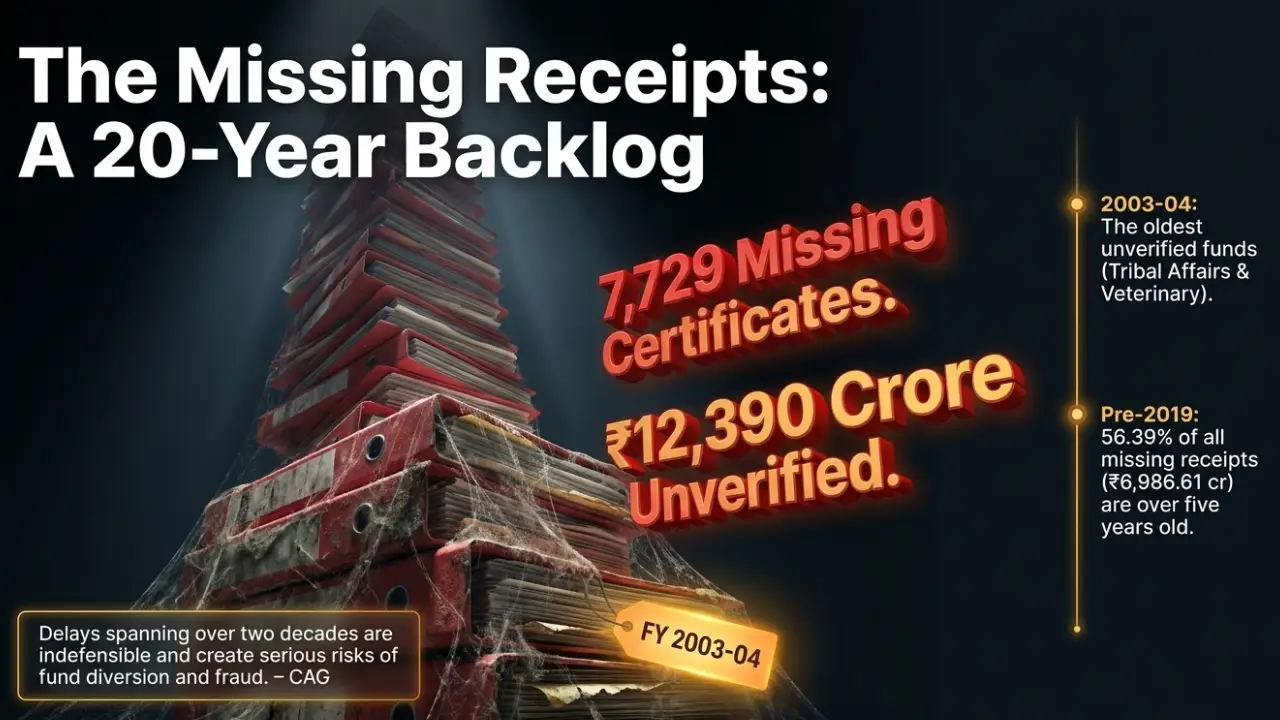
As of March 31, 2025, 7,729 UCs worth Rs 12,390.48 crore were outstanding across state departments, the report found. More than half of that amount — Rs 6,986.61 crore, or 56.39 percent — relates to certificates due before 2018-19. Ten departments accounted for Rs 11,676.84 crore, or 94.24 percent, of the total backlog. The Rural Development and Panchayati Raj Department alone held Rs 5,332.29 crore in unverified grants, followed by the Power Department at Rs 1,551.18 crore and the Department of Tribal Affairs and Hills Development at Rs 1,219.03 crore.
The audit noted that some of the oldest pending certificates date back to 2003-04, including amounts in the Tribal Affairs and Veterinary and Animal Husbandry departments. Departmental officials, during an exit conference held in January 2026, attributed the delays to lags in project execution on the ground. The CAG rejected this explanation, stating that delays spanning more than two decades cannot be justified and raise the risk of fund diversion and double counting.
The report also flagged a large volume of unadjusted Abstract Contingent bills — advances drawn by Drawing and Disbursing Officers without immediate supporting vouchers, which are meant to be regularised through Detailed Countersigned Contingent bills within a prescribed period.
As of March 31, 2025, 2,282 such bills worth Rs 9,448.82 crore remained unadjusted across 59 departments, according to the audit. Of this, Rs 6,607.28 crore relates to bills due before 2023-24. The Planning Department had the largest pending amount at Rs 1,924.17 crore, followed by Medical and Health Services at Rs 1,600.98 crore, Secondary Education at Rs 1,358.21 crore, the Police Department at Rs 1,191.37 crore, and Rural Development and Panchayati Raj at Rs 1,057.33 crore.
The audit also pointed to a spike in advance withdrawals toward the end of the financial year. It found that 136 bills worth Rs 933.35 crore — nearly 29 percent of the year's total advance drawdowns — were made in March 2025 alone, with 33 bills worth Rs 310.98 crore drawn on the final day of the fiscal year, March 31. The report said the oldest pending bill traces back to 2003-04 in the Secondary Education Department, and warned that leaving large advances unadjusted for years increases the risk of financial irregularities.
The audit found that only 37 of the state's 81 Chief Controlling Officers fully reconciled their monthly accounts with the Principal Accountant General's records during 2024-25, as required under state financial rules. While 99.63 percent of total receipts were reconciled, 44 officers failed to reconcile Rs 8,119.05 crore in expenditure, or about 28.70 percent of total disbursements — a decline from the 73.59 percent reconciliation rate recorded in 2023-24.
A separate discrepancy was found between the state's cash balance as recorded by the Accountant General and the figure reported by the Reserve Bank of India, with an unreconciled gap of Rs 496.77 crore, up from Rs 490.29 crore the previous year. The audit attributed this to delayed adjustments and pending reconciliations between treasuries and bank branches.
The report also found that the state government made no budget provision for Rs 33.92 crore in interest payable on interest-bearing deposits, including the National Pension System, State Compensatory Afforestation Fund and State Disaster Response Fund, understating revenue expenditure by that amount. Separately, the Manipur Electricity Regulatory Commission was found to be maintaining its State Electricity Regulatory Fund in a commercial bank account rather than the state's Public Account, in violation of Article 266(2) of the Constitution, with a closing balance of Rs 1.70 crore as of March 2025.
On accounting standards, the audit found the state only partly complied with three Indian Government Accounting Standards covering government guarantees, grants-in-aid and loans and advances, citing gaps such as missing commitment records and undisclosed grants received in kind.
The report noted that 27 annual accounts across eight autonomous bodies remained overdue as of March 2025. Six Autonomous District Councils — Chandel, Churachandpur, Sadar Hills (Kangpokpi), Senapati, Tamenglong and Ukhrul — had not submitted accounts for three consecutive years. The Manipur State Legal Services Authority had three years of accounts pending, while the State Compensatory Afforestation Fund Management and Planning Authority had six years pending.
Separately, the audit found that State Finances Audit Reports for five consecutive years — 2019-20 through 2023-24 — have yet to be discussed by the Public Accounts Committee of the Manipur Legislative Assembly, with action taken notes on departmental responses still pending in each case.
The Chapter 3 findings build on broader concerns raised elsewhere in the same audit report. According to the CAG, Manipur depends on central transfers for 87.55 percent of its revenue, while 81.22 percent of fresh borrowing is used to repay principal on existing debt. The audit also found that 23.88 percent of total budgeted funds, or Rs 8,927.55 crore, went unspent during the year, while spending on debt servicing exceeded sanctioned amounts by Rs 3,728.99 crore without legislative approval. More than a quarter of the year's expenditure — 27.68 percent — was incurred in March alone.
Recommendations
The CAG has recommended that the state government fully disclose off-budget liabilities in its budget documents, set a time-bound plan to clear the utilisation certificate backlog, enforce deadlines for departments to submit detailed bills against outstanding advances, and direct autonomous bodies to file overdue accounts. It has also called for adequate budget provisioning for interest liabilities, full compliance with government accounting standards, and mandatory monthly reconciliation between controlling officers and the Accountant General's office.
Editorial note: This report is based solely on findings published in CAG Audit Report No. 1 of 2026. There is no government response included in the source material.