NSO’s ASUSE 2025 data shows Imphal West leads Manipur’s unincorporated economy, while Imphal East records 72% women-owned proprietary enterprises.
Imphal, Sept. 10: Imphal West accounts for nearly a quarter of Manipur’s unincorporated non-agricultural enterprises, while Imphal East has emerged as a national standout for women-owned proprietary businesses, according to district-level estimates from the National Statistics Office’s (NSO) Annual Survey of Unincorporated Sector Enterprises (ASUSE) 2025.
The district-level release, published by the Ministry of Statistics and Programme Implementation (MoSPI), provides detailed estimates of India’s unincorporated non-agricultural enterprise sector for the first time at the district level. The data covers 757 of 770 districts nationwide and offers a more granular picture of enterprise distribution, employment, labour structures and female ownership.
In Manipur, economic activity is concentrated heavily in the valley. The top three districts account for more than half of the state’s unincorporated establishments, while the top 10 together account for 97% of the state’s business units.
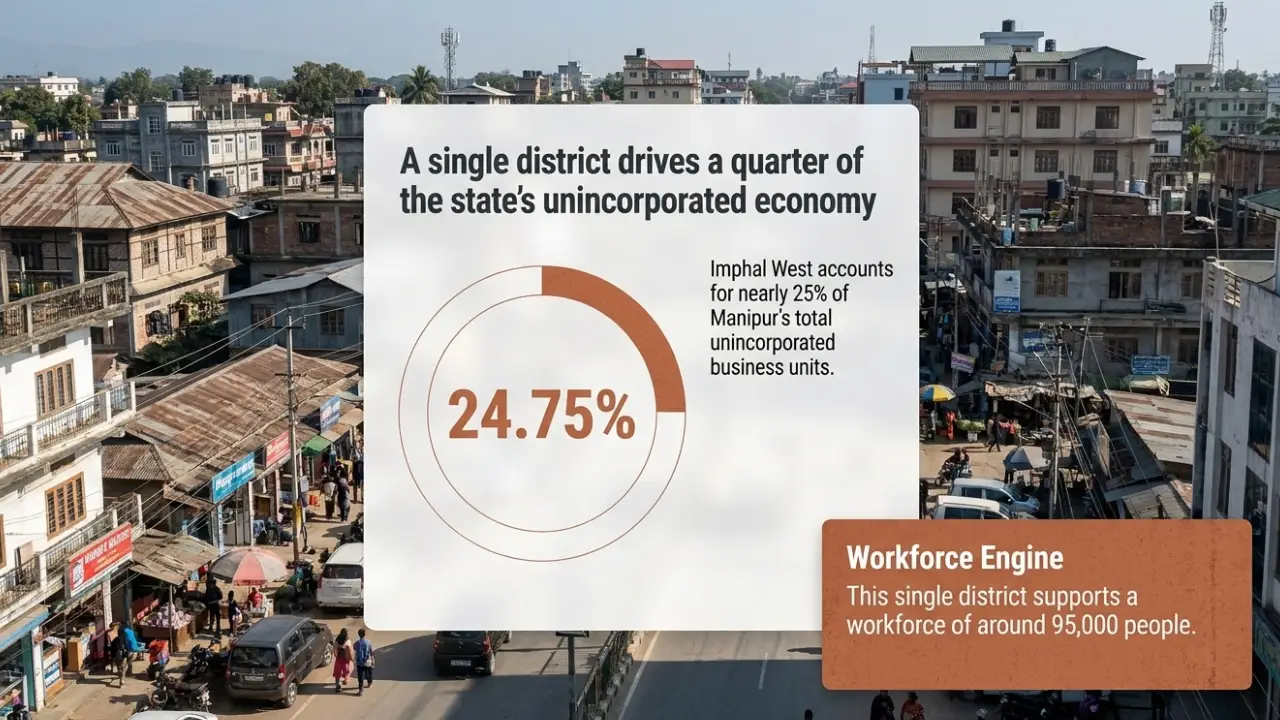
Imphal West is the largest enterprise centre, with 46,737 establishments, representing 24.75% of Manipur’s total unincorporated business units. The district also supports a workforce of around 95,000 workers.
Thoubal follows with 35,998 establishments, while Imphal East has 33,925. Bishnupur accounts for 22,787 establishments and Kakching for 11,824.
The other districts among Manipur’s top 10 are Churachandpur with 9,932 establishments, Ukhrul with 6,612, Kangpokpi with 6,321, Senapati with 5,219 and Tamenglong with 2,857.
Imphal West among Northeast’s leading capital-centred economies
The concentration of enterprise activity in Imphal West places Manipur within a broader pattern seen across the Northeast, where major commercial or capital districts account for a substantial share of their respective state economies.
West Tripura has the highest district concentration in the region, accounting for 32.66% of establishments in Tripura. Aizawl accounts for 31.49% of Mizoram’s enterprises, while Gangtok contributes 27.97% in Sikkim.
East Khasi Hills accounts for 26.85% of Meghalaya’s establishments, followed by Imphal West at 24.75% in Manipur and Papum Pare at 24.57% in Arunachal Pradesh.
Kohima accounts for 17.54% of Nagaland’s enterprises. Assam shows a more dispersed pattern, with Dhubri being its largest single district contributor at 8.14%.
Manipur districts among national leaders in women’s enterprise ownership
One of the key findings of the ASUSE 2025 district estimates is the strong representation of Manipur and other northeastern states among districts with high levels of female enterprise ownership.
The report places districts from Telangana, Manipur and Meghalaya among the top 10 nationally for the proportion of female-led unincorporated establishments.
Imphal East stands out with women owning 72% of proprietary establishments, placing the district among the national leaders in female enterprise ownership.
Mizoram records an even broader state-wide pattern. Female-owned proprietary enterprises account for at least half of establishments in every district of the state, making it the only state in the country to record that level of female enterprise representation across all its districts, according to the data.
The national figures also show that women account for at least one-third of the workforce in 237 districts. In 25 districts, women make up more than half of the total workforce.
Districts in Telangana, Manipur, Meghalaya and Mizoram feature prominently among those with high female workforce shares.
Churachandpur records highest share of hired-worker establishments
The survey also points to differences in labour structures across Manipur’s districts.
While self-employment and family-based enterprise structures remain prominent, Churachandpur records the highest share of establishments employing hired workers in the state, at 37%.
This indicates a greater reliance on wage-based employment in the district compared with other parts of Manipur’s unincorporated sector.
National enterprise activity remains concentrated
At the all-India level, the ASUSE 2025 district estimates show that economic activity in the unincorporated sector is concentrated in a relatively small number of districts.
The top 10 districts nationally account for roughly one-tenth of establishments, workforce and Gross Value Added (GVA), while the top 50 districts together account for nearly one-third of unincorporated economic activity.
The largest concentrations are found in Gujarat, Telangana, Uttar Pradesh and West Bengal. Sixteen districts across the country have more than five lakh unincorporated establishments.
The survey also found that 280 districts record GVA per worker above the national average of Rs 1,56,539. Another 331 districts have average GVA per worker between Rs 1 lakh and Rs 1.5 lakh.
The district-level data provides policymakers and financial institutions with a more detailed basis for assessing local enterprise activity. The release also includes Relative Standard Errors (RSEs) for district-level labour and financial estimates to help users assess the reliability of the estimates.
For Manipur, the findings point to a sharp geographical concentration of enterprise activity alongside strong participation by women in the state's unincorporated economy. The district-level picture also shows significant differences in employment structures between the valley and hill districts.