Manipur secures national recognition as the top-performing hill and northeastern state under NITI Aayog's IEMI 2025, even as the index flags weak private EV adoption and research gaps; Delhi, Maharashtra and Karnataka lead the overall national rankings.
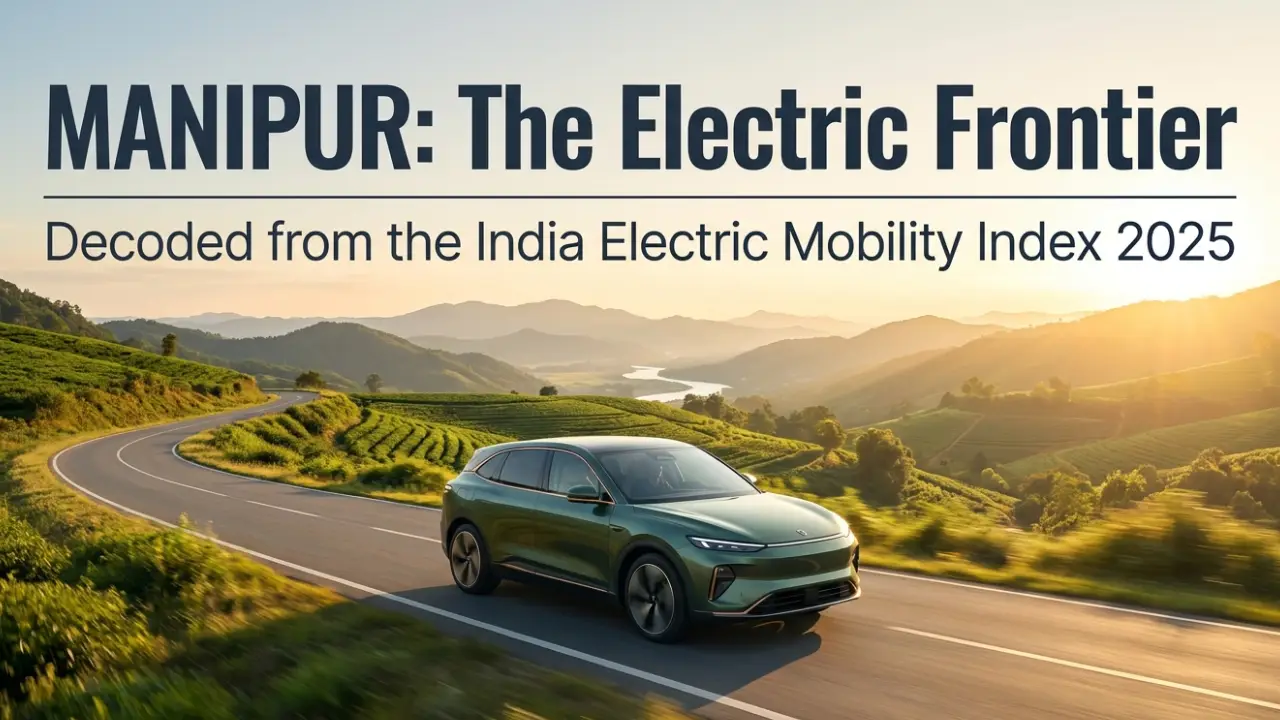
IMPHAL/NEW DELHI, Sept. 17: The State Government of Manipur has been conferred the Award for the Best Performing State among Hilly and North-Eastern States under the India Electric Mobility Index (IEMI) 2025, an assessment issued by NITI Aayog in collaboration with WRI India. The recognition places Manipur at the top of a 12-member peer group of hilly and northeastern jurisdictions, marking a significant milestone in the state's push toward electric vehicle adoption and sustainable transportation.
In the Open Category of the national rankings, Delhi topped the overall list, followed by Maharashtra, Karnataka and Chandigarh. Within its own regional peer group, however, Manipur was recognized as the best-performing state, underscoring steady progress in building out its electric mobility ecosystem even as it competes in a category shaped by challenging terrain and dispersed infrastructure.
The award recognizes Manipur's efforts and performance in promoting electric mobility and sustainable transportation, and the State Government has described it as a milestone in its ongoing work to accelerate the adoption of electric vehicles and develop an enabling ecosystem for clean mobility.
The award was received on behalf of the Government of Manipur by a team headed by Shri R.K. Dinesh Singh, Principal Secretary (Transport), Government of Manipur. The team also included Ms. Laltanpuii, Special Secretary (TCI); Kh. Diana Devi, Director (Transport); Shri Priyoranjan of MSPCL; and Shri Kh. Sanjeevkumar, District Transport Officer, Imphal West.
Officials said the recognition reflects the coordinated efforts of the Transport Department and other stakeholders in advancing the state's electric mobility agenda. Manipur has been undertaking a range of initiatives to facilitate the shift toward cleaner modes of transportation, including measures to strengthen electric mobility infrastructure and promote sustainable transport solutions. The Department of Transport, Government of Manipur, said the NITI Aayog award is expected to further encourage the state to intensify its efforts toward building a cleaner, greener and more sustainable transportation system, adding that the government remains committed to promoting innovative and environmentally sustainable mobility solutions.
Under IEMI 2025's newly introduced peer-group framework, Manipur secured an overall composite score of 46 out of 100, placing it first among the 12 states and Union Territories evaluated in the Hilly and Northeastern States Category and earning it the classification of "Emerging Performer," a tier spanning scores of 35 to 49.
The index evaluates jurisdictions across three weighted themes. In Charging Infrastructure Readiness, weighted at 30 percent, Manipur scored 61 out of 100, ranking first in its regional category and achieving "Frontrunner" status, a tier reserved for scores between 50 and 64. Manipur and Meghalaya, which scored 56, were the only two states in the Hilly and Northeastern category to reach Frontrunner status in charging deployment.
In Transport Electrification Progress, the index's heaviest-weighted theme at 50 percent, Manipur scored 42 out of 100, placing third in the region behind Assam at 47 and Tripura at 44. The state recorded a 39 percent commercial EV adoption rate, driven largely by vehicles such as e-rickshaws and shared fleets, but lagged in private EV adoption, which stood at just 1 percent.
In EV Research and Innovation Status, weighted at 20 percent, Manipur scored 34 out of 100. While every state in the Hilly and Northeastern category fell into the lowest "Aspirant" tier for this theme due to a lack of industrial automotive hubs, Manipur recorded the highest score in the category, ahead of Ladakh at 30 and Jammu and Kashmir at 25.
Manipur's state government has also highlighted a specific policy advantage: under its e-mobility promotion framework, the state provides government land free of cost to Central or State agencies for setting up public EV charging stations, an incentive that will remain in place through 2027.
Looking ahead, NITI Aayog and WRI India have outlined priority areas for Manipur, including accelerating private EV adoption through vehicle scrappage incentives, retrofitting or conversion kit subsidies, low-emission urban zones and direct consumer purchase subsidies; strengthening infrastructure governance by designating a dedicated nodal agency for charging infrastructure and extending concessional land rates to private charging operators; and building local research and development capacity through specialized R&D centers, EV Centres of Excellence and technical skilling courses at state institutions.
While Manipur secured the top position in the Hilly and Northeastern States Category with an overall score of 46 out of 100, the India Electric Mobility Index (IEMI) 2025 also points to several notable shortfalls, structural gaps and policy limitations across the state's electric mobility ecosystem.
In the Transport Electrification Progress theme, where Manipur scored 42 out of 100 and was classified an Emerging Performer, the index identifies a sharp disparity between commercial and private EV adoption. Manipur recorded a 39 percent commercial EV adoption rate in shared and commercial three-wheelers and light transit, but private EV adoption remains critically low at just 1 percent for personal two-wheelers and cars. The state's policy framework also lacks targeted per-vehicle direct purchase subsidies to offset the higher upfront cost of acquisition for individual retail consumers, and unlike some peer states, Manipur does not offer fiscal incentives for scrapping older internal combustion engine vehicles or subsidies for retrofitting existing vehicles with EV conversion kits. The state has additionally not designated low-emission or mandatory zero-emission zones in major urban centers such as Imphal to encourage or mandate local EV usage.
In Charging Infrastructure Readiness, where Manipur achieved a Frontrunner score of 61 out of 100, the index nonetheless flags governance gaps. The state currently lacks a designated, centralized nodal agency tasked with coordinating, regulating and expediting charging infrastructure rollout across electricity distribution networks. While Manipur provides free government land to Central or State agencies for charging infrastructure through 2027, it has no formal policy mechanism offering concessional land rates to private charge point operators.
Manipur's weakest showing came in the EV Research and Innovation Status theme, where it scored 34 out of 100, placing it in the lowest "Aspirant" performance tier, a shortfall the index attributes to the broader absence of automotive manufacturing bases across frontier territories. The state recorded zero active EV-related patents per trillion GSDP and lacks dedicated research and development centers or institutional Centres of Excellence focused on clean mobility technology. Its policy framework has also not integrated dedicated e-mobility courses into polytechnics or technical vocational institutes, leaving a gap in building a local skilled workforce for the sector.
Despite topping its regional peer group, Manipur's composite score of 46 remains well below the national Top Performer threshold of 65 and above, a tier led by Delhi at 84 and Maharashtra at 78. The gap underscores that hill states continue to face terrain, connectivity and industrial constraints that separate their performance from that of India's leading urban and industrial states.
Beyond the policy metrics, the everyday experience of electric vehicle ownership in Manipur tells a more textured story — one of cautious optimism tempered by infrastructure frustrations.
Thoithoi Luwang, an EV owner in Imphal, said switching to an electric two-wheeler has been a mostly positive experience. "Running costs have dropped significantly compared to my old petrol scooter, and maintenance has been minimal so far," he said. "For daily commuting within the city, it works well, and I don't miss fuel stations at all." He, however, said that he isn't sure if he will rely on his electric scooter if he wants to travel to another district.
Not every EV owner shares that enthusiasm. Naorem Jivan, who owns an electric car, pointed to gaps in charging infrastructure and the state's ongoing power supply challenges as major deterrents. "Public charging stations are still few and far from calling it effecient," he said. "And with the current load-shedding schedule, even charging at home isn't always reliable. There have been days I've had to plan my trips around when I know the power will be on."
The contrasting experiences underscore a tension the IEMI 2025 findings also point to: Manipur's strong charging infrastructure score of 61 reflects state-level readiness metrics, but ground-level access, particularly outside urban centres, and amid recurring power cuts, remains inconsistent for individual owners.
NITI Aayog launched the second edition of the India Electric Mobility Index this week, with Delhi, Maharashtra and Karnataka emerging as the top national leaders in India's electric mobility transition. Developed by NITI Aayog in collaboration with WRI India, the index evaluates 36 states and Union Territories across the same three weighted themes applied to Manipur: Transport Electrification Progress, Charging Infrastructure Readiness and EV Research and Innovation Status.
Only five jurisdictions nationwide achieved the elite "Top Performer" status by scoring 65 or above. Delhi ranked first nationally with a score of 84, followed by Maharashtra at 78, Karnataka at 73, Chandigarh at 71 and Goa at 65.
To ensure fair peer comparison, IEMI 2025 benchmarked jurisdictions across three distinct peer groups. In the Large States Category, Maharashtra placed first with a score of 78, followed closely by Karnataka at 73, the only two Top Performers in that group; Tamil Nadu, Madhya Pradesh, Odisha and Andhra Pradesh followed as Frontrunners. In the Union Territories and City States Category, Delhi claimed top honors both nationally and within its category, a result attributed to fleet electrification mandates and concentrated urban demand, with Chandigarh and Goa also securing Top Performer status. In the Hilly and Northeastern States Category, Manipur topped the region with its score of 46, followed by Tripura at 36 and Assam at 35, with all three qualifying as Emerging Performers since no state in the group reached the Frontrunner or Top Performer bands.
Across individual themes, Delhi and Chandigarh led the nation in Transport Electrification Progress, with scores of 77 and 75 respectively, while Maharashtra, at 68, was the sole state to achieve Top Performer status in that theme. In Charging Infrastructure Readiness, Karnataka posted a national best of 97 out of 100, followed by Goa at 92, Maharashtra at 91, Haryana at 91 and Delhi at 88. In EV Research and Innovation Status, Delhi and Chandigarh again led with scores of 94 and 90, while Maharashtra, Karnataka and Tamil Nadu anchored state-level automotive and technology hubs with scores of 85, 82 and 77 respectively.
Within the Hilly and Northeastern States Category, Assam, Tripura and Manipur were the only three Emerging Performers in the region for Transport Electrification Progress, while the remaining states in the group fell into the Aspirant tier, ranging from Jammu and Kashmir at 33 down to Sikkim at 9, Arunachal Pradesh at 6 and Nagaland at 4. Commercial EV adoption, particularly e-rickshaws and shared fleets, is driving uptake in Assam, Tripura and Manipur, while private passenger vehicle adoption remains constrained across the region's dispersed terrain.
In Charging Infrastructure Readiness, Manipur and Meghalaya were the region's Frontrunners, while Arunachal Pradesh, Himachal Pradesh, Tripura, Sikkim, Nagaland and Ladakh reached Emerging Performer status, and Uttarakhand, Jammu and Kashmir, Mizoram and Assam remained Aspirants. Notably, Assam presented a sharp internal contrast, leading the region in vehicle adoption while ranking last in charging readiness, suggesting that adoption there has outpaced infrastructure rollout.
In EV Research and Innovation Status, every state and Union Territory in the Hilly and Northeastern category was classified as an Aspirant, with Manipur, Ladakh, Jammu and Kashmir, Himachal Pradesh and Arunachal Pradesh recording the top scores in the group. Sikkim and Nagaland recorded no measurable activity in EV patents, startups or dedicated research and development programs, and half of the region's states scored 10 or lower in this theme.
Elsewhere in the national rankings, Madhya Pradesh registered the biggest year-on-year jump, climbing 16 positions from 23rd place in 2024, with a score of 31, to seventh place in 2025, with a score of 59, a rise attributed to major advancements in EV policy, charging network expansion and model city designations. Goa also posted a notable climb, moving up 10 spots to fifth place nationally.