A CAG audit of Manipur's 2024-25 finances finds 81% of fresh borrowings went to repaying old debt, the fiscal deficit ceiling was breached, and capital spending fell to a five-year low.
Imphal, Sept. 10: More than four-fifths of the money Manipur borrowed in 2024-25 went straight into repaying earlier debt, leaving little for building roads, schools or other public assets, according to a Comptroller and Auditor General (CAG) audit of the state's finances tabled as Report No. 1 of 2026.
The audit, covering the financial year ended March 31, 2025, found that Manipur raised gross borrowings of Rs 11,599.08 crore during the year. Of this, Rs 9,420.41 crore, or 81.22 per cent, was used to repay the principal on past loans. That left just Rs 2,178.67 crore in net funds available for the state to spend. The report noted this pattern has repeated every year since 2020-21, meaning fresh debt has consistently gone toward servicing old liabilities and funding day-to-day expenses rather than creating income-generating assets.
The audit also flagged that Manipur breached its statutory fiscal deficit ceiling. The fiscal deficit for 2024-25 came to Rs 2,090.89 crore, or 4.16 per cent of the state's Gross State Domestic Product (GSDP). That exceeds the 3 per cent limit set under both the state's Fiscal Responsibility and Budget Management (FRBM) Act and the recommendations of the Fifteenth Finance Commission. The CAG attributed the breach to high operational spending, a shortfall in non-tax revenue and central grants, and an unbudgeted Rs 500 crore transfer to the state's Contingency Fund.
CAPITAL SPENDING KEEPS SHRINKING
Even as the fiscal deficit widened, capital expenditure — the money spent on building physical infrastructure — kept falling. It dropped to Rs 2,704.23 crore in 2024-25, just 14.33 per cent of total expenditure and 5.38 per cent of GSDP. That share has declined steadily since 2022-23, when capital spending stood at Rs 3,484.24 crore and 9.04 per cent of GSDP.
Revenue expenditure — spending on salaries, pensions, subsidies and other recurring costs — told a different story. It rose 13.32 per cent over the previous year to Rs 15,662.82 crore, absorbing 83.01 per cent of total expenditure. Total expenditure for the year reached Rs 18,867.60 crore, only 64.51 per cent of the Rs 29,246.01 crore the state had budgeted.
Within expenditure by sector, General Services — largely administrative costs — took the largest share at 45.38 per cent (Rs 8,334.85 crore), followed by Social Services at 31.44 per cent (Rs 5,775.50 crore) and Economic Services at 20.34 per cent (Rs 3,735.72 crore).
COMMITTED COSTS EAT INTO REVENUE
The audit also pointed to a growing burden from committed expenditure — salaries, pensions and interest payments the state cannot easily reduce. These reached an all-time high of Rs 10,341.68 crore in 2024-25, consuming 66.03 per cent of revenue expenditure and 61.64 per cent of total revenue receipts.
Salaries and wages alone accounted for Rs 5,913.18 crore, or 37.75 per cent of revenue expenditure — above the 35 per cent ceiling set under the Manipur Fiscal Responsibility and Budget Management Act, according to the report. Pension outgo rose 40.18 per cent over the previous year to Rs 3,406.27 crore, while interest payments came to Rs 1,022.23 crore.
REVENUE STILL OVERWHELMINGLY FROM DELHI
Manipur's revenue base remained heavily dependent on the central government. Total revenue receipts grew 14.07 per cent year-on-year to Rs 16,775.60 crore, but 87.55 per cent of that, or Rs 14,687.35 crore, came from central transfers.
The state's share of Union taxes and duties contributed Rs 9,214.14 crore, or 54.93 per cent of total revenue receipts. Grants-in-aid from the central government added Rs 5,473.21 crore, though this represented just 34.17 per cent of the Rs 16,015.85 crore that had been budgeted, which the audit attributed mainly to shortfalls in scheme-specific releases.
The state's own revenue — combining its own tax and non-tax collections — contributed only Rs 2,088.25 crore, or 12.45 per cent of total revenue receipts. Own tax revenue came to Rs 1,611.74 crore, missing its budget target by 34.76 per cent, with State GST forming the bulk of collections at Rs 1,116.85 crore, followed by sales tax, taxes on vehicles, state excise, stamp duty and land revenue. The report also flagged that a large share of non-tax revenue booked under Social Security and Welfare — Rs 211.75 crore — was not genuine user-fee income but an accounting reimbursement for central expenses the state had already paid. Actual user charges came to Rs 135.13 crore.
Among central scheme grants received during the year, the audit listed Additional Central Assistance for Externally Aided Projects at Rs 714.19 crore, up 48.20 per cent; Samagra Shiksha at Rs 463.59 crore, up 80.53 per cent; relief and rehabilitation for migrants and repatriates at Rs 349.48 crore, a jump of 266.91 per cent; Integrated Child Development Services at Rs 342.87 crore; and the PM Ayushman Bharat Health Infrastructure Mission at Rs 236.44 crore.
GROWTH OUTPACED THE NATIONAL AVERAGE, BUT BUDGETS MISSED THE MARK
The audit noted that Manipur's economy expanded faster than the national average during the year. GSDP at current prices grew to Rs 50,309 crore, a nominal year-on-year increase of 15.85 per cent, compared with national GDP growth of 9.78 per cent. Per capita GSDP rose from Rs 1,34,111 to Rs 1,53,993, though it remained well below the national per capita figure of Rs 2,34,859. The state's population reached a projected 32.82 lakh as of March 2025, with a decadal growth rate of 10.13 per cent, close to the national average of 10.85 per cent.
Despite this growth, the state's budget estimates diverged sharply from actual outcomes. Total revenue receipts realised only 60.53 per cent of budgeted projections, and total expenditure reached just 64.51 per cent of the budget estimate. The state did post a revenue surplus of Rs 1,112.78 crore, satisfying the requirement under the FRBM Act, but this fell far short of the Rs 7,088.66 crore surplus that had been budgeted. The primary deficit — the fiscal deficit excluding interest payments — stood at Rs 1,068.66 crore, or 2.12 per cent of GSDP.
DEBT STOCK CROSSES FINANCE COMMISSION BENCHMARK
Total outstanding public liabilities stood at Rs 20,846.88 crore as of March 31, 2025, equivalent to 41.44 per cent of GSDP — above the 40.40 per cent benchmark recommended by the Fifteenth Finance Commission. This marked a 10.47 per cent increase over the previous year.
Of this debt, internal debt made up 61.73 per cent (Rs 12,869.32 crore), public account liabilities 22.32 per cent (Rs 4,653.10 crore), and loans from the central government 15.95 per cent (Rs 3,324.46 crore).
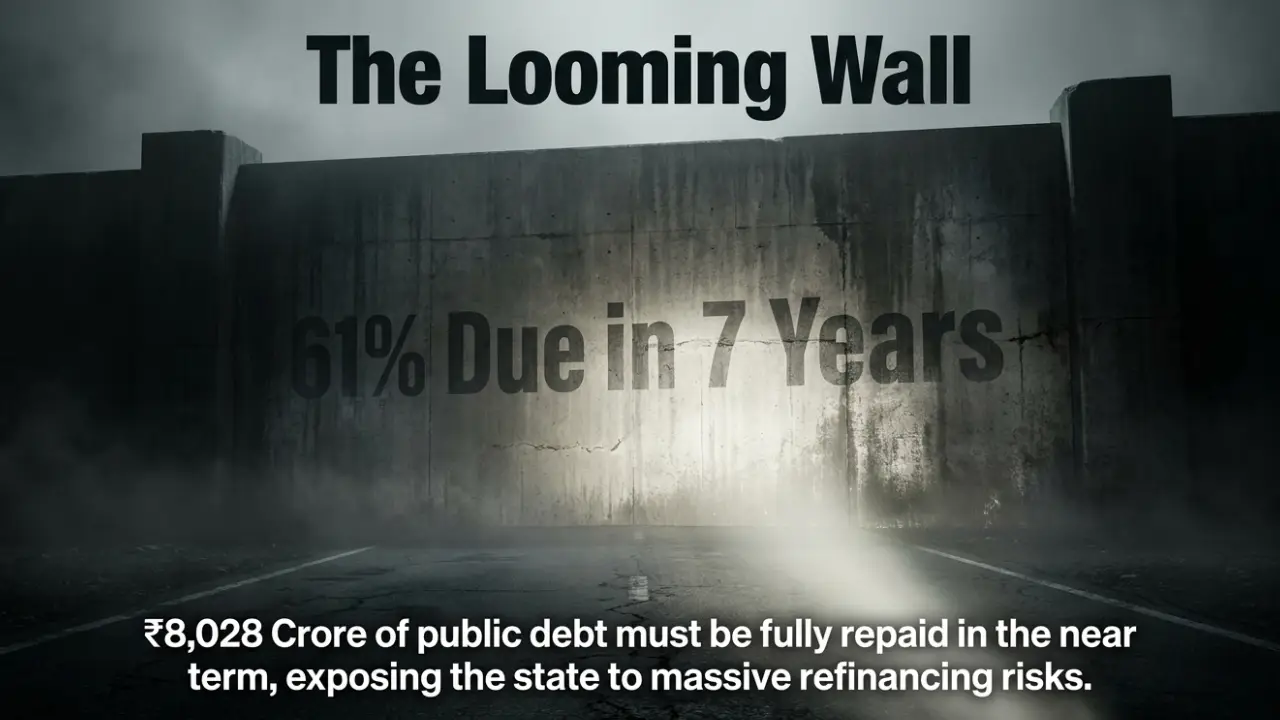
The report also flagged a bunched repayment schedule ahead: 15.25 per cent of public debt, or Rs 3,070.57 crore, comes due within one to three years, and 61 per cent, or Rs 8,028.34 crore, must be repaid within seven years. The audit said this concentration exposes the state to higher rollover and refinancing risk if borrowing costs rise.
On debt sustainability, the audit noted the Domar criterion remained positive, with the real GSDP growth rate of 10.43 per cent exceeding the real effective interest rate of -0.11 per cent, producing a growth-interest differential of 10.53 per cent. The Debt Stabilisation Indicator, which combines quantum spread and primary balance, came to a positive Rs 492.53 crore. The CAG cautioned, however, that persistent negative primary balances in preceding years and the state's high overall debt stock continue to pose underlying fiscal risks.
On cash management, the state avoided drawing on financial accommodation from the Reserve Bank of India for 243 days during the year but still needed ordinary Ways and Means Advances for 73 days, Special Drawing Facility for 18 days and overdraft facilities for 31 days to meet its mandatory minimum cash balance.
Subsidies extended by the state totalled Rs 337.89 crore, most of it power sector support at Rs 335.85 crore, while financial assistance to local bodies and institutions fell 7.73 per cent over the previous year to Rs 1,768.54 crore.
PSU INVESTMENTS YIELD LITTLE RETURN
The audit also examined the state's investments in public sector undertakings and cooperatives, totalling Rs 337.02 crore across 3,158 entities. These investments earned dividends in only two of the last five years, with Rs 12.52 crore received in 2024-25. Over the 2020-2025 period, the report said, the gap between what the state paid to borrow and what it earned on these investments reached Rs 4,361.26 crore.
State guarantees extended to public sector bodies and housing corporations rose to Rs 1,557.02 crore, remaining within the ceiling set under the Manipur Guarantee Act, 2004. However, the report noted the state failed to collect Rs 0.98 crore in mandatory guarantee commission during the year.
AUDIT RECOMMENDATIONS
While acknowledging some positive trends — including incremental growth in own-tax collection, adherence to statutory guarantee ceilings, and the avoidance of a revenue deficit — the CAG recommended a set of structural reforms. These included discontinuing the use of borrowed funds for current consumption and past debt servicing, and redirecting borrowings toward capital projects capable of generating future income.
The audit also called on the state to broaden its own revenue base beyond State GST, update outdated user charges and municipal land valuations, and establish a clearer dividend policy for state undertakings. It further recommended containing the growth of salary and pension spending, improving revenue forecasting to narrow the gap between budget estimates and actual outcomes, and ensuring prompt collection of guarantee commissions and returns from public sector investments.