A CAG audit of Manipur's General Sector for 2023-24 finds Rs 2,082 crore unspent, with the Planning Department surrendering 76% of its budget, prompting fiscal reform recommendations from the auditor general to the state government.
Imphal, Sept. 13: A CAG audit of Manipur's General Sector for 2023-24 has found that 16 key administrative departments left more than Rs 2,082 crore of their sanctioned budget unspent, with the state's Planning Department accounting for the sharpest failure among them.
According to Chapter I of CAG Report No. 2 of 2026, covering the financial year ended March 31, 2024, the Manipur legislature had approved a combined budget of Rs 8,420.23 crore for the General Sector. Departments under this sector spent only Rs 6,337.50 crore, leaving savings of Rs 2,082.73 crore, which is nearly a quarter of the total allocation.
The General Sector covers the administrative functions that underpin all government activity in the state, including policy formulation, financial management, law enforcement, judicial administration and district administration. Weak spending in this sector, the report noted, has knock-on effects for how efficiently social and economic programmes are planned and rolled out elsewhere.
Of the 16 departments reviewed, the Planning Department recorded the steepest shortfall. It spent just Rs 352.40 crore out of a sanctioned Rs 1,481.94 crore, utilising only 23.78 percent of its budget and surrendering Rs 1,129.54 crore, which is over 76 percent of what it had been allocated.
The audit described this as a critical concern given the department's role as the state's main policy and planning body responsible for allocating capital resources across sectors. Five-year data included in the report shows the department's expenditure had been rising steadily, from Rs 63.14 crore in 2019-20 to Rs 535.45 crore in 2022-23, before falling sharply to Rs 352.40 crore in 2023-24 despite a much larger budget sanction that year.
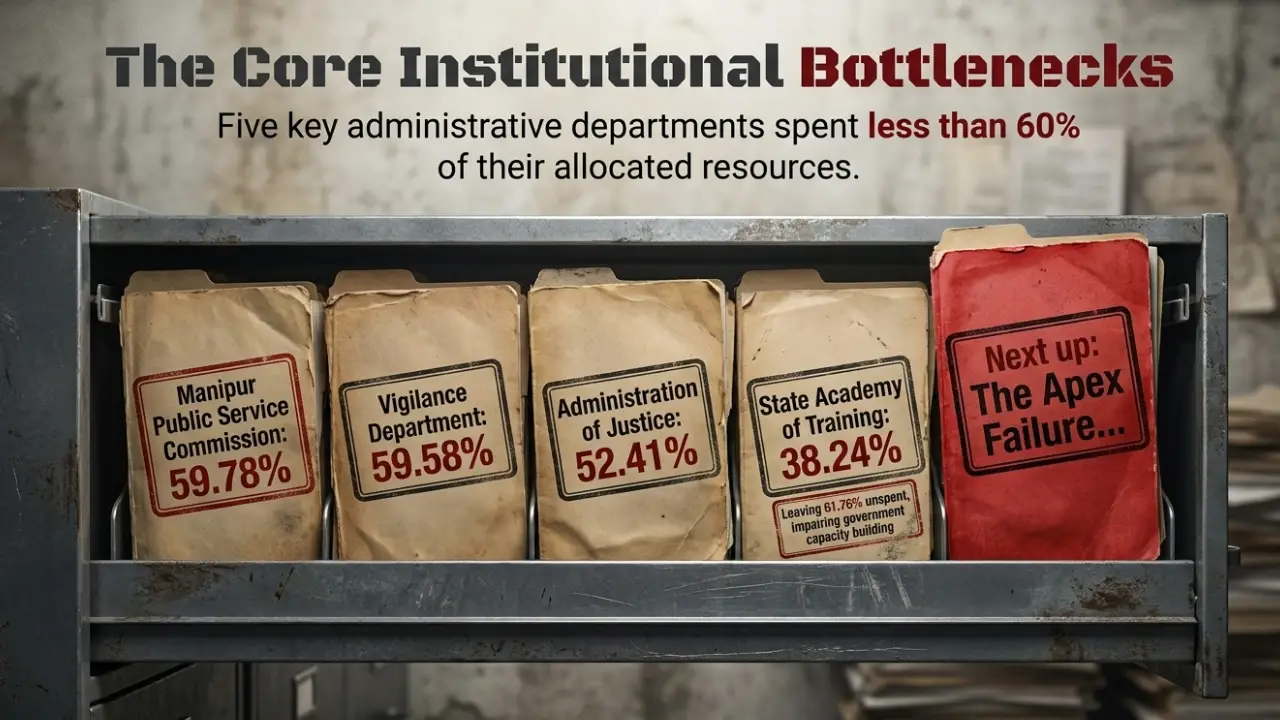
Four other departments also fell below the 60 percent utilisation mark that the CAG treats as a threshold for concern. The State Academy of Training spent only 38.24 percent of its funds. Administration of Justice used 52.41 percent, Vigilance 59.58 percent, and the Manipur Public Service Commission 59.78 percent.
The report said the State Academy of Training's inability to use nearly 62 percent of its allocation has a direct bearing on administrative training and capacity-building programmes for government staff.
At the other end of the scale, three departments cleared 90 percent utilisation. The Election Department recorded the highest rate in the sector at 96.64 percent, spending Rs 89.17 crore of its Rs 92.27 crore allocation. Home Guards followed at 93.35 percent, and the Finance Department at 93.32 percent, having spent Rs 2,506.95 crore of a Rs 2,686.39 crore outlay.
Eight departments fell into a middle band, utilising between 60 and 85 percent of their funds. These included Rehabilitation at 85.97 percent, Police at 85.10 percent, Jails at 77.58 percent, the Governor's Secretariat at 73.98 percent, Fire Protection and Control at 73.65 percent, Land Revenue, Stamps and Registration at 71.28 percent, Stationery and Printing at 61.96 percent, and the Secretariat at 61.09 percent.
The Police Department's spending has grown considerably over five years, from Rs 1,577.20 crore in 2019-20 to Rs 2,902.98 crore in 2023-24, though this still left the department short of its Rs 3,411.20 crore sanction that year.
Overall, total General Sector expenditure across the five years reviewed rose from Rs 3,740.79 crore in 2019-20 to Rs 6,337.51 crore in 2023-24, even as the 2023-24 shortfall remained large in absolute terms.
The CAG report flagged several risks stemming from the pattern of low fund utilisation. It noted that departments holding large unspent balances through most of the year tend to face pressure for hurried, unplanned spending, or are forced to surrender funds, as the financial year closes in February and March. The report said this pattern reduces the quality of expenditure and increases the risk of funds being used without adequate planning.
The audit also linked chronic underspending to missed physical targets, stating that persistent low utilisation delays public service delivery across the departments it examined.
The CAG said its review followed an Annual Audit Plan, with audit units selected based on risk factors such as financial size, social relevance, the strength of internal controls, past audit findings, and any prior reports of financial irregularities.
Out of 117 auditable units in the General Sector, 44 were originally planned for audit. Sixteen units were eventually test-checked, including two apex bodies that had incurred no expenditure during the year. The audit covered Rs 1,144.54 crore in expenditure, including amounts relating to earlier financial years, and resulted in eight inspection reports containing 39 audit paragraphs submitted to the state government and department heads as of March 2024.
The CAG said observations are settled where departmental responses are found satisfactory, while unresolved issues involving significant financial or procedural lapses are carried forward into the audit report placed before the state legislature, as required under constitutional provisions.
The CAG made five recommendations to the Manipur government to address the underutilisation pattern.
It called for the five departments with utilisation below 60 percent — Planning, State Academy of Training, Administration of Justice, Vigilance and the Manipur Public Service Commission — to submit formal, time-bound action plans to improve fund absorption.
It specifically urged the Planning Department to overhaul how it formulates, implements and monitors projects to ensure development funds are deployed on schedule.
The report also recommended that the state institute mandatory mid-year expenditure reviews to catch implementation bottlenecks before they cause end-of-year rushes, and that the Finance Department set up a formal mechanism to reallocate unspent funds mid-year from slow-spending departments to those performing better. Finally, it recommended that the Finance Department introduce standardised performance indicators to track spending efficiency across departments on an ongoing basis.
The report did not specify what corrective measures, if any, the state government has taken so far in response to these findings.