The Supreme Court sought a detailed report on deaths in Manipur relief camps and reviewed the progress of 3,020 violence cases, CBI probes and delayed trials.
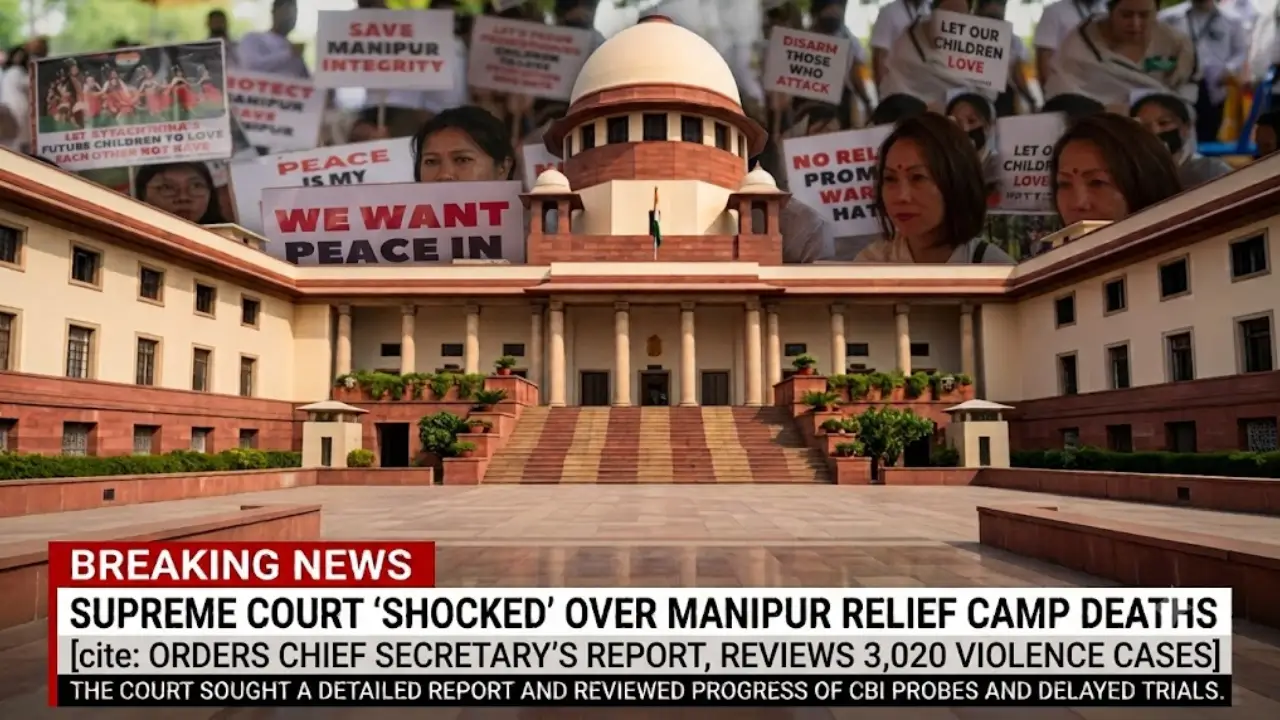
Imphal, Sept. 17: The Supreme Court on Thursday directed the Chief Secretary of Manipur to file a detailed affidavit on deaths reported in relief camps for internally displaced persons, including cases described as unnatural, while reviewing the progress of thousands of criminal investigations arising from the violence that began in 2023.
A three-judge bench headed by Chief Justice of India Surya Kant and comprising Justices Joymalya Bagchi and V. Mohana examined the latest reports on investigations, trials, relief and rehabilitation during the hearing of a batch of petitions relating to the Manipur violence.
The court's directions covered two broad concerns, the progress of criminal investigations and trials, and the circumstances surrounding deaths in relief camps where thousands of people displaced by the conflict continue to live.
The bench also sought an explanation from the state over the limited number of post-mortems conducted in reported unnatural deaths and questioned the payment of relatively small amounts of compensation to some families.
Court seeks details of deaths in relief camps
The most significant intervention during Thursday's hearing concerned deaths among internally displaced people living in relief camps.
The Chief Justice directed the Chief Secretary to submit details of all 25 unnatural deaths reported in the media, together with post-mortem reports identifying the causes of death and information on preventive measures taken by the state.
The court also sought details on the measures adopted inside relief camps to protect displaced people.
The direction followed the court's examination of reports submitted in the proceedings, including material from the three-member committee headed by former Jammu and Kashmir High Court Chief Justice Gita Mittal, which has been monitoring aspects of relief and rehabilitation.
The court was told that hundreds of people had died in relief camps. The material placed before the bench referred to 640 deaths across camps in eight districts, while an IAS officer's report cited in the hearing referred to 608 deaths. The court also examined information concerning 34 deaths identified as unnatural, with post-mortems conducted in only 20 cases.
The difference between the figures reflects separate reports placed before the court and underlines why the bench has now sought a consolidated account from the Chief Secretary.
The court specifically asked why post-mortems had not been conducted in all cases of unnatural death and why compensation of only around Rs 20,000 to Rs 30,000 had reportedly been paid to some families.
The bench directed the state to explain the circumstances of the deaths, the investigations undertaken and the reasons for the compensation amounts.
The court was also informed of an allegation involving a death following sexual assault. The matter was considered as part of the broader concerns regarding the safety and dignity of displaced people in relief camps.
Legal Services Authority asked to act on unnatural deaths
The Supreme Court directed the Manipur State Legal Services Authority to take up the issue immediately.
The authority was asked to ensure that FIRs are registered in cases involving unnatural deaths, that the causes of death are properly established and that investigations into cases already registered are conducted expeditiously.
It was also directed to monitor the safety and dignity of internally displaced persons in the relief camps.
The court further directed the state to ensure adequate medical facilities and day-to-day necessities for camp residents.
The directions place responsibility not only on the police and administration to investigate deaths, but also on the legal services mechanism to monitor whether cases involving potentially criminal circumstances are formally registered and pursued.
42 SITs handling 3,020 cases
The bench separately reviewed the investigation of cases arising from the wider violence.
Additional Solicitor General Aishwarya Bhati informed the court that 42 Special Investigation Teams of the Manipur Police had been constituted across eight districts in accordance with the Supreme Court's earlier directions.
These SITs are investigating a total of 3,020 cases.
According to the status placed before the bench:
The latest reports based on the status placed before the court put the number of cases in which trials had commenced at 33. The hearing transcript supplied for this report contains references to 38 cases, indicating a discrepancy in the figures presented or reported during the proceedings.
The 42 SITs were originally created as part of the investigation framework ordered by the Supreme Court in August 2023. The court had directed that the state investigations be independently monitored by former Maharashtra Director General of Police Dattatray Padsalgikar.
CBI has filed reports in 28 cases
The court also reviewed the progress of cases being investigated by the Central Bureau of Investigation.
The CBI is handling 31 cases, according to the status presented to the bench. Of these, final reports have been filed in 28 cases, while three cases remain under investigation.
The status report further said that six closure reports had been filed by the CBI and that four of those had been accepted.
The proceedings also revealed the scale of the pending evidence. A total of 978 witnesses have been cited in the CBI cases, but only six had been examined so far. Thirty-eight accused persons have been arrested in connection with these matters.
The small number of witnesses examined compared with those cited emerged as an important issue in the discussion on the pace of trials.
Guwahati court's workload comes under scrutiny
Several CBI cases arising from Manipur have been transferred to a Special Court in Guwahati.
Advocate Nizamuddin Pasha, appearing in matters before the bench, told the court that the Special CBI Court was also handling other cases, including Prevention of Corruption Act matters.
He said this had restricted the time available for the Manipur cases. According to the submission, cross-examination was taking place, but the court could accommodate the cases only about two days a week because of its existing roster.
Pasha also pointed to logistical difficulties involving witnesses appearing remotely from Churachandpur. On days when witnesses appear remotely, arrangements have to be made to provide privacy and security, which further limits the number of days on which such proceedings can be conducted.
The Chief Justice said the court had already conveyed its concern to the jurisdictional High Court and indicated that the matter should be allowed some time to improve.
The bench observed that even if a case is taken up twice a week, regular hearings could still contribute to a faster trial.
Supreme Court explores additional courts
The availability of judicial capacity became another focus of the hearing.
The Chief Justice noted that there was only one NIA court in Assam and that there was already a requirement for two additional courts.
The bench directed that the possibility of having two courts dealing with the CBI cases should also be explored.
The court also indicated that once additional NIA courts are created and the pressure on the existing judicial infrastructure eases, the Special CBI Court could focus more exclusively on the Manipur cases.
The court expressed confidence that the High Courts would respond to the requirements and that competent judicial officers would continue to take up the matters regularly.
The issue is significant because transferring trials outside Manipur was part of the Supreme Court's earlier response to concerns about the ability to conduct sensitive cases arising from the ethnic conflict within the state.
Dattatray Padsalgikar submits 16th status report
The bench also considered the 16th status report submitted by Dattatray Padsalgikar, the former Maharashtra DGP appointed by the Supreme Court to supervise the investigation of the Manipur cases.
The report, dated September 8, 2026, covers the period from August 1 to September 7.
The report described both continuing concerns and signs of improvement in the state.
According to the material discussed in court, a campaign demanding an NRC before the Census in Manipur led to a two-day shutdown followed by a two-day general strike. The state subsequently decided to suspend the Census process until the NRC issue was addressed, according to the report placed before the bench.
The report also noted that the Manipur Assembly had reopened and that the state government's peace initiative had received a positive response.
Road transport services for passengers on important routes, including the Imphal-Guwahati route, had also resumed successfully, according to the status report.
At the same time, the report recorded that attacks had continued in some areas, resulting in the deaths of three people during the reporting period.
Nearly 9,000 weapons recovered
The status report also gave an update on the recovery of weapons during the conflict.
According to the figures placed before the Supreme Court, security agencies had recovered:
8,901 arms, 1,06,699 rounds of ammunition and 6,390 explosives.
The recovery of weapons has remained an important component of the Supreme Court's monitoring of the Manipur situation. In its August 2023 judgment, the court had directed the authorities to take stock of weapons looted from state armouries and formulate a plan for recovering them.
The latest figures therefore represent the continuing recovery effort more than three years after the outbreak of violence.
Court continues long-running supervision
Thursday's hearing forms part of the Supreme Court's continuing judicial supervision of the Manipur violence.
In August 2023, the court had established a framework for independent monitoring of investigations, including the appointment of Padsalgikar to supervise CBI and state investigations. It also constituted a three-member committee of former High Court judges headed by Justice Gita Mittal to address issues involving relief, rehabilitation and the protection of victims, particularly women affected by sexual violence.
The court had also ordered the creation of 42 SITs for focused investigation of cases in Manipur. The teams were intended to investigate serious offences, including murder and sexual violence, under external monitoring.
The latest hearing shows that the judicial process is now dealing with two separate but connected dimensions of the conflict.
One concerns the criminal justice process, where thousands of cases remain at different stages of investigation, chargesheeting and trial.
The other concerns the continuing condition of displaced people, including deaths in relief camps, medical care, compensation and the investigation of deaths that may have occurred under unnatural circumstances.
Relief camp deaths add a new layer to the court's scrutiny
The court's focus on deaths inside relief camps is significant because the camps were established as emergency shelters for people displaced by the violence but have continued to house thousands of people more than three years after the conflict began.
A state report cited on September 17 said 28,899 internally displaced people were still living in relief camps and temporary locations as of September 3, including 24,530 in relief camps and 4,369 at temporary locations. It said 105 relief camps remained operational.
The same report said 31,823 displaced people had returned to their homes and that 7,034 houses had been constructed, while 4,159 houses had been repaired.
Against this backdrop, the Supreme Court's demand for a detailed accounting of deaths in the camps places greater emphasis on the state's responsibility to ensure that people who remain displaced receive not only shelter but also medical care, security and access to justice.
What the court has now directed
The principal directions emerging from Thursday's proceedings include:
A justice process still dealing with the scale of the conflict
The figures presented to the Supreme Court underline the scale of the legal challenge left by the Manipur violence.
The state SITs are dealing with more than 3,000 cases, while the CBI is handling a separate set of cases involving hundreds of witnesses. At the same time, the court is now examining whether deaths among displaced people were adequately investigated and whether families received appropriate assistance.
The hearing therefore shifted attention beyond the original question of investigating violence committed during the conflict to the conditions in which survivors and displaced people have continued to live.
For the Supreme Court, the next stage will depend on the explanations and reports to be submitted by the Manipur government and the Legal Services Authority. Those reports are expected to clarify the circumstances of the deaths in relief camps, the extent of criminal investigation into them and the measures being taken to protect people who remain displaced.
The court has also indicated that it will continue monitoring the progress of the criminal cases, while seeking ways to ensure that the judicial infrastructure handling the CBI and NIA matters does not itself become a source of delay.