At a New Delhi memorial, a Kuki musician remembered his Meetei friend of nearly four decades — not through the identities that divide Manipur, but through the music and memories they shared.
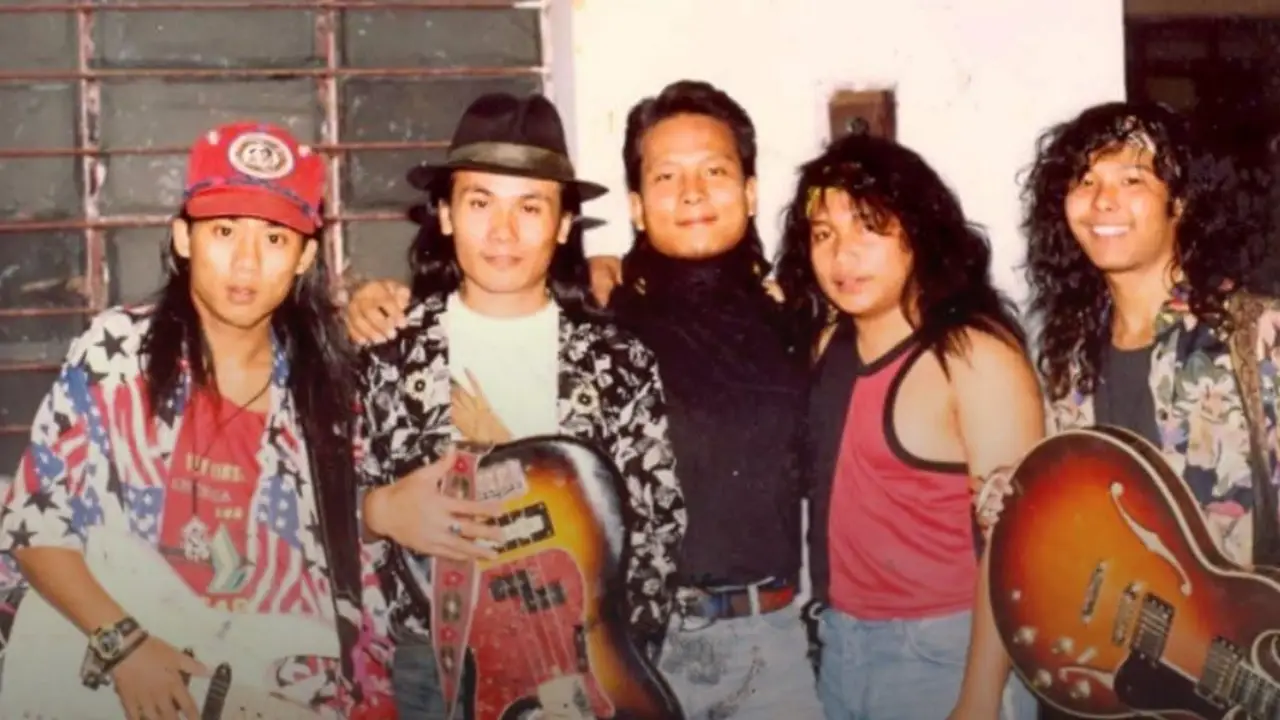
Photo: Manipur Pop Culture
On Thursday, September 10, 2026, inside the Dr. B.R. Ambedkar International Centre on Janpath, grief brought together people who had come to remember a man whose life had been closely intertwined with the history of Manipuri rock.
The gathering was a memorial for Chongtham Vikram Singh, the Manipuri rock guitarist and pioneer who was recently killed in Delhi. Among those who spoke was Lien Gangte, a Kuki musician who had been Vikram's friend and bandmate for nearly four decades.
In another time, that detail might have passed without particular notice. In today's Manipur, it is difficult to miss. Lien is Kuki. Vikram was Meetei. Their friendship had endured for almost 40 years. As Lien spoke about his friend's death, he did something that has grown increasingly rare since the ethnic conflict erupted in Manipur in May 2023: he spoke about a Meetei not as a member of another community, but simply as a friend.
A friendship from another Manipur
For nearly three and a half years, Manipur has been consumed by a conflict in which identity has become almost impossible to escape. People are often encountered first through the communities to which they belong – Meetei or Kuki – words that now carry histories, grievances and competing narratives, and have become political and territorial markers, and increasingly, ways of understanding danger itself.
Lien's memories of Vikram belong to a different vocabulary. He recalled a man he had known for nearly 40 years, a musician, a bandmate, a friend. He said Vikram was a good person and that in all their years together, he never heard him speak harshly of anyone. It is a small memory, not a grand or political one. It is simply a friend remembering the character of another human being, and perhaps that is precisely why it resonates.
"Our land is in disarray"
Lien's tribute also revealed how difficult it has become to speak about Manipur at all. While mourning Vikram, he touched briefly on the state of the land they came from, then hesitated, saying people might not welcome whatever he said. It was a small moment but a revealing one. In a deeply polarized society, even grief can turn political, sympathy read as allegiance, statements about one community's suffering read as attacks on another. So Lien stopped himself. He did not turn the memorial into a political speech. Instead, he returned to the person he had come to remember: Vikram, the musician with whom he had shared decades of his life.
And then there was the song
The most affecting part of Lien's tribute came at the end, when he said he wanted to play a song he and Vikram used to perform together, in his friend's memory. It is hard to imagine a more intimate gesture between musicians. After nearly 40 years of friendship, what Lien chose to leave the audience with was not an argument about history, but music, a song they had once played together, presumably one of the very things that had brought the two men together in the first place. Before the political identities that now dominate public life, there was sound, rhythm, rehearsals and shared performances, the simple act of two people creating something together. Decades later, one of them stood before an audience and played again. This time, his friend was gone.
Why does tragedy make humanity visible?
There is an uncomfortable question at the heart of this tribute: why does it sometimes take tragedy to bring out the humanity in people? Perhaps tragedy does not create humanity so much as make it visible. That humanity was already there, in the friendship, the music and the decades of knowing one another. What changed was the world around them.
The conflict that began in May 2023 did not erase every relationship between Meetei and Kuki people, but it transformed the environment in which such relationships exist. Fear makes strangers of people who once knew one another; conflict turns individuals into representatives of their communities. A person once known by name can become merely "a Meetei" or "a Kuki", and individuality begins to disappear. Lien's tribute reverses that process. He gives Vikram his individuality back, his kindness, the years they shared, and finally, the music.
Not a story about two communities
It would be easy to describe this simply as a Kuki man paying tribute to a Meetei friend. That description is factually true but misses the deeper point, since it still puts ethnicity at the centre. The more profound story is that two people remained friends across a boundary that has since become one of Manipur's most painful fault lines. Their identities were real, but so was their friendship, a reminder that identity need not consume an entire human being. Lien did not stop being Kuki because he loved his Meetei friend, nor did Vikram stop being Meetei because he had a Kuki friend. They were simply two musicians who shared part of their lives. That is not a political solution to Manipur's crisis, but it is a reminder of what any solution must ultimately protect: the ability of individuals to see one another as individuals.
The relationships that history rarely records
Conflicts produce archives, government records, court proceedings, political speeches, casualty figures, photographs and testimonies. Ordinary friendship rarely leaves such records. No one typically documents the neighbour who helped another neighbour, or archives the musicians who formed a band across community lines, or writes down the countless ordinary conversations that once crossed boundaries that now seem so formidable. Yet these relationships are part of history too. They speak to what Manipur was before the violence, and perhaps to what remains possible afterward. The friendship between Lien and Vikram is one such fragment. Nearly 40 years is not a small span of time; it means the two men built an enormous private history together, much of it unrelated to ethnicity. That history cannot undo what has happened since May 2023, but neither can the events of the past three years make it meaningless.
Remembering the divisions, and what came before them
There is no virtue in romanticizing the past. Manipur had social and political tensions long before May 2023, and the current conflict has deep roots; the suffering of those affected cannot be reduced to a sentimental story about friendship. Nor should one act of kindness be read as proof that reconciliation is easy. It is not the wounds are too deep, the distrust too entrenched, the losses too immense. But remembering friendship is not the same as forgetting conflict. It may, in fact, be necessary precisely because the conflict is remembered so intensely. Manipur needs to remember not only when its communities became divided, but also the many ways people once crossed those divisions, through friendships, music, workplaces, classrooms, neighbourhoods and ordinary shared life. Those memories offer a different kind of evidence: that the present condition is not the only way people can relate to one another.
A song for Vikram
There is something almost unbearably heartbreaking in the final image: at a memorial in New Delhi, a Kuki musician stands before an audience to remember a Meetei friend of nearly 40 years. He speaks of the man's character. He mourns the violence that took him. He struggles to find words for the state of the land they came from. Then, rather than say more, he turns to music and plays the song they once played together. For a few minutes, perhaps, there is no Kuki and no Meetei, only a musician remembering another musician, a friend remembering a friend, and a song carrying a piece of a friendship that violence could not destroy.
That may be the quiet power of Lien Gangte's tribute. It does not erase Manipur's fault lines or resolve its conflict. But amid a landscape where identity has become so painfully dominant, it recalls something that existed before those identities hardened into walls: people knew one another, trusted one another, made music together and became friends, and sometimes, even after the world around them changes, that memory remains.
Lien did not offer a political solution on September 10. He offered something quieter. He remembered his friend. And then he played their song.