A CAG audit finds Manipur left Rs 8,307 crore of its welfare budget unspent in 2023-24, denying rural workers guaranteed employment and cutting nutrition support to over 3.7 lakh children and mothers.
Imphal, Sept. 14: Thousands of Manipur's rural workers went without the state's guaranteed 100 days of employment last year, and hundreds of thousands of children and mothers missed out on supplementary nutrition, as departments meant to deliver welfare services left more than Rs 8,307 crore of their budgets unspent in 2023-24, according to a report by the Comptroller and Auditor General of India.
The shortfalls, detailed in Chapter II (Social Sector) of CAG Report No. 2 of 2026 for the year ended March 31, 2024, span rural employment, child development, minority welfare and disaster relief — areas where delays and non-spending translated directly into services not reaching the people they were meant for. The audit covered 54 of 263 auditable units in the sector, including seven apex bodies, examining cumulative expenditure of Rs 7,453.20 crore and producing 36 Inspection Reports with 197 audit paragraphs submitted to the state government.
Workers denied guaranteed employment
The clearest impact showed up under the Mahatma Gandhi National Rural Employment Guarantee Scheme, where a performance audit covering 2019-20 to 2023-24 found that rural job card holders received an average of just 42 days of work a year, less than half the 100 days guaranteed by law. Across the state, only 0.02 percent to 0.79 percent of households that asked for work actually got the full 100 days, the report said.
The scheme also generated 1,092 lakh person days of work over the five-year period, against 1,425 lakh approved by the central government — a gap of 333 lakh person days of employment that did not materialise, according to the audit.
Workers who did get jobs often waited to be paid. Statewide, unpaid wages and material dues ranged from Rs 454.01 crore in 2023-24 to Rs 1,020.37 crore in 2021-22. In three sampled districts — Bishnupur, Imphal East and Imphal West — unpaid wages stood at Rs 8.39 crore and unpaid material bills at Rs 49.01 crore as of December 2024, together amounting to Rs 57.40 crore owed to workers and suppliers.
The state also lost money that could have funded more work. Due to delayed utilisation certificates and late submission of paperwork, Manipur received Rs 1,971.39 crore less in central funding than the Rs 5,556 crore it was due between 2019 and 2024. Central releases fell to zero in 2023-24 alone, a shortfall of Rs 1,040 crore for that year. Separately, the State Finance Department's delays in passing on funds — 13 to 248 days for the central share and up to 347 days for the state share — created an avoidable penal interest liability of Rs 146.76 crore, according to the report.
Even funds that were spent did not always reach workers as intended. The audit found Rs 39.23 crore spent in excess on materials rather than wages, in violation of the scheme's 60:40 wage-material ratio — an amount the report said could otherwise have generated 15.77 lakh person days of employment. Oversight meant to catch such problems was largely absent: the State Employment Guarantee Council met only twice in five years against ten required meetings, and 95 percent of surveyed beneficiaries said they were unaware a grievance mechanism existed at all.
Children and mothers went without nutrition support
The impact on early childhood welfare was similarly direct. A performance audit of the Integrated Child Development Services scheme, covering 2018-19 to 2023-24, found the department failed to lift 3,000 metric tonnes of allocated rice in the last quarter of 2019-20 alone, denying supplementary nutrition to 3,77,140 people — 3,22,186 children and 54,954 pregnant or lactating mothers, according to the report. Grain allocations for adolescent girls also went unlifted in 2018-19 and 2021-22.
The consequences are reflected in coverage data cited in the report. Under NFHS-5 (2019-21), only 42 percent of children in Manipur received even one service from an Anganwadi Centre, well below the all-India average of 67.5 percent and the North-East's average of 58.26 percent. Food supplement coverage stood at 40.9 percent against a national average of 62.10 percent.
Infrastructure meant to support these services remained incomplete: 936 Anganwadi Centre buildings were still unfinished as of March 2024, despite Rs 22.30 crore already spent on them. Of 100 centres physically inspected, more than half lacked working weighing scales or growth monitoring devices, and many had no drinking water or toilet facilities, the audit found. The committee meant to oversee the entire scheme — required to meet monthly — did not hold a single meeting in six years, according to the report.
Broader budget picture
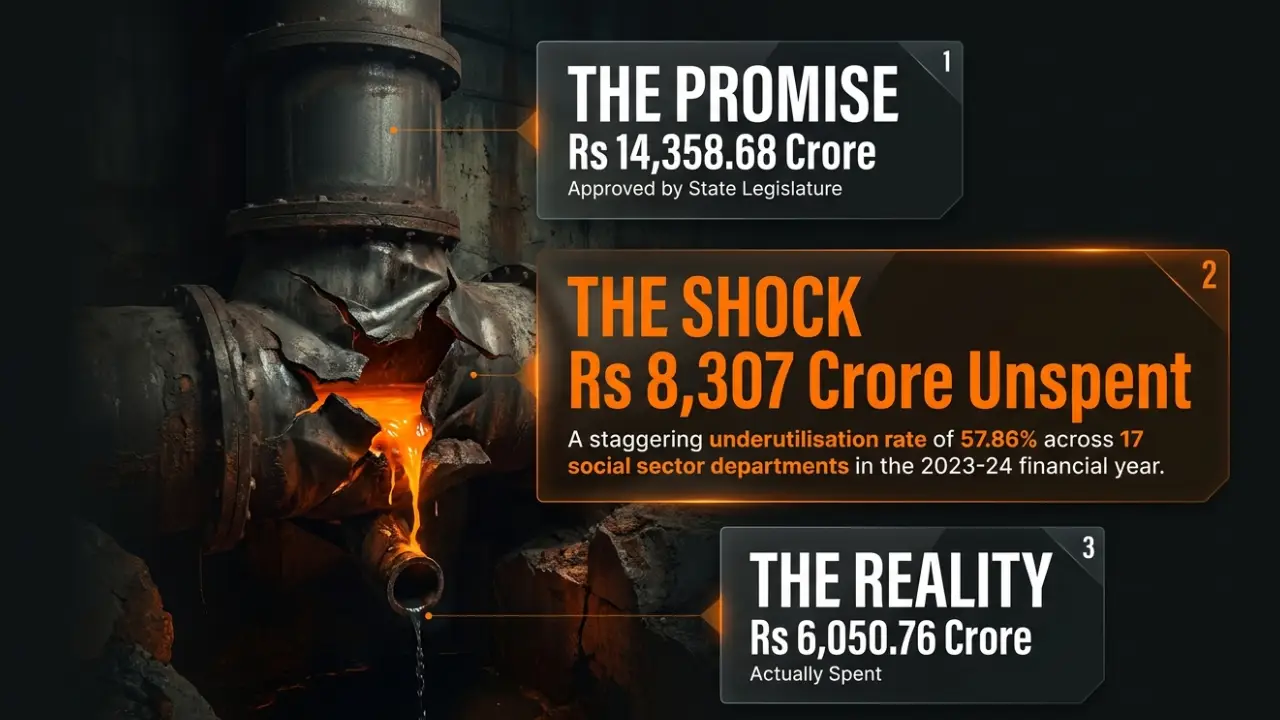
These service failures sit within a wider pattern of unspent funds. Against a legislature-approved budget of Rs 14,358.68 crore across 17 Social Sector departments, actual spending reached only Rs 6,050.76 crore — leaving 57.86 percent of the sanctioned budget unused. Eight departments spent less than half their allocations. Relief & Disaster Management spent just 4.85 percent, the lowest in the sector, while the Panchayat Department spent 8.72 percent and Minorities & OBC Development spent 11.99 percent. Community & Rural Development, which received the sector's largest allocation at Rs 4,754.58 crore, spent only Rs 1,205.17 crore, leaving Rs 3,549.41 crore unused — funds that, under a different execution record, could have supported the same rural programmes found lagging elsewhere in the report.
Only three departments crossed 70 percent utilisation: Information & Publicity (90.63 percent), Tribal Affairs & Hill & SC Development (75.06 percent), and Education (70.21 percent, or Rs 2,331.06 crore spent).
Contractors overpaid on minority welfare projects
A compliance audit of the Manipur Minorities and OBC Economic Development Society found that public money meant for 13 infrastructure projects under the Pradhan Mantri Jan Vikas Karyakaram, sanctioned at Rs 73.21 crore, was partly diverted through inflated cost estimates. The society applied a construction rate intended for upper-floor lifting to ground-floor brickwork across 12 projects, inflating contract values by Rs 2.08 crore. As a result, private contractors were overpaid Rs 0.98 crore as of August 2025, according to the report.
CAG's recommendations
The CAG recommended that departments below 60 percent utilisation — including Community & Rural Development, MAHUD, Minorities & OBC, Panchayat, and Relief & Disaster Management — submit formal, time-bound action plans to improve spending. For MGNREGS, it called for timely fund releases, clearance of pending wages and material dues, and adherence to the 60:40 wage-material ratio. For ICDS, it recommended reviving the State Empowered Committee, completing the 936 stalled Anganwadi buildings, and supplying missing equipment and amenities. It also called for recovery of the Rs 0.98 crore in excess MOBEDS payments and for stronger oversight through full-time leadership at the Manipur Social Audit Agency, functional vigilance cells, and grievance redressal systems across welfare schemes.