UPI will introduce 0.4% MDR on select merchant payments above Rs 2,000 from October 15, while consumers and P2P transactions remain free.
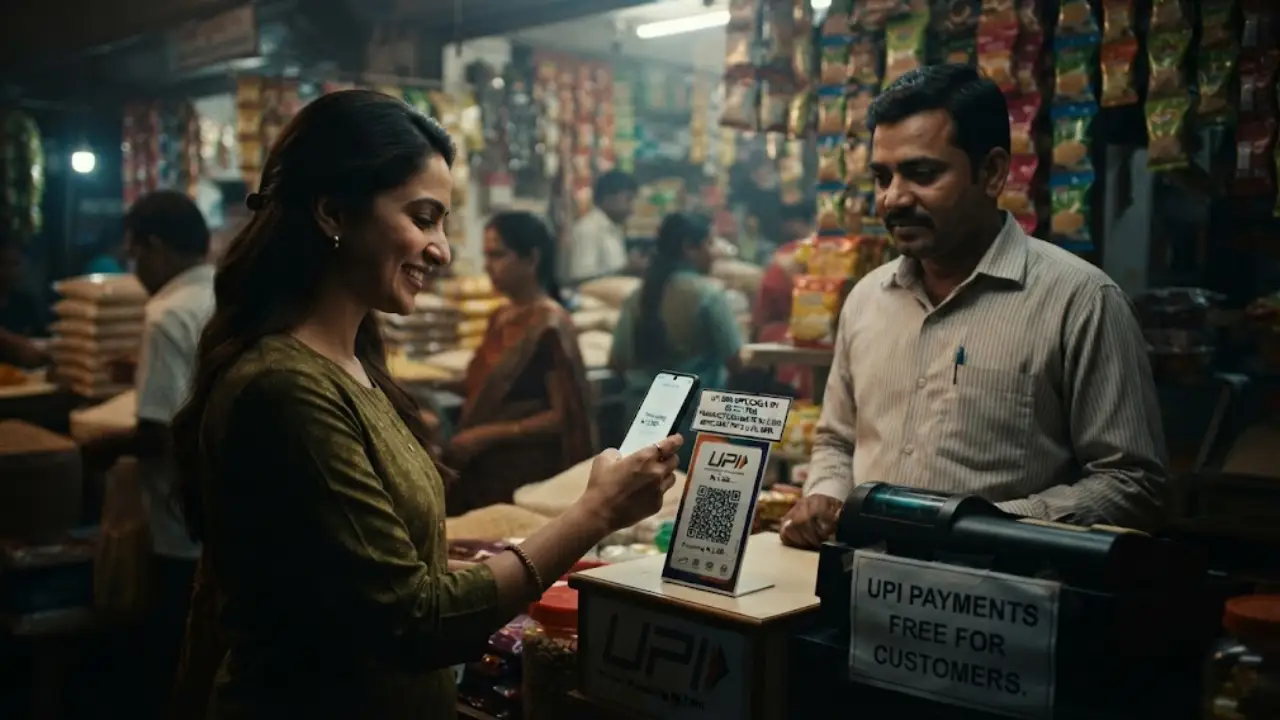
Imphal, Sept. 15: A new Merchant Discount Rate (MDR) framework for Unified Payments Interface (UPI) transactions will introduce a fee on select person-to-merchant (P2M) payments above Rs 2,000, while consumers will continue to make UPI payments without a transaction charge.
Under the framework announced by the National Payments Corporation of India (NPCI), a 0.4% MDR will apply to eligible P2M UPI transactions above Rs 2,000 from October 15, 2026. The charge will be borne by merchants rather than the customer. For transactions of Rs 75,000 or more, the MDR for general merchants will be capped at Rs 300 per transaction.
The move marks a change from the zero-MDR structure that has been a central feature of UPI's rapid expansion in India. At the same time, the new framework does not introduce a general charge on people using UPI to make payments.
The government has separately clarified that consumers will not be charged for making UPI payments. A Finance Ministry notification issued on September 14 prohibits banks and payment system providers from imposing direct or indirect charges on UPI transactions of up to Rs 2,000. The provision also covers payments made through RuPay-powered debit cards.
The government had earlier said that any future MDR would be limited to selected merchant transactions above a specified threshold, while person-to-person (P2P) UPI transfers would remain free.
Under the new arrangement, therefore, a customer paying Rs 2,000 or less through UPI will not face a transaction fee. A customer making a larger payment to an eligible merchant will also not be separately billed for MDR; the applicable cost is charged within the merchant-side payment ecosystem.
P2P transfers, such as sending money from one individual's bank account to another individual's account, remain outside the new merchant MDR framework.
How the new MDR will work
For a general merchant receiving an eligible UPI payment above Rs 2,000, the MDR will be calculated at 0.4% of the transaction value.
For example, an eligible payment of Rs 5,000 would generate an MDR of Rs 20. On a Rs 20,000 transaction, the MDR would be Rs 80.
For transactions at or above Rs 75,000, the MDR is capped at Rs 300 for general merchants. This means the percentage-based charge will not continue rising beyond the prescribed ceiling.
Certain sectors will have a separate structure. Railways, telecommunications, insurance and fuel-related merchant transactions above Rs 2,000 will attract a flat MDR of Rs 5 per transaction, according to reports on the NPCI framework.
The differentiated treatment is intended to limit the payment cost for selected high-volume or essential-service categories.
Why the framework is being introduced
The change comes after years of rapid growth in UPI transactions and continuing debate over how the payment ecosystem should fund its infrastructure.
The government has maintained that UPI needs to remain affordable and widely accessible, while banks, payment service providers and fintech companies incur costs in maintaining payment infrastructure, security systems, fraud controls and transaction-processing networks.
The government said in August that the legislative changes relating to UPI were intended to provide an enabling framework for the long-term sustainability, technological development and resilience of digital payments. It also stressed that consumers would continue to use UPI free of charge.
UPI processed 2,366 crore transactions worth Rs 29.9 lakh crore in July 2026 alone, according to the Finance Ministry. The scale of the network has made the question of how its underlying costs are funded increasingly important.
Reuters reported that UPI recorded about 24 billion transactions worth $311 billion in August, illustrating the scale of India's dependence on the platform for everyday digital payments.
Most everyday users are unlikely to see a direct charge
The new system is structured to keep the customer-facing UPI experience unchanged.
A person buying groceries, paying a restaurant bill or making another merchant payment does not receive a separate MDR bill. The fee is part of the merchant-side payment arrangement.
Similarly, sending money to a friend or family member remains a P2P transaction and is not covered by the new MDR.
The Finance Ministry has also stressed that the government does not intend to impose a blanket MDR across UPI transactions. Earlier official communication said the vast majority of merchant transactions would continue without an MDR, while any future charge would be nominal and restricted to a limited category of transactions above a threshold.
A shift from the zero-MDR era
UPI's expansion was supported in part by a policy of keeping merchant transactions free of MDR. The government had previously used incentive schemes to encourage low-value digital payments, particularly among small merchants.
For the 2024-25 financial year, for instance, the Union Cabinet approved an incentive scheme under which small merchants received a 0.15% incentive for eligible UPI P2M transactions up to Rs 2,000, while MDR remained zero. Transactions above Rs 2,000 also carried zero MDR under that scheme but did not qualify for the incentive.
The new framework represents a different approach: rather than relying entirely on government-supported incentives and subsidies to maintain the ecosystem, selected higher-value merchant transactions will contribute to the cost of operating it.
What changes for merchants
The immediate impact will depend on the type and value of payments a merchant receives.
A small retailer whose UPI payments are predominantly below Rs 2,000 will see little direct impact from the new threshold. Larger merchants and businesses receiving a significant number of high-value P2M payments, however, will face an additional payment-processing cost on eligible transactions.
For merchants, the practical effect will therefore vary according to transaction size, merchant classification and the sectors in which they operate.
The government has also indicated that the MDR applicable to UPI will remain substantially below typical debit or credit card MDRs.
No MDR on person-to-person payments
One of the key distinctions under the framework is between P2P and P2M payments.
A P2P transaction occurs when one individual transfers money to another individual. A P2M transaction occurs when an individual pays a registered merchant for goods or services.
The new MDR applies to the latter category. It does not create a charge for ordinary bank-to-bank transfers between individuals.
This distinction is significant because UPI is used not only for purchases but also for transfers between family members, friends and other individuals.
The broader question of UPI's sustainability
The introduction of MDR on selected high-value merchant transactions comes as policymakers try to balance two objectives: preserving UPI's position as a low-cost payment system and ensuring that the institutions supporting it have a sustainable revenue model.
UPI has become a core part of India's retail payment infrastructure, with merchants ranging from neighbourhood shops to large online businesses using the system.
The new framework keeps the customer-facing service free while shifting a limited portion of the cost to eligible merchant transactions. Whether that balance remains sustainable will depend on transaction volumes, merchant adoption and the ability of banks and payment companies to maintain the infrastructure as UPI usage continues to grow.
For consumers, the immediate message is straightforward: UPI remains free to use. The significant change is on the merchant side, where selected P2M transactions above Rs 2,000 will carry an MDR from October 15.