The World Meteorological Organization (WMO) says El Niño is firmly established and could become very strong by late 2026, raising risks of extreme heat, drought and floods into early 2027.
Geneva, Sept 4: El Niño is firmly established in the tropical Pacific and is expected to strengthen into a very strong event in the coming months, with the World Meteorological Organization (WMO) warning of significant shifts in global rainfall and temperature patterns and increased risks of floods, drought and extreme heat through early 2027.
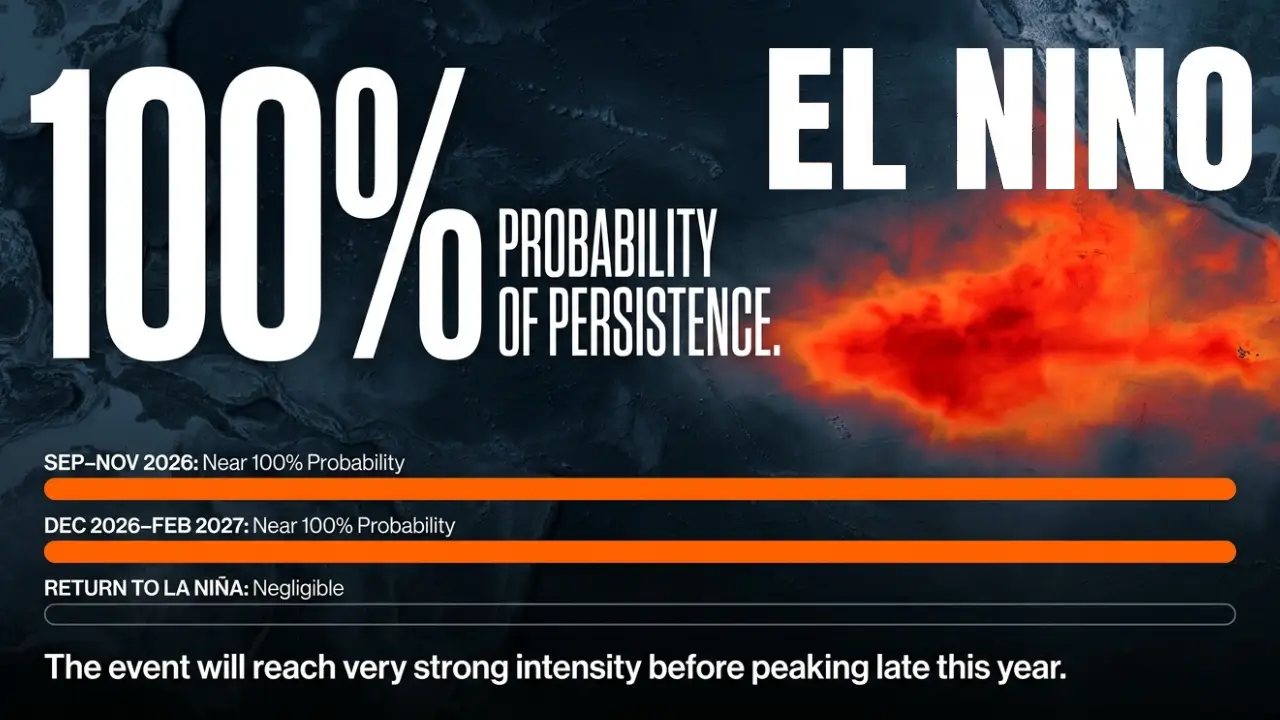
The latest WMO El Niño/La Niña Update for August 2026, released on September 3, places the probability of El Niño persisting through February 2027 at nearly 100 per cent. WMO described this as the first time one of its El Niño/La Niña Updates has expressed such a high degree of confidence, reflecting strong agreement among its global forecasting centres and reinforcing oceanic and atmospheric signals.
WMO forecasts indicate that the event will continue strengthening and could reach very strong intensity before peaking towards the end of 2026. Its effects are expected to continue well into 2027, including through changes in temperature, rainfall and atmospheric circulation.
UN Secretary-General António Guterres described the developing event as being “supersized” and warned that rising sea-surface temperatures and global heat were placing the planet in a danger zone. WMO Secretary-General Celeste Saulo, meanwhile, described the expected event as an exceptional challenge requiring exceptional preparation.
Pacific Ocean warming drives rapid intensification
The principal signal behind the forecast is the exceptional warming of the tropical Pacific.
By mid-August, persistent and intensifying positive sea-surface temperature anomalies had become established across the central and eastern equatorial Pacific. WMO’s latest assessment states that exceptionally warm conditions at the surface are being accompanied by unusually high temperatures beneath the ocean, creating a substantial reservoir of heat capable of supporting further El Niño development.
The WMO update reports that subsurface ocean temperatures in some parts of the tropical Pacific were more than 8°C above normal during July and early August. This deep ocean heat is one of the key indicators supporting the forecast of continued strengthening.
The development follows a rapid progression during 2026. WMO forecasts issued earlier in the year had already pointed towards a strong El Niño. By July, seasonal model forecasts were indicating a much stronger event, with the upward trend continuing into the boreal autumn.
The latest Global Seasonal Climate Update from WMO forecasts the seasonal mean Niño 3.4 sea-surface temperature anomaly at approximately 3.6°C for September-November 2026, with the intensification trajectory expected to peak around November-December. The relatively narrow spread among forecast systems is another indication of high confidence in the projected development.
Near-100 per cent persistence forecast
The strongest element of the latest WMO assessment is not simply the projected intensity, but the level of agreement among forecasting systems.
WMO's Global Producing Centres indicate a nearly 100 per cent likelihood that El Niño will persist through September-November 2026 and December 2026-February 2027. Neither a return to ENSO-neutral conditions nor a transition to La Niña is anticipated during this outlook period.
WMO cautioned, however, that a very strong El Niño does not mean every region will experience equally severe weather. The strength of the Pacific event is an indicator of the climate system's forcing, rather than a direct forecast of the magnitude of impacts in a particular country.
Local effects depend on geography, season and the interaction of El Niño with other climate drivers.
This distinction is important because El Niño produces different effects across the world. Some regions can experience prolonged dryness, while others may see increased rainfall, flooding or changes in tropical cyclone activity.
Indian Ocean adds another climate factor
The Pacific will not be acting in isolation.
WMO's September-November 2026 Global Seasonal Climate Update forecasts the development of a positive Indian Ocean Dipole (IOD), with a seasonal mean value of approximately 0.9°C. At the same time, the equatorial Atlantic is expected to remain generally warm, with sea-surface temperatures in both the North and South Tropical Atlantic above normal.
These additional oceanic conditions could modify the usual regional effects associated with El Niño.
WMO has therefore stressed that seasonal climate risks need to be assessed using multiple climate drivers rather than relying on the El Niño classification alone. The interaction between the Pacific, Indian Ocean and Atlantic conditions could produce regional rainfall and temperature patterns that differ from historical El Niño averages.
Most land areas face increased heat risk
The WMO Global Seasonal Climate Update for September-November 2026 projects an increased likelihood of above-normal temperatures across almost all land areas.
Rainfall patterns are also expected to show a pronounced response to the strong Pacific El Niño. Depending on location, this can translate into increased risks of drought or excessive rainfall.
The implications extend beyond daily weather.
Agriculture can be affected by changes in rainfall timing and growing conditions. Water systems face the possibility of both shortages and excessive runoff. Energy systems may have to deal with changes in hydropower availability alongside increased demand for cooling during heatwaves.
Health authorities may also face increased risks associated with heat stress, flooding and water-borne diseases.
India faces a separate but important seasonal signal
The developing El Niño is particularly relevant to India because ENSO is one of the major climate drivers influencing the South Asian monsoon, although its effects are not uniform and can be modified by other factors.
The India Meteorological Department (IMD) has forecast below-normal rainfall over India as a whole during September 2026, with monthly rainfall expected to be below 91 per cent of the long-period average.
IMD's earlier 2026 monsoon forecast had also projected below-normal rainfall for the country as a whole, while its May update indicated that Northeast India was more likely to receive normal seasonal rainfall.
The current El Niño outlook should therefore not be interpreted as a direct forecast of drought or deficient rainfall for every part of India. Regional weather conditions continue to depend on monsoon circulation, low-pressure systems, the IOD and other atmospheric factors.
For Northeast India in particular, local and extended-range forecasts from IMD remain more useful for assessing immediate rainfall risks than the global El Niño signal alone.
WMO shifts focus towards early action
With the event expected to strengthen, WMO is placing greater emphasis on preparedness rather than simply monitoring the phenomenon.
Saulo said WMO had launched a major mobilisation involving National Meteorological and Hydrological Services, which are responsible for turning climate forecasts into information that can be used by governments and communities.
WMO is working with United Nations and humanitarian partners to support preparedness in climate-sensitive sectors, including agriculture, health, energy, water resources, transport, fisheries and disaster management.
The organisation's approach is based on the principle that advance warning can reduce the human and economic cost of climate extremes. Governments can use seasonal forecasts to adjust agricultural planning, prepare water supplies, strengthen heat-health measures and position emergency resources before hazards occur.
Several countries have already begun developing measures around the expected event. WMO cited preparedness activities in Africa, Latin America and the Caribbean, Asia and the Pacific, including agricultural planning, flood protection, drought preparedness and heat-response measures.
A natural phenomenon in a warmer world
El Niño is part of the naturally occurring El Niño-Southern Oscillation (ENSO) cycle and is not itself caused by human-induced climate change.
The significance of the current event, however, is that it is developing against a background of exceptionally warm global oceans and rising global temperatures.
WMO noted that the previous strong El Niño in 2023-24 contributed to the exceptional global temperatures recorded in 2024, which became the warmest year on record. The organisation warned that the current event could contribute to further global temperature increases and will be closely monitored.
That does not mean the 2026-27 El Niño will automatically produce record temperatures everywhere, nor that every extreme weather event during the period will be caused by El Niño. Rather, the phenomenon is expected to add another major source of natural climate variability to an already warmer climate system.
Strong event does not mean identical impacts
The latest WMO assessment represents a significant increase in confidence about the persistence and strengthening of El Niño, but it does not amount to a prediction that every region will experience catastrophic weather.
WMO's central message is that the risks are sufficiently clear to justify advance preparation.
The organisation expects El Niño to peak towards the end of 2026, while its influence on global climate patterns can continue into 2027. The coming months will therefore be critical for monitoring how the Pacific event interacts with the Indian Ocean, Atlantic Ocean and regional atmospheric circulation.
For governments, weather agencies and climate-sensitive sectors, the emphasis is increasingly shifting from asking whether El Niño will develop to determining how its changing influence will affect individual regions—and what can be done before those impacts arrive.