The Election Commission has directed five states, including Manipur, to complete transfers of election-related officers by November 30, 2026, ahead of the 2027 Assembly polls.
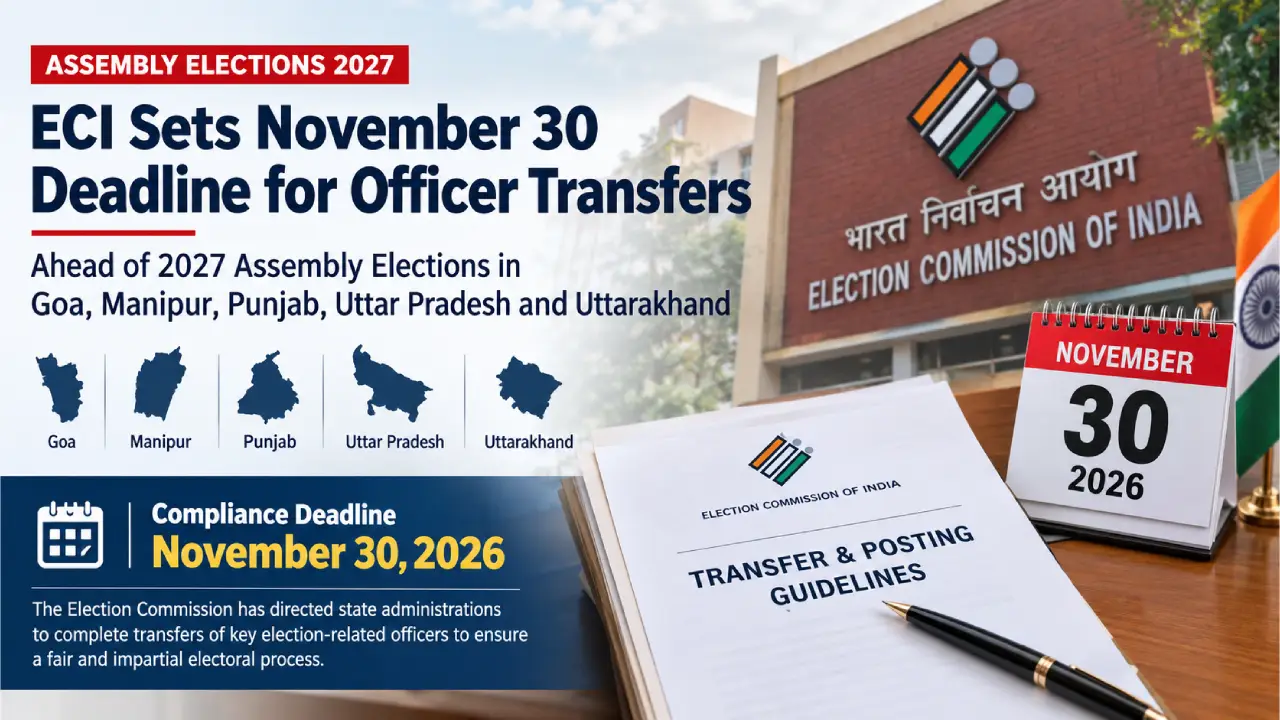
New Delhi, Oct, 27: The Election Commission of India (ECI) has directed the administrations of Manipur, Goa, Punjab, Uttar Pradesh and Uttarakhand to complete the transfer and posting of officers connected with election management ahead of the 2027 Legislative Assembly elections by November 30, 2026.
The directive, issued by ECI Under Secretary Prafull Awasthi to the Chief Secretaries and Chief Electoral Officers of the five states, sets out criteria for transferring officials to prevent prolonged postings in the same district and ensure impartiality in the conduct of elections.
The Commission has instructed the state administrations to submit compliance reports by the deadline. The guidelines cover officers in the civil administration, police, excise, prohibition and transport departments, along with officials holding various election-related responsibilities.
For Manipur, the directive comes ahead of the expiry of the current Legislative Assembly's term on March 13, 2027, and forms part of the administrative preparations for the next Assembly elections.
Assembly Tenures and Transfer Deadlines
The Commission's directive identifies the following expiry dates for the existing Legislative Assemblies:
- Manipur: March 13, 2027
- Goa: March 14, 2027
- Punjab: March 16, 2027
- Uttarakhand: March 28, 2027
- Uttar Pradesh: May 22, 2027
The ECI has fixed March 31, 2027, as the cut-off date for calculating officers' tenure in Goa, Manipur, Punjab and Uttarakhand. For Uttar Pradesh, the cut-off date is May 31, 2027.
Under the guidelines, officers directly connected with election administration cannot remain posted in their home districts. They are also liable for transfer if they have completed three years in a district during the preceding four years, or are due to complete that period by the applicable cut-off date.
The Commission has clarified that promotions to higher positions within the same district will count towards the three-year tenure calculation. However, service at state headquarters during the preceding four years will be excluded from the calculation, even where the headquarters falls within the same revenue district.
The guidelines also restrict the posting of certain election and police officials to constituencies or districts where they served during the previous Assembly election or a subsequent by-election.
District Election Officers (DEOs), Returning Officers (ROs), Assistant Returning Officers (AROs), Police Inspectors, Sub-Inspectors and officers of equivalent or higher rank covered by the directive cannot be posted back to, or allowed to continue in, such constituencies or districts.
Civil Administration and Election Officials Covered
The transfer policy extends to a broad range of officers responsible for electoral administration and district-level governance.
These include District Election Officers, Deputy District Election Officers, Returning Officers, Assistant Returning Officers, Electoral Registration Officers, Assistant Electoral Registration Officers, nodal election officers and executive magistrates.
The categories of executive magistrates covered include Additional District Magistrates, Sub-Divisional Magistrates, Deputy and Joint Collectors, Tehsildars and Block Development Officers.
Divisional Commissioners, Municipal Commissioners and officers deputed to municipal corporations and urban development authorities are also covered by the relevant provisions.
The Commission has emphasised that positions designated for specific cadres must be occupied by officers belonging to those cadres, without exceptions to the requirement.
Police Officers and Enforcement Departments Included
The directive covers police officers responsible for district security arrangements, law and order, and the deployment of personnel during the electoral process.
The listed ranks and positions include Range Additional Directors General of Police, Inspectors General, Additional Inspectors General, Commissioners of Police, Deputy Inspectors General, Additional Commissioners of Police, commandants of State Armed Police, Senior Superintendents of Police, Superintendents of Police and Additional Superintendents of Police.
Sub-Divisional Police Officers, Inspectors and Reserve Inspectors are also covered by the applicable provisions.
For police Sub-Inspectors who have completed three years out of the preceding four years in a police sub-division, the Commission has directed that they be transferred to a sub-division outside the Assembly constituency concerned or moved out of the district.
Police personnel serving in non-field functional units, including computerisation, special branches and training, are exempt from this provision.
The guidelines also extend to officers of the rank of Sub-Inspector and above in the Prohibition and Excise Department. In the Transport Department, the covered positions include Regional Transport Officers, District Transport Officers and Assistant Transport Officers.
Exemptions for Technical Staff and Officers Near Retirement
The Commission has provided exemptions for certain categories of personnel to avoid unnecessary disruption to essential administrative services.
Departmental staff posted at state headquarters and specialised technical or essential-service personnel not directly connected with election administration are exempt from automatic transfers under the general policy. These categories include doctors, engineers, teachers and school principals.
However, the exemption does not prevent action against personnel facing substantiated complaints of political bias. The guidelines provide for prompt transfer and disciplinary action in such cases.
Sector Officers and Zonal Magistrates are also exempt from automatic transfers under the blanket policy. Their conduct, however, is to remain under close scrutiny by election observers, Chief Electoral Officers and District Election Officers to ensure impartiality.
Officers due to retire by March 31, 2027, in Manipur, Goa, Punjab and Uttarakhand, or by May 31, 2027, in Uttar Pradesh, will not be transferred out of their districts.
If such officers fall under the home-district or three-year tenure restrictions, they must be relieved of election-related responsibilities and assigned other administrative duties.
The Commission has also barred officials serving on contract extensions or through re-employment from being assigned election-related duties. The stated exception is for personnel specifically posted in the Office of the Chief Electoral Officer.
Officers Facing Disciplinary or Criminal Proceedings Barred from Poll Duty
The ECI has specified restrictions on assigning election duties to officers whose conduct or service record raises concerns about their suitability for the electoral process.
Officials against whom the Commission has previously recommended disciplinary action, those facing pending disciplinary proceedings or penalties, and those previously held responsible for lapses during election work are barred from poll duty under the guidelines.
The restriction also applies to officials facing pending criminal cases in court connected with the discharge of their official functions.
The provisions are intended to ensure that officers entrusted with election-related responsibilities meet the Commission's requirements for impartiality and administrative accountability.
Transfers During Special Summary Revision
The Commission has clarified the procedure for officers currently engaged in the ongoing Special Summary Revision (SSR) of Photo Electoral Rolls.
For such officials, transfer orders can be implemented only after the final publication of the electoral rolls, in consultation with the respective State Chief Electoral Officer.
Any transfer required before the final publication under exceptional circumstances will need prior approval from the ECI.
The provision is intended to account for the work involved in revising electoral rolls while maintaining the broader transfer requirements for election-bound states.
Written Declarations and Immediate Handover of Charge
The guidelines also require election-related officers to submit a written declaration within two days after the last date for filing nomination papers.
The declaration must confirm that the officer is neither a close relative of a contesting candidate or a leading political functionary in the district or state nor facing any pending criminal case.
The Commission has warned that false declarations will attract disciplinary action.
Chief Secretaries and Directors General of Police in the five states have been instructed to implement the transfer orders without delay. Officers who are transferred must hand over charge immediately rather than wait for their replacements to be appointed.
The administrations must submit comprehensive action-taken reports to the Election Commission by November 30, 2026.
The deadline places the immediate responsibility on the five state governments to complete the prescribed administrative changes before the final phase of preparations for the 2027 Assembly elections.