ED arrests six and freezes 1,424 bank accounts in a Manipur-Mizoram narco-hawala probe, tracing alleged drug-money transfers worth crores and cross-border links to Myanmar.
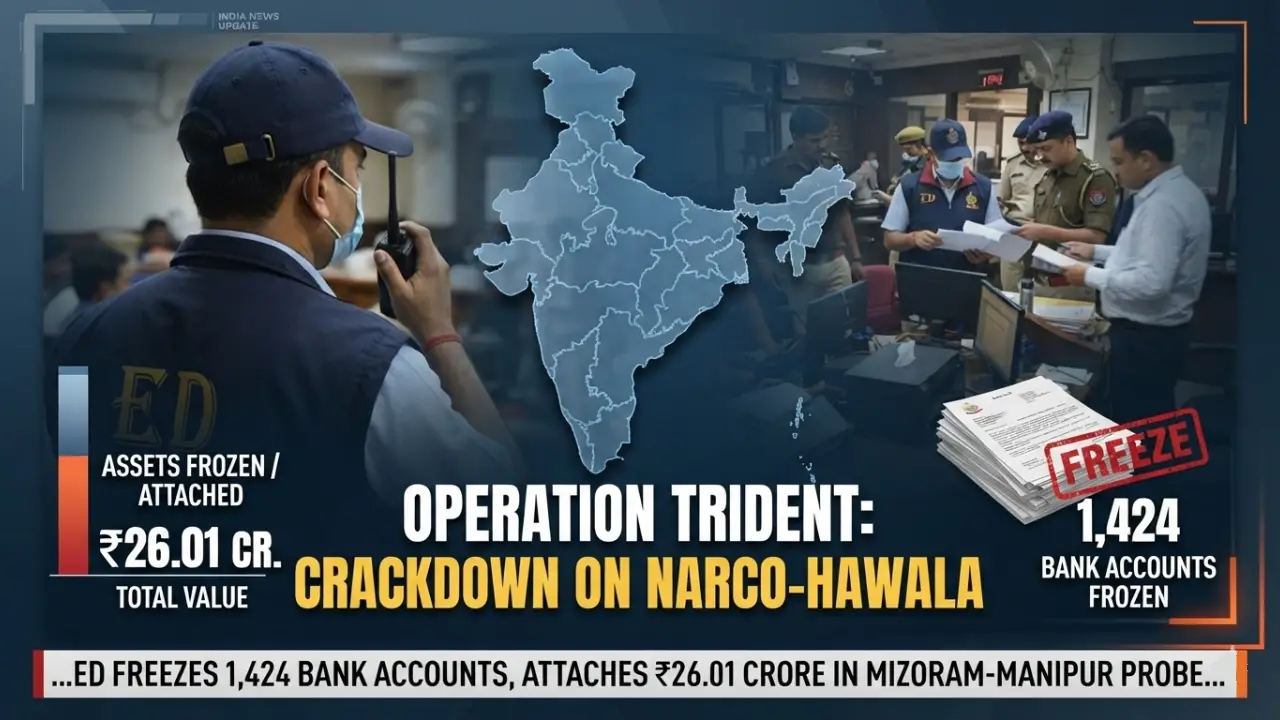
Imphal, Oct. 25: The Directorate of Enforcement (ED) has arrested six people and frozen 1,424 bank accounts while attaching or freezing assets worth Rs 26.01 crore in an investigation into an alleged cross-border narcotics and hawala network operating between Manipur, Mizoram and Myanmar.
The ED conducted coordinated searches on October 23 at multiple locations in Aizawl, Champhai and Lawngtlai in Mizoram, and Churachandpur in Manipur. The action was carried out by the agency’s Aizawl and Imphal Sub-Zonal Offices under Section 17 of the Prevention of Money Laundering Act (PMLA), 2002.
According to the ED’s press release issued on October 25, the investigation covers three money-laundering cases arising from the alleged trafficking of heroin, brown sugar and methamphetamine tablets from Myanmar and the transfer of drug proceeds through hawala channels.
The six people arrested under Section 19 of the PMLA include three from Mizoram and three from Manipur. The ED said it was also processing applications before the Special Court in Mizoram to secure the arrest of four additional accused who are currently in judicial custody in narcotics cases.
The agency provisionally attached properties worth Rs 17.82 crore belonging to alleged hawala operators in Mizoram. It had previously secured assets worth Rs 8.19 crore through the freezing of bank accounts, taking the total value of assets secured in the investigation to Rs 26.01 crore.
The searches were conducted in coordination with the Narcotics Control Bureau (NCB) and Mizoram Police, which carried out parallel action against the alleged trafficking network.
Three narcotics cases reveal interconnected network
The ED said its investigation began following the registration of three cases under the Narcotic Drugs and Psychotropic Substances (NDPS) Act, 1985.
The first case, registered as ECIR/AZSZO/05/2025, concerns Krishiv Enterprise in Mizoram. It originated from the seizure of 4.722 kg of heroin, packed in 440 soap cases, by Zokhawthar Police in Champhai district on March 14, 2025. The consignment was allegedly being transported from Zokhawthar to Aizawl for a supplier based in Myanmar.
The second case concerns Jabrul Haque and relates to the seizure of 49.101 kg of methamphetamine tablets and 40 grams of heroin by the NCB, Agartala, near Seling on National Highway 6A in Mizoram on August 21, 2025.
According to the ED, the drugs had allegedly originated from a Myanmar-based supplier identified as Chintuang and were intended for delivery near the Damchhera-Kanhmun border.
The third case, registered as ECIR/IMSZO/12/2026, concerns Zenngaihniang, also known as Taniang, in Manipur. It arose from the seizure of 2.413 kg of brown sugar and Rs 31.43 lakh in cash by Churachandpur Police on July 2, 2026. Investigators suspected that the cash represented proceeds from drugs supplied from Myanmar and collected in Churachandpur for remittance to suppliers.
The ED said investigations into the three cases uncovered an interconnected network in which bank accounts in Champhai, Aizawl and Lawngtlai allegedly received drug proceeds generated across Manipur, Mizoram, Assam and Tripura before transferring the money to suppliers in Myanmar.
Churachandpur money-transfer counter allegedly routed Rs 175 crore
The investigation identified a money-transfer counter operated by M/s Go Alpha Trip in Churachandpur as a key link in the alleged financial network.
The business, described by the ED as a Mini-ATM and money-transfer counter run by H. Gouzalal, allegedly received cash from Zenngaihniang, who was identified by the code name “NUNIANG” in the records.
According to the agency, Taniang delivered as much as Rs 1 crore a day to the counter, accompanied by lists of beneficiary bank accounts.
The ED said the counter recorded 2,947 transfers totalling Rs 175.03 crore between 2024 and June 2026. The money was allegedly transferred to traders, pharmacies and individuals in Zokhawthar, Champhai, Lawngtlai and Aizawl.
Investigators alleged that some funds were routed through other money-transfer counters and front businesses to make the transaction trail more difficult to follow.
Several account holders in Mizoram allegedly allowed suspected operators to use their bank accounts in return for payments of Rs 500 per lakh transferred. The agency said the funds were generally moved onward through electronic banking channels, including RTGS, NEFT and IMPS, with little cash withdrawn.
In seven accounts examined by investigators, Rs 11.98 crore was received, but only Rs 17 lakh was withdrawn in cash, according to the ED.
One account belonging to a homemaker in Champhai, allegedly operated by her husband, who worked in a bank, received Rs 15.48 crore despite the family having a reported monthly income of around Rs 27,000.
The agency said the transaction patterns raised suspicions that the accounts were being used to move money without corresponding legitimate commercial activity.
Alleged hawala operators handled funds from across India
The ED identified Lalrampari and her husband, Lalliansanga, proprietor of JTS Store, as alleged operators of an unlicensed rupee-kyat exchange network in Champhai.
According to the investigation, accounts linked to the operators recorded credits of approximately Rs 268.80 crore, including around Rs 125 crore deposited in cash. The funds allegedly originated from Assam, Nagaland, West Bengal, Tripura and Delhi, among other locations.
Investigators also traced transactions involving funds from major cities outside the Northeast. The ED said alleged hawala operator Lalrinkima received approximately Rs 2.14 crore from shell entities based in Kolkata, while Taniang received Rs 10 lakh from a shell company based in Howrah.
Cash was also reportedly deposited in Delhi, Kolkata, Guwahati and Silchar into accounts associated with operators based in Champhai.
The findings suggest, according to the ED’s investigation, that proceeds from narcotics allegedly sold in different parts of India were channelled back towards the Myanmar border through layered banking and hawala transactions.
The operators allegedly transferred money to accounts across India on instructions from Myanmar-based individuals and settled suppliers’ dues in Myanmar currency, the kyat, in exchange for commissions ranging from Rs 250 to Rs 500 per lakh.
The agency further alleged that proceeds were invested in property and businesses, including Hotel JTS, a five-storey commercial building in Zion Veng, Champhai, which investigators believe was constructed using funds routed through the hawala accounts.
Chemical supplies allegedly linked to methamphetamine production
The ED’s investigation also examined the movement of chemicals from India to Myanmar, alleging that the cross-border corridor was used in both directions: chemicals moved towards Myanmar, while finished narcotics entered India.
According to the agency, Krishiv Enterprises dispatched approximately 32 tonnes of caffeine anhydrous in 15 consignments between March and November 2024. It also reportedly supplied 10 tonnes of aluminium chloride anhydrous.
The consignments were allegedly sent using regular e-way bills and GST invoices to small retail pharmacies and a general store in Aizawl and Mizoram’s border areas. The ED said the recipients did not have manufacturing or processing facilities of their own.
Investigators suspect that the chemicals were subsequently transported across the border to tablet-pressing units in Myanmar, where caffeine anhydrous was allegedly used to bulk out or dilute methamphetamine during the production of Yaba tablets.
The agency said the finished narcotics were then transported across the Tiau river near Zokhawthar, opposite Khawmawi in Myanmar, before being moved through Champhai and Aizawl towards Vairengte and the borders with Assam and Tripura.
Myanmar-based organisers identified in the investigation allegedly hired local carriers in Zokhawthar and Champhai to transport consignments concealed in soap cases, taxis, motorcycles and truck convoys accompanied by escort vehicles.
The ED said the same hawala accounts used to receive drug proceeds were allegedly involved in settling payments linked to these cross-border activities.
Digital evidence seized during searches
The October 23 searches covered the premises of alleged hawala operators, holders of suspected mule accounts, front businesses, the Go Alpha Trip counter in Churachandpur and bank branches holding key accounts.
The ED said investigators seized ledgers documenting cash receipts and transfers, cheque books, debit cards, mobile phones and other digital devices allegedly used to operate the accounts.
According to the agency, some account holders admitted that they had rented out their bank accounts to suspected narco-hawala operators in return for payments of Rs 500 per lakh.
The ED also said the records maintained by Go Alpha Trip in Churachandpur corresponded with credits in bank accounts in Mizoram examined in the two Aizawl cases.
The findings form part of the agency’s investigation into the alleged financial infrastructure supporting narcotics trafficking across the region.
The ED said the Northeast’s 1,643-km porous border with Myanmar makes the region an important land corridor for narcotics originating in the Golden Triangle. Heroin and methamphetamine entering Mizoram and Manipur are allegedly sold locally or transported onwards through Assam to other parts of India and Bangladesh, while the proceeds are routed back towards border towns for settlement with suppliers in Myanmar.
The investigation into the three cases is continuing. The allegations against the individuals and businesses named by the agency remain subject to the legal process.