Former JNU scholars back Bimol Akoijam, alleging procedural lapses, breaches of confidentiality and a media trial following his dismissal over sexual harassment complaints.
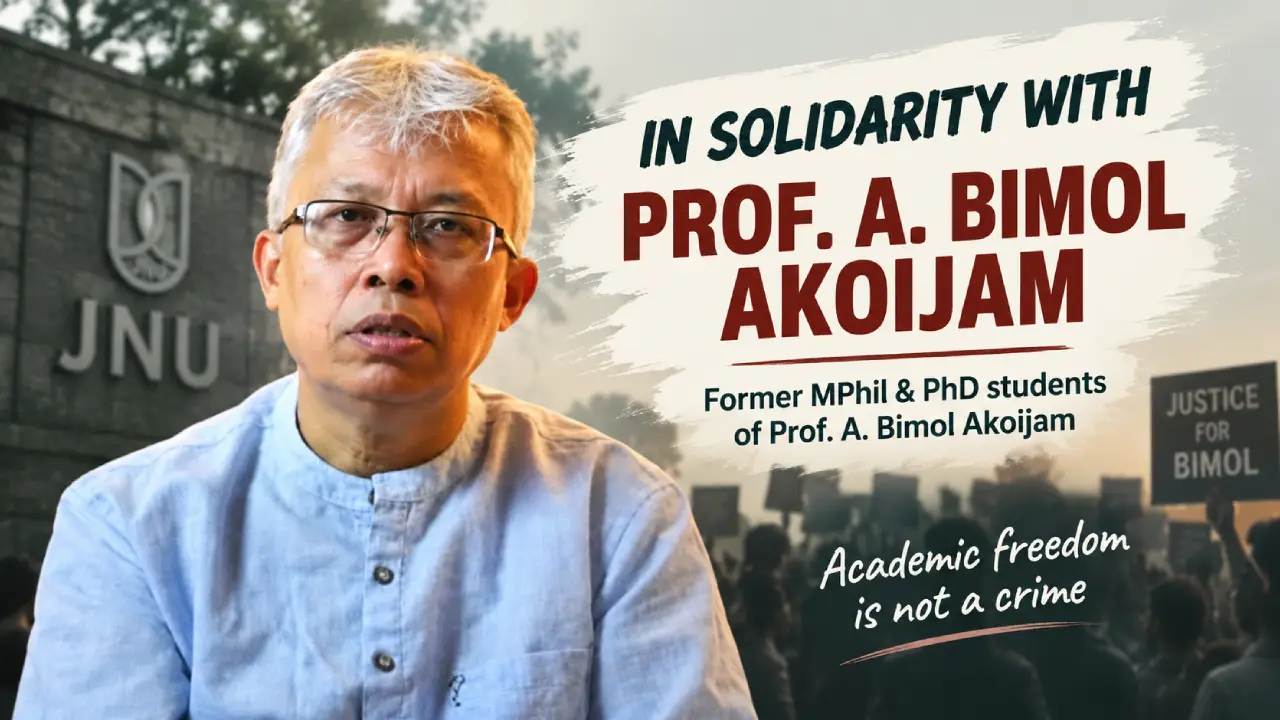
Imphal, Oct. 2026: Former MPhil and PhD students of Congress MP A. Bimol Akoijam at Jawaharlal Nehru University (JNU) have issued a statement in his defence, questioning the legality and fairness of the university’s decision to dismiss him following sexual harassment complaints.
In a statement dated October 15, 2026, the former scholars said the dismissal appeared rushed, procedurally flawed and politically charged. They rejected the allegations against their former supervisor and condemned what they described as a violation of confidentiality and due process under the Sexual Harassment of Women at Workplace (Prevention, Prohibition and Redressal) Act, 2013, commonly known as the POSH Act.
The students argued that the merits of a case could not be separated from the procedure followed to determine it. They maintained that any assessment of guilt or innocence must adhere to established legal principles and provide the person facing allegations a fair opportunity to respond.
“We outrightly reject the ‘allegations’ and ‘major punishment’ lashed out at him,” the statement said, comparing the action against Akoijam to the punishment of Socrates for teaching critical thinking.
The former scholars alleged that confidentiality was not maintained during the inquiry, with details of the complaints, the committee’s findings and the dismissal order circulating in the media and on social media.
Citing Section 16 of the POSH Act, they said the provision imposes restrictions on the disclosure of the identities of the parties involved and details of proceedings under the law.
According to the statement, the circulation of selective information created a parallel media trial before the matter had been formally concluded. The students said this had subjected Bimol Akoijam and his family to public humiliation and mental distress, while also compromising the privacy of the complainants.
The statement further questioned the sequence of events surrounding the dismissal. It claimed that the inquiry report was submitted and the dismissal order issued on the same day, with the order becoming publicly available almost immediately.
The former students said Bimol Akoijam had stated that he was not provided with a copy of the inquiry report before the punishment was imposed. They argued that this raised concerns about whether he had been given a meaningful opportunity to examine the findings and respond before the decision was taken.
They invoked the principle of audi alteram partem, which requires that the other side be heard before an adverse decision is made.
The allegations concerning procedural irregularities were presented by the former students in their statement. The document did not include a response from JNU to their specific claims.
The statement also defended Bimol Akoijam’s academic approach, saying his teaching encouraged critical thinking and open discussion on gender, sexuality, politics and society.
The former scholars, who studied at the Centre for the Study of Social Systems (CSSS) at JNU, described him as a mentor who maintained a supportive and inclusive relationship with students from diverse social and cultural backgrounds.
They said BimolAkoijam had supervised students from several Indian states, including Manipur, Assam, Jammu and Kashmir, Tripura, Bihar, Kerala, Meghalaya, Telangana, West Bengal and Jharkhand, as well as students from outside India.
According to the former scholars, his approach rejected rigid hierarchies in the teacher-student relationship and encouraged students to express disagreement, seek academic guidance and discuss personal as well as academic difficulties.
They also said research scholars regularly gathered at his on-campus residence for reading groups, collective discussions and other academic and social activities. The statement described these gatherings as open academic-community interactions and objected to what it called an attempt to portray ordinary hospitality and scholarly engagement as inherently predatory.
The former students said gender and sexuality were established subjects in Bimol Akoijam’s courses, including Culture, Personality and Society and Cinema and Culture in Society.
They listed works by Masters and Johnson, John Gagnon and William Simon, Michel Foucault, Andrea Dworkin, Sudhir Kakar and Anthony Giddens among the readings and theoretical frameworks used in his teaching.
The scholars argued that questions concerning romantic relationships and one-night stands had to be understood within their academic context, particularly discussions of changing relationships and the concept of “plastic sexuality” associated with Giddens.
They also defended his use of films in the classroom, saying cinematic material was used to examine concepts such as the male gaze, developed by film theorist Laura Mulvey, and representations of sexuality in cinema.
The statement said the use of films and discussions of sensitive subjects were not new in Bimol Akoijam’s classes and were part of established academic methods. It argued that specific terms or classroom discussions could be misinterpreted if separated from the theories and readings being discussed.
The former scholars said they had attended his classes as teaching aides across multiple MA batches and were familiar with his teaching methods.
The statement strongly rejected the allegation that Bimol Akoijam had sought sexual favours in exchange for additional marks, describing it as fabricated.
The former students said their experience of his viva voce examinations had been different from the allegations circulating publicly. They maintained that the examinations were intended to assess students’ understanding of course concepts and readings, rather than simply determine marks.
Some signatories said they had attended vivas as observers or appeared for examinations themselves under Bimol Akoijam. They recalled that he would sometimes explain concepts to students who struggled to answer questions.
The statement quoted his reported advice to students that marks were not everything and that they should prioritise conceptual clarity.
However, the former students’ account reflects their experiences and position on the allegations. Their statement does not independently establish the findings of the university inquiry or determine the merits of the complaints.
Concluding the statement, the scholars condemned what they described as flawed procedures and an unethical media trial that had harmed Bimol Akoijam and his family.
They said they believed the campaign against him had underestimated his resolve and pledged to support him in his fight.
The statement was signed by 12 former MPhil and PhD students: T. Longkoi Khiamniungan, Jyoti Das, Rimlee Das, Himakshi Choudhury, Khadeeja Mangat, Sweta Azad, Pusham Priyanka Kshetrimayum, Sushant Gaurav, Chabungbam Babina, Gopi Tadaka, Yusoof Ali and Sanam Sharief Khan.
The intervention comes amid a wider political controversy surrounding Bimol Akoijam’s dismissal from JNU and demands by BJP leaders for his resignation as the Lok Sabha member representing Inner Manipur.
While the former students have questioned the university’s handling of the case and defended his academic practices, the allegations against Bimol Akoijam and the findings of the university’s inquiry remain central to the dispute.