If Bimol Akoijam’s courses were misrepresented, the implications could extend beyond his career. Recasting sociological inquiry as moral deviance risks academic freedom, encouraging faculty to self-censor discussions on gender, sexuality, power and critical theory.
The institutional crisis at Jawaharlal Nehru University over the sudden dismissal of Professor Angomcha Bimol Akoijam has mostly been discussed in terms of administrative overreach, procedural illegality and partisan vendetta. The Vice-Chancellor's termination order appears to have been issued contrary to Statute 30 of the JNU Act, which reserves dismissal authority for the Executive Council. The leak of confidential findings has also drawn strong condemnation from faculty and student representatives. Beneath the procedural questions, however, there may be a less visible dimension worth considering: the possible weaponisation of the university classroom. When an academic who teaches the sociology of culture, psyche and intimacy becomes an uncompromising opposition voice, his syllabus could, in the hands of political adversaries, start to look less like a teaching tool and more like a ready supply of ammunition.
The Curriculum in the Crosshairs: Course SS453N
One way to see how academic discourse might be turned into accusation is to look at the intellectual ground Professor Bimol Akoijam has worked on for over three decades at JNU's Centre for the Study of Social Systems (CSSS). For instance, his Master's course from 2025, SS453N: Culture, Personality and Society, reflects the JNU tradition of critical, interdisciplinary social inquiry. It sets out to connect collective social structures with individual subjectivity, moving across the binaries of nature and culture and of psyche and society.
The course may be most exposed in the second half of the syllabus. Unit 3 (Discursive Practices and Lived Experience) asks students to examine the self as "alienated," "colonized," "gendered" and "monitored," using Marxist, post-colonial, feminist and Foucauldian frameworks to trace how power acts on the individual. Unit 4 (Private and Public Realms of Intimate Relation) then turns to sexuality and intimacy, examining the "sexualizing the social and sexual structuring of social life" in order to study the gendered world, marriage and family in South Asia.
The reading list reads much like a primer in critical theory. It includes Michel Foucault's The History of Sexuality, on the biopolitics of bodily regulation, and Lisa Adkins and Vicki Merchant's Sexualising the Social, on heteronormativity and power. It also includes Sudhir Kakar's psychoanalytic study Intimate Relations: Exploring Indian Sexuality, Ashis Nandy's The Intimate Enemy and Kimberlé Crenshaw's work on intersectionality. Engaging with such texts would plausibly require students and instructors to take apart entrenched taboos and to discuss desire, patriarchal surveillance, bodily autonomy and the psychological structure of intimacy.
How Context Could Be Stripped Away
In an ordinary academic setting, these subjects are explored through careful, searching dialogue. Bimol Akoijam has described this as a commitment that "education should always be a conversation between life and letter." In an atmosphere of political hostility, though, the same openness could become a liability. Critical sociology relies on abstraction, on safe intellectual exploration and on the deconstruction of sensitive social realities. Without their epistemological context, the vocabulary of psychoanalysis and sexual politics might be misread by untrained observers, bad-faith actors or ideologically hostile auditors as inappropriate, intrusive or even predatory.
The way the course is evaluated may add to this exposure. SS453N spreads assessment across mid-semester examinations, a substantial research essay and an end-semester paper. For the term paper, students write 3,000 to 3,500 words on difficult topics, including caste, race, religion, colonialism and "gender and sexuality," drawing on perspectives such as Gopal Guru and Sundar Sarukkai's Experience, caste, and the everyday social. The syllabus also specifies a mandatory one-on-one viva voce examination after the submission to assess the student's mastery.
In a polarised campus, it might take little effort for opponents to recast a routine viva as something sinister. A rigorous scholarly discussion of a student's paper on "gender and sexuality" could, in principle, be described as an inappropriate personal interrogation. A collapse of context of this kind may help explain how external political actors and sensationalist media outlets came to circulate the "sex for grades" narrative. Bimol Akoijam has strongly maintained that this allegation appears nowhere in the documentary filings or the formal complaint itself.
The Possible Catalysts: Outspoken Politics and Timing
The shift from classroom pedagogy to criminal accusation may not have happened in an ideological vacuum. Bimol Akoijam is not only an academic but also an opposition lawmaker, elected to the Lok Sabha in 2024 from Inner Manipur. In Parliament, he broke what had been a prevailing silence on the prolonged ethnic violence in Manipur, offering sharp criticism that directly addressed the central government's failures.
For an establishment used to managing parliamentary narratives, an articulate, tenured intellectual from a historically marginalised frontier state could present a particular political challenge. Targeting him on grounds of sexual impropriety might be seen as an attempt to damage the base of his credibility. The timing lends some weight to this reading: the dismissal order and the media leaks reportedly came just hours before planned major protests at Jantar Mantar and ahead of campaign mobilisations in Manipur, where Bimol Akoijam was expected to take a leading role.
The sequence that followed resembles a familiar pattern of political containment. The JNU administration reportedly compressed inquiry submission, appellate consideration and dismissal into a single afternoon. Ruling-party functionaries held press conferences in New Delhi, and affiliated political wings organised street protests in Imphal demanding his parliamentary resignation. Within forty-eight hours, and before the High Court could stay the Vice-Chancellor's procedurally flawed order, the university's Chief Security Officer filed a police complaint, and Delhi Police registered an FIR under multiple sections of the Bharatiya Nyaya Sanhita (BNS). By then, the matter had moved from classroom discourse to the criminal docket.
A Possible Chilling Effect on Academic Freedom
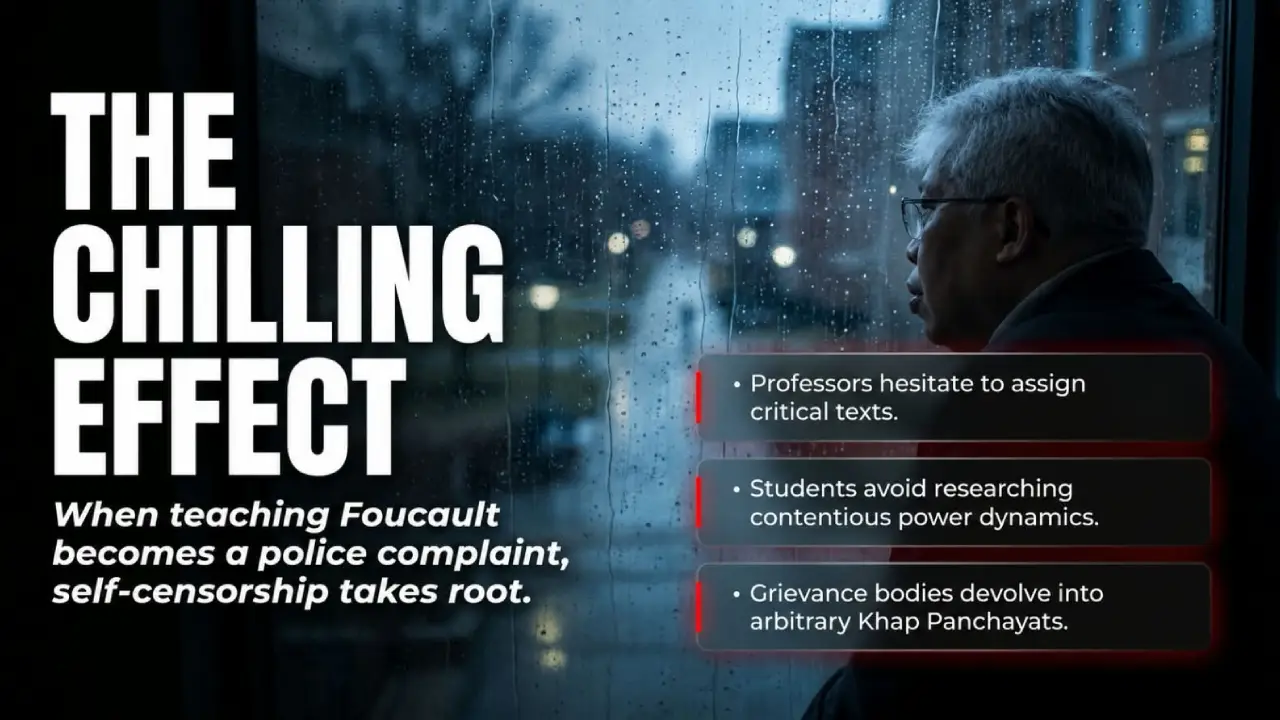
If Professor Bimol Akoijam's courses were in fact used this way, the consequences could reach well beyond his own political career. When serious sociological inquiry into gender, sexuality and power can be lifted out of the classroom and recast as moral deviance, a basic premise of higher education may be put at risk.
Faculty who teach Foucault, psychoanalysis or feminist theory might reasonably worry that any lecture, tutorial discussion or viva voce could be decontextualised into a police complaint. Self-censorship could then become likely. Professors might hesitate to assign critical texts on sexuality, students might avoid researching contentious gender dynamics, and the university could gradually stop being a refuge for fearless inquiry. Bimol Akoijam himself has warned that turning specialised grievance redressal bodies into arbitrary "Khap Panchayats" not only subjects individuals to media trials but also erodes public trust in legitimate institutional mechanisms.
The episode may therefore serve as a warning for Indian democracy. If political rivalry reaches into academic life to the point where syllabi are searched for material to use in smear campaigns, the casualty might not be only an opposition politician. It could be the autonomy of thought, critical inquiry and intellectual courage that institutions like JNU were created to protect.