Manipur's second Water Bodies Census counts 4,374 sites, up 163.8% since the first. Small private ponds dominate and fish farming leads use, but unused sites are rising and irrigation use is minimal.
The second national Water Bodies Census shows a 163.8% jump since the first count, but also a rising share of unused sites and almost no irrigation use.
Imphal, Oct. 4: Manipur has 4,374 water bodies, up 163.8% from the 1,658 recorded in the first national census, according to the second Water Bodies Census released in October by the Ministry of Jal Shakti's Department of Water Resources. Nearly all of them are small, privately owned ponds used mainly for fish farming rather than irrigation.
The state-level report gives a detailed picture of a water landscape that is large in number but small in scale. Ponds make up 99.34% of the total, individuals own 70.4% of all sites, and a single pond in the state is used for irrigation. Meanwhile, the share of water bodies in use fell to 92.89% from 97% in the first census, and no site has been revived in the past five years.
The report cautions that the headline increase cannot be read as a straightforward measure of new water bodies. It says coverage in Manipur was incomplete during the first census because of disturbance in the state. Part of the rise, therefore, reflects better enumeration. The report does not say how much.
Ponds dominate, other types shrink
Ponds account for 4,345 of the 4,374 water bodies, up 179.2% from 1,556 in the first census. The report describes them as sources of water for domestic use, traditional aquaculture and dry-season irrigation that sustain rural livelihoods.
Other categories moved in the opposite direction. Reservoirs fell from 64 to four, a drop of 93.8%. Tanks declined from 17 to seven, down 58.8%. Lakes slipped from 19 to 18, a decrease of 5.3%. The census recorded no water conservation schemes, percolation tanks or check dams in the latest count, compared with one in the first.
The report does not explain the declines. It does not say whether they reflect disappearance, reclassification or differences in how the two censuses counted. The sharp fall in reservoirs, from 64 to four, is the largest change in any category and is likely to draw questions from planners.
In its text, the report states that the number of ponds "decreased" by 179.2%. Its own tables show the opposite: a rise from 1,556 to 4,345.
Rural majority, urban surge
Of the 4,374 water bodies, 2,731, or 62.44%, are in rural areas and 1,643, or 37.56%, are in urban areas. The urban share has more than doubled from 17% in the first census.
Urban water bodies rose 468.5%, from 289 to 1,643, while rural ones grew 99.5%, from 1,369 to 2,731. The gap suggests that much of the added count is in and around towns, where small ponds may have been missed or less thoroughly surveyed before. That, too, is an inference from the figures. The report does not give a reason.
Private hands, few public owners
Private owners hold 3,134 water bodies, or 72%. Public bodies own 1,240, or 28%. Individuals and farmers account for 3,078 of the private total, or 98.2% of private holdings. Another 49 belong to groups of individuals and seven to other private bodies.
Among public water bodies, cooperative societies own 1,087, or 87.7% of the public total and 24.9% of all water bodies in the state. Panchayats own 96, municipal authorities 36 and other government agencies 21. State water resources and irrigation departments own none.
The ownership pattern has practical consequences. Because individuals and cooperatives hold the great majority of sites, upkeep, desilting and restoration depend largely on thousands of small owners rather than a handful of government agencies. Any state program to improve water bodies would have to reach those owners directly.
Fish farming leads, irrigation barely registers
The census counted 4,063 water bodies in use, or 92.89%, and 311 not in use, or 7.11%. In the first census, 1,601 were in use and 57 were not, or 97% and 3%.
The number of water bodies in use rose 153.8%. The number not in use rose 445.6%. The unused category grew nearly three times as fast as the used one.
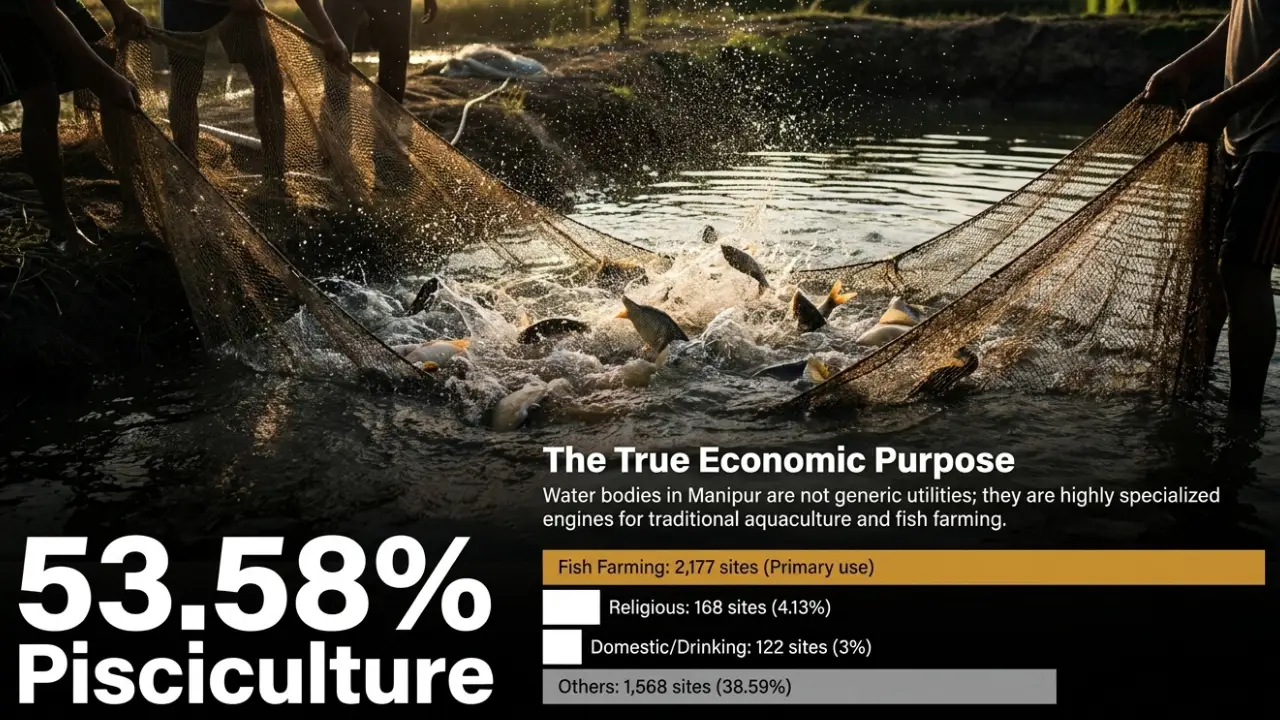
Pisciculture is the leading use, accounting for 2,177 sites, or 53.58% of the total. Ponds make up 2,169 of those, along with five lakes and three tanks. The report says the predominance of water bodies with moderate to high storage capacity points to significant potential for fish production in the state.
Other uses are minor. Religious purposes account for 168 sites, or 4.13%, and domestic or drinking use for 122, or 3%. Recreation accounts for 14 sites, industry for nine and natural habitat for birds and animals for four. A further 1,568 sites, or 38.59%, fall under "others." The report's text puts that share at 43.1%, a figure that does not match its own at-a-glance table.
Irrigation accounts for just one water body, a pond whose average culturable command area and irrigation potential created is one hectare, according to the report. The finding indicates that, in Manipur, the tens of thousands of hectares of farmland depend on sources other than these counted water bodies, or that irrigation potential in them remains largely untapped.
Weak institutional links
The report records no Water User Associations for any water body in the state. Only six water bodies are tied to a central government scheme, and only 12 are included in a district or state irrigation plan. None has been revived in the past five years.
Taken together, the figures suggest that most of Manipur's water bodies operate outside formal water management systems. Some owners may prefer that arrangement. It also means the sites receive little public investment or organized oversight.
Why sites fall out of use
Of the 311 water bodies not in use, 87, or 27.97%, have dried up. Construction has made six unusable, siltation two, industrial effluents two and salinity one. The largest group, 213 sites or 68.49%, is listed under "other reasons." The report's chart shows 212 ponds and one lake in that group.
The size of the "other" category limits what can be concluded about causes. Drying up is the only specific reason that affects a meaningful share.
The change among unused sites is steepest in cities and towns. Urban water bodies not in use rose from two to 80, an increase of 3,900%, though from a very small base. Rural unused sites rose 320%, from 55 to 231. Urban sites in use grew 444.6%, to 1,563 from 287.
Small in size, mostly full
The census found that 96% of the state's water bodies have a water spread area of less than 1 hectare. By the report's table, 3,803 are up to 0.5 hectare, or about 87%, and 571 are larger. In the first census, 1,502 were up to 0.5 hectare and 156 were larger.
About 29% of water bodies hold up to 1,000 cubic meters. Another 57% hold between 1,000 and 10,000 cubic meters, and 14% hold more than 10,000 cubic meters.
Most contain water throughout the year. The report says 97% hold water all year, and about 76% are filled to more than half of their capacity. Eleven percent are full and 65% are filled to up to three-quarters. Twenty percent are filled to up to half, and 4% are filled to a quarter or less. Together, 24% have very little water.
Siltation is limited but present. The census found silt in 259 water bodies, or 5.9%. Ponds account for 257 of those, with one lake and one reservoir. The reservoir figure translates to 25% of the state's four reservoirs. Two ponds are out of use because of silt.
Few encroachments, mostly in a lake
Only seven water bodies, or 0.16%, were reported encroached. Six are ponds, or 0.14% of ponds, and one is a lake, or 5.56% of the state's 18 lakes. The report does not name the sites. The figures reflect what was reported during the census, which may not capture informal or disputed occupation.
Geographically, 170 water bodies, or 3.89%, are in tribal areas. The report says those are mostly used for pisciculture. Four fall in drought-prone area program blocks and one in a flood-prone area. The remaining 4,199, or 96%, are in other areas.
What the numbers imply
The census describes a state where water is abundant in small pockets and managed informally. Fish farming, not farm irrigation, is the main economic use. Most owners are private individuals, and few schemes or associations support them.
The report offers no recommendations. Its own figures, however, point to several pressures: a growing group of unused urban and rural sites, a sharp loss of reservoirs and tanks, and a lack of revival work. They also point to an opportunity the report itself highlights, the potential to expand fish production in water bodies that already hold substantial water.
Manipur covers about 22,347 square kilometres in northeastern India.