Manipur microbiologists discover Mollisia sokpayensia, a new fungal species associated with a rare medicinal plant in the Sikkim Himalaya, opening avenues for biodiversity research.
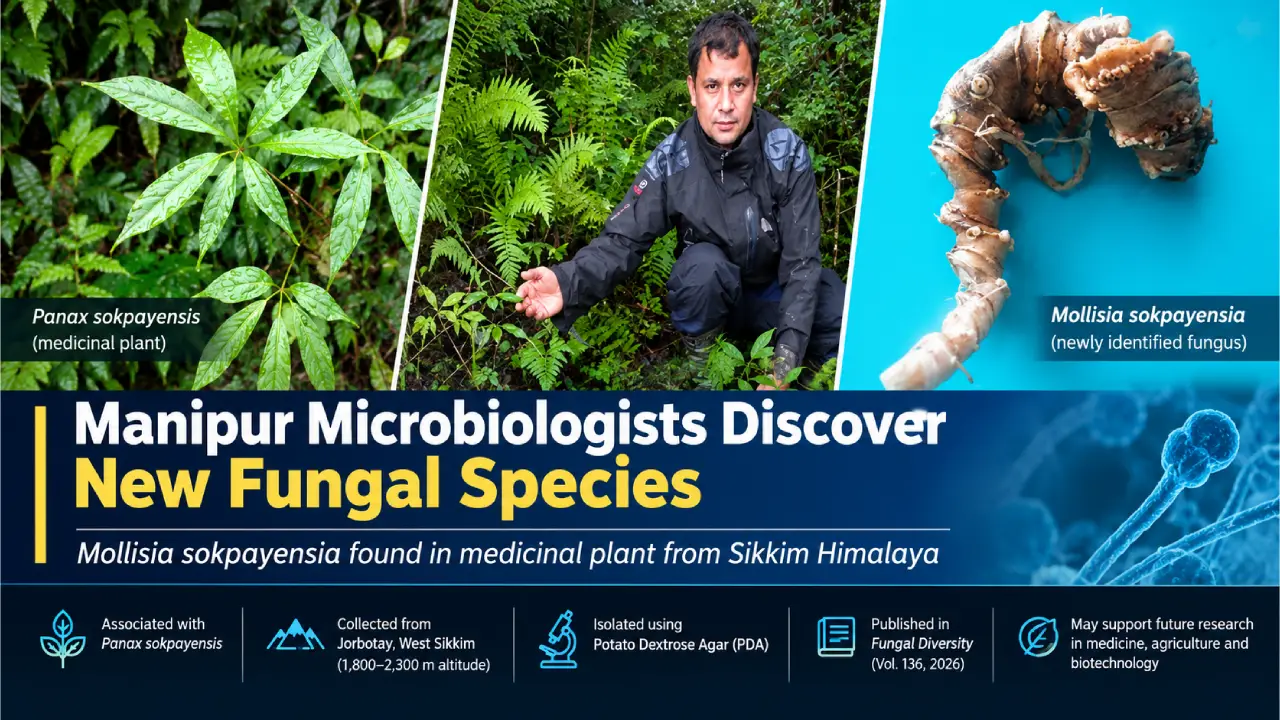
Imphal, Oct. 29: A team of microbiologists led by Dr. Laishram Shantikumar Singh has discovered a new fungal species associated with the rhizome of Panax sokpayensis, a rare medicinal plant found in the Sikkim Himalaya. The discovery adds to scientific knowledge of Himalayan fungal diversity and could support future research into microorganisms associated with medicinal plants.
The newly identified fungus has been named Mollisia sokpayensia in recognition of its association with the plant. The research team includes Subecha Rai, Gajanan V. Mane, Dr. Rohit Sharma and Dr. Thounaojam Salvia, who, along with Dr. Singh, are the authors of the species description.
Dr. Shantikumar and Dr. Salvia are residents of Khangabok in Manipur's Thoubal district.
Fungus isolated from high-altitude medicinal plant
According to the research findings, the fungus was isolated from a rhizome of Panax sokpayensis collected at Jorbotay in Uttarey, West Sikkim, at an altitude of 1,800 to 2,300 metres above sea level. The plant is considered rare and has medicinal value.
The species was named after its host plant to acknowledge the distinctive association between the fungus and P. sokpayensis. The identification and description of the fungus were published in the international scientific journal Fungal Diversity, Volume 136 (2026), in a paper titled “Fungal Diversity Notes: Notes on Worldwide New Species and Records”. The publication appeared on October 25, 2026.
The fungus was isolated using Potato Dextrose Agar (PDA), a medium commonly used to grow fungi under laboratory conditions. Researchers observed that the species grows slowly, with colonies initially appearing cottony and brown.
At a laboratory temperature of 28 degrees Celsius, the colonies reached a diameter of 2–3 cm after six days and approximately 8 cm after 14 days. Their colour gradually changed from brown to blackish-brown.
The study also examined the fungus's morphological characteristics and used molecular analysis to distinguish it from related species. The research paper records the species under the name Mollisia sokpayensia and documents its association with the rhizome of Panax sokpayensis.
Potential importance for medicinal plant research
Fungal endophytes are microorganisms that live inside the tissues of healthy plants without causing visible disease symptoms. Some endophytes can benefit their host plants, while receiving nutrients and shelter in return.
These microorganisms are of interest to researchers because they may produce bioactive compounds with potential applications in medicine, agriculture and biotechnology. However, the discovery of a new fungal species does not by itself establish that it has medicinal properties or can be developed into a commercial product.
The research team noted the importance of investigating microorganisms associated with medicinal plants. Such studies could help identify previously undocumented microbial resources and provide a basis for further research into their biological properties.
The rhizome of P. sokpayensis has traditionally been used for medicinal purposes. Plants belonging to the genus Panax, commonly associated with ginseng, are valued in international markets.
While the diversity and medicinal properties of Panax species and their associated endophytes have received considerable research attention on the Chinese side of the Himalayas, investigations on the Indian side remain limited, according to the press release.
The discovery therefore adds to the documented fungal diversity of the Sikkim Himalaya, a region that forms part of the Indo-Burma biodiversity hotspot.
Scope for further research and conservation
The researchers said the discovery opens opportunities to investigate the biological properties and possible applications of Mollisia sokpayensia. Further studies would be needed to determine whether the fungus produces useful compounds and whether those compounds have practical applications.
In the longer term, research into cultivable endophytes could potentially help scientists explore useful microbial products without repeatedly harvesting rare medicinal plants from their natural habitats. Any such benefits would depend on further laboratory investigation and validation.
The study was supported by an externally funded research project awarded to Dr. Laishram Shantikumar Singh by the Department of Biotechnology (DBT), Government of India, under grant number DBT/NER/Agri/24/2013.
Dr. Shantikumar is an Associate Professor and Programme Head in the Programme of Microbiology, Faculty of Science, Assam down town University, Guwahati. Dr. Thounaojam Salvia is a Professor and Principal at the Department of Microbiology and Immunology, CPMS College of Allied and Healthcare Sciences, PEWS Group of Institutions, Guwahati. Both researchers are from Khangabok in Thoubal district, Manipur.
The research paper is available through its DOI: https://www.bioacad.com/article/doi.org/10.65390/fdiv.2026.136019