Manipur University and CSIR-NGRI concluded a five-day seismic hazard training programme for 39 participants, strengthening earthquake research and scientific capacity in Northeast India.
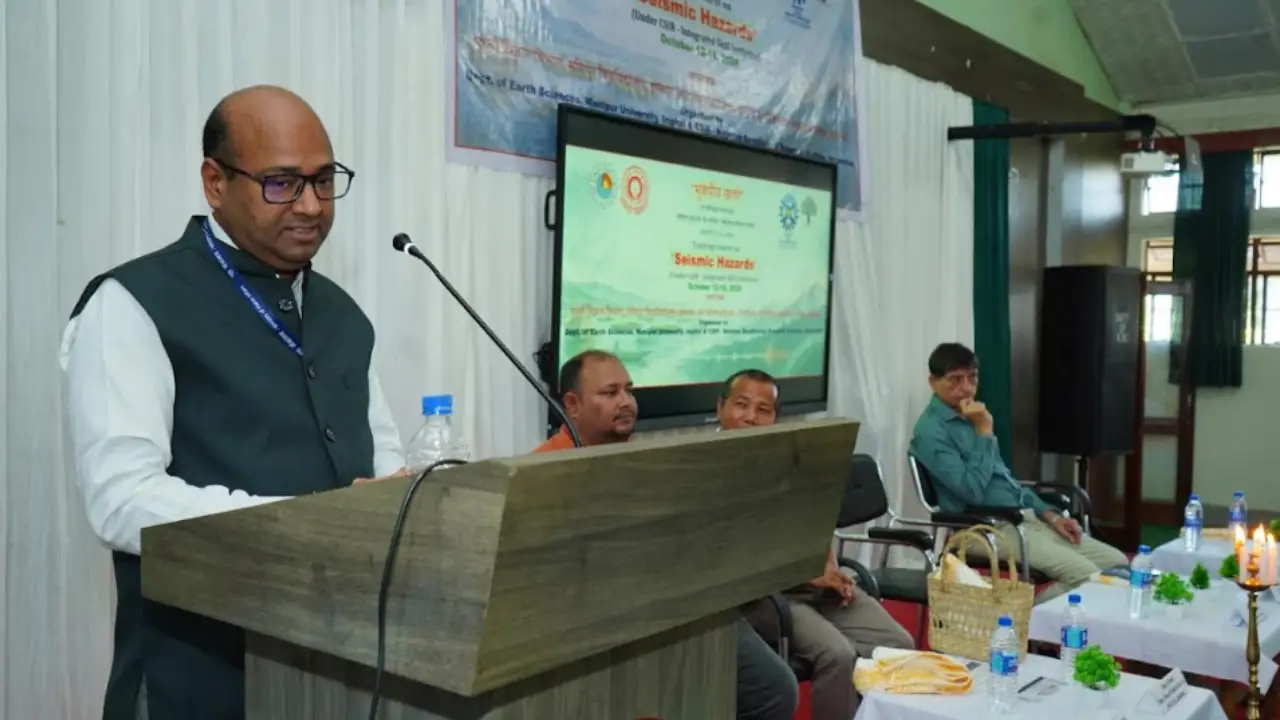
Imphal, Oct. 16: Manipur University and the CSIR–National Geophysical Research Institute (CSIR-NGRI), Hyderabad, have concluded a five-day training programme on seismic hazards, aimed at strengthening earthquake research and technical capacity in Northeast India.
The programme, held at Manipur University, Canchipur, from October 12 to 16 under the CSIR-Integrated Skill Initiative of the Ministry of Science and Technology, Government of India, brought together 39 participants from academic and research institutions in Manipur, Arunachal Pradesh and Meghalaya.
The training focused on improving scientific knowledge, technical skills and research capabilities in earthquake studies and seismic hazard assessment, particularly in a region vulnerable to seismic activity.
Dr. Tourangbam Brajkumar Singh, Director of the Department of Environment and Climate Change, Government of Manipur, attended the valedictory ceremony as chief guest. He stressed the importance of specialised scientific training in Manipur, given the region’s high seismic vulnerability.
He said systematic seismic studies were necessary to improve understanding of the state’s earthquake potential and strengthen the scientific basis for disaster preparedness and risk reduction.
The programme was inaugurated on October 12 by Manipur University Vice-Chancellor Prof. R.K. Hemakumar Singh, who highlighted the importance of skill development initiatives in Northeast India, particularly in areas exposed to earthquakes and other seismic hazards.
He called for similar specialised programmes to be organised on a larger scale, enabling more students and researchers from colleges and academic institutions across the region to participate.
Dr. Abhey Ram Bansal, Scientist G at CSIR-NGRI and the programme’s nodal person, outlined the objectives of the CSIR-Integrated Skill Initiative. He emphasised practical, research-oriented training for students and young professionals, along with wider access to specialised scientific programmes at academic institutions across the country.
Dr. Vinay Kumar, Scientist G at CSIR-HRDC, who attended the inaugural programme, provided an overview of CSIR training programmes and their role in developing scientific and technical expertise among students and researchers.
Dr. Avinash Kumar Chauhan, Assistant Professor in the Department of Earth Sciences at Manipur University and the training coordinator, said the course was designed to help students and young researchers from Northeast India develop a better understanding of earthquakes and seismic hazards.
He noted that the region’s susceptibility to seismic activity made specialised training important for building local scientific expertise.
Chauhan said the programme was particularly relevant for postgraduate students and PhD scholars, as it could strengthen their research capabilities and help them study existing seismic conditions as well as potential future earthquake hazards.
He added that scientific knowledge and technical training were important not only for academic advancement but also for improving the region’s ability to investigate and respond to earthquake-related risks.
The training coordinator expressed hope that similar programmes would be organised more frequently through continued collaboration among Manipur University, CSIR-NGRI, other CSIR laboratories and national research institutions.
The programme enrolled 39 candidates representing institutions including Manipur University, Osmania University, the Centre of Earth Science and Himalayan Studies, Delhi University, NIT Manipur and Bangalore University.
Female participants accounted for more than 50 per cent of the total enrolment, according to the programme details.
The participation reflected the involvement of women in specialised scientific and technical training, while the presence of candidates from different institutions provided opportunities for academic interaction and knowledge-sharing.
As part of the programme, visiting CSIR-NGRI scientists inspected the Manipur University Seismic Observatory and examined the condition of its installed instruments.
The visit facilitated technical interaction on seismic monitoring infrastructure and its role in earthquake research. Discussions focused on the importance of scientific observation and reliable monitoring facilities in improving understanding of seismic activity and supporting research into earthquake hazards.
The Department of Earth Sciences also organised a tree plantation programme during the event.
During the inaugural session, Prof. Y. Raghumani Singh, Head of the Department of Earth Sciences at Manipur University, welcomed the dignitaries, visiting scientists and participants. He highlighted the department’s role in earth science education and research and welcomed the opportunity to strengthen academic engagement with scientists from national research institutions.
Faculty members of the department attended the inaugural and valedictory programmes.
At the closing ceremony, Dr. Avinash Kumar Chauhan proposed the vote of thanks, acknowledging the support of CSIR-NGRI, the CSIR-Integrated Skill Initiative, the university administration, resource persons, faculty members, student volunteers and participants.
The five-day programme strengthened academic engagement between Manipur University and CSIR-NGRI and provided a platform for scientific training in seismic hazard assessment. Continued collaboration between universities and national research institutions could create further opportunities for specialised training and research in Northeast India, where understanding earthquake hazards is important for disaster preparedness and public safety.