Manipur University has inaugurated a national seminar examining yoga, cognitive readiness and social cohesion, with experts discussing human security and resilience in frontier regions.
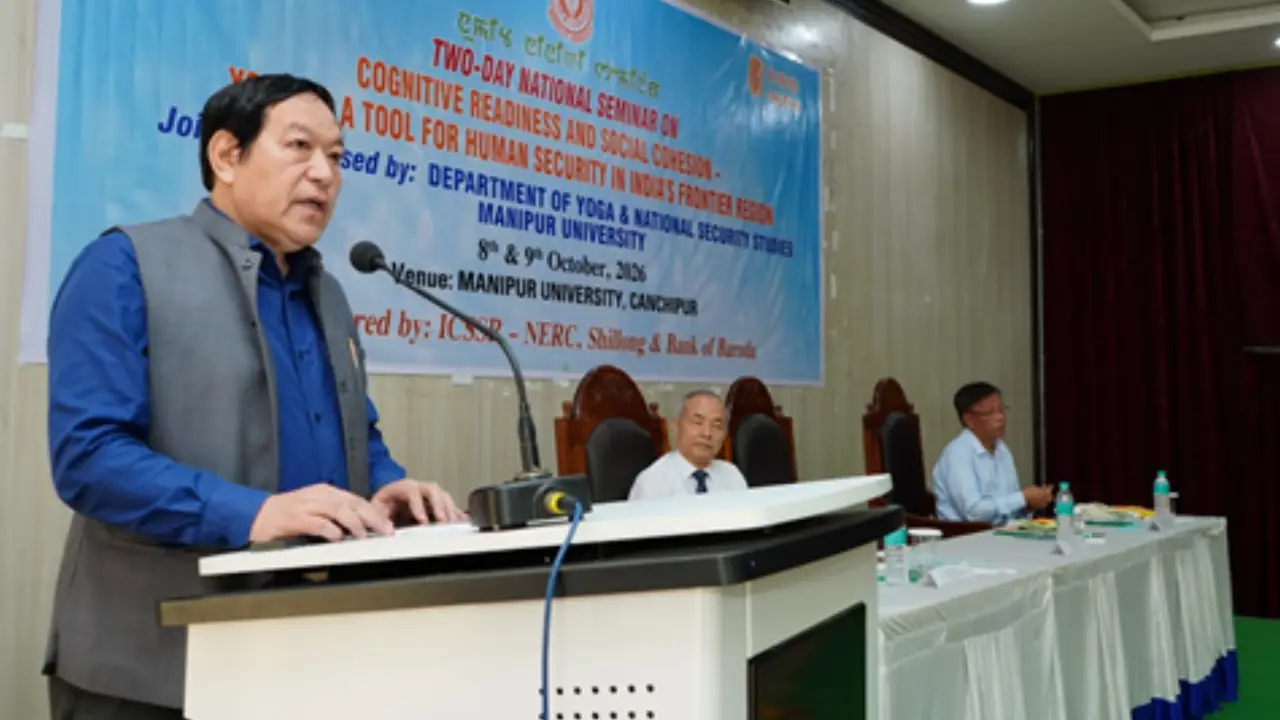
Imphal, Oct. 8: Manipur University on Thursday inaugurated a two-day national seminar exploring the role of yoga in cognitive readiness, emotional resilience and social cohesion, with scholars and practitioners examining broader concepts of human security in the context of Manipur and India's frontier regions.
The seminar on “Cognitive Readiness and Social Cohesion – Yoga as a Tool for Human Security in India's Frontier Region” is being jointly organised by the Departments of Yoga and National Security Studies, Manipur University.
The programme is sponsored by the Indian Council of Social Science Research–North Eastern Regional Centre (ICSSR-NERC), Shillong, and Bank of Baroda.
Prof. R.K. Hemakumar Singh, Vice-Chancellor (in-charge), attended the inaugural function as Chief Guest. Prof. A. Rajmani Singha, Director of the Internal Quality Assurance Cell, was the Guest of Honour, while Lt. Gen. Dr. Konsam Himalay Singh (Retd.), Visiting Scholar in the Department of National Security Studies, presided over the programme.
Addressing the gathering, Prof. Hemakumar Singh stressed the importance of multidisciplinary collaboration in higher education.
He encouraged academic departments to jointly develop programmes that respond to emerging social challenges and said universities should create opportunities for students to gain knowledge across disciplinary boundaries.
He also urged the organisers to consider translating the seminar's discussions into curriculum development and multidisciplinary learning opportunities.
Encouraging young participants to interact with experts, Prof. Hemakumar said students should actively raise questions, exchange ideas and develop intellectual curiosity rather than remain passive listeners.
Prof. Rajmani Singha said the seminar's theme was particularly relevant to Manipur, where prolonged conflict has affected relationships between communities.
Referring to disruptions caused by the COVID-19 pandemic and subsequent years of conflict, he said rebuilding trust, mutual understanding and social cohesion had become an important requirement.
He explained that cognitive readiness involved the ability to adapt and respond to changing circumstances while continuing to function effectively under difficult conditions.
Social cohesion, he said, required respect, empathy and a willingness among individuals and communities to live together.
Prof. Rajmani also argued that human security should not be limited to border protection. It should include psychological well-being, dignity and relationships within society.
He identified self-awareness, communication, empathy, interpersonal relationships, critical thinking, problem-solving, decision-making and the ability to manage emotions and stress as important life skills.
According to him, yoga could serve as a complementary tool for developing concentration, emotional regulation, mental calmness and considered decision-making.
Prof. Rajmani also called attention to the need for a comprehensive State Youth Policy in Manipur.
Drawing on his earlier experience with the National Service Scheme and youth-related initiatives, he expressed concern over the absence of a dedicated framework to guide young people towards educational, professional and social opportunities.
He said youth development should extend beyond career preparation to include peaceful coexistence, constructive participation in society and contribution to social harmony.
A comprehensive policy, he suggested, could provide clearer directions for skill development, career opportunities and the integration of young people into wider national life.
Presiding over the programme, Lt. Gen. Dr. Konsam Himalay Singh said yoga should not be viewed solely as a religious practice or restricted to breathing exercises and physical postures.
He described it as a discipline that brings the mind, body and inner strength into harmony and helps individuals exercise greater control over their thoughts and actions.
Referring to his experience during the Kargil War, he recalled practising pranayama while serving at altitudes of around 18,000 to 19,000 feet, where oxygen availability was a serious challenge.
He said the experience helped him recognise the relationship between physical endurance, mental discipline and human needs.
Lt. Gen. Himalay also discussed the challenges facing India's Northeast, particularly Manipur, where social tensions have been shaped by historical circumstances and governance-related issues.
He maintained that education alone would not necessarily resolve social divisions without an accompanying understanding of human needs, compassion and mutual respect.
He suggested that yoga and a broader understanding of human security could contribute to the gradual restoration of social cohesion, while stressing that such change would require sustained efforts.
He also linked yogic practices with leadership and decision-making, saying people in positions of responsibility require mental clarity, emotional balance and inner strength when dealing with difficult situations.
Delivering the keynote address, Dr. Subhan T. Jadhav, Assistant Professor in the Department of National Security Studies, raised the question of whether yoga could serve as a complementary tool for strengthening human security.
He said the issue required sustained academic discussion and research, particularly as the concept of security increasingly extends beyond conventional military and territorial concerns.
Dr. Jadhav said the seminar had been structured around four components: research paper presentations, poster presentations, exhibitions and practical yoga sessions.
The organisers received 68 research papers, including 30 related to National Security Studies and 38 concerning Yoga.
He said the response demonstrated the interdisciplinary character of the seminar and provided an opportunity to connect the two areas.
Dr. Jadhav also stressed the relationship between research, policy and practical experience, saying researchers and practitioners need to engage with one another, with research informing policy and policy remaining grounded in practical realities.
The inaugural programme began with a welcome address by Dr. Md. Samir Hussain, Guest Faculty, Department of National Security Studies. It included the ceremonial lighting of the candle and release of the Book of Abstracts.
Dr. I. Yaipharemba Singh, Head (in-charge), Department of National Security Studies, proposed the vote of thanks.
The academic programme also featured special lectures by Lt. Gen. Dr. Konsam Himalay Singh (Retd.) and Dr. Mantu Saha, former Scientist F, Defence Research and Development Organisation, Ministry of Defence, who participated online.
The seminar will continue on October 9 with further discussions and activities examining the relationship between yoga, cognitive readiness, social cohesion and human security.