NCB's Operation Trident targeted a transnational drug trafficking network across Manipur, Assam and Mizoram on October 23, leading to 18 arrests and major financial seizures.
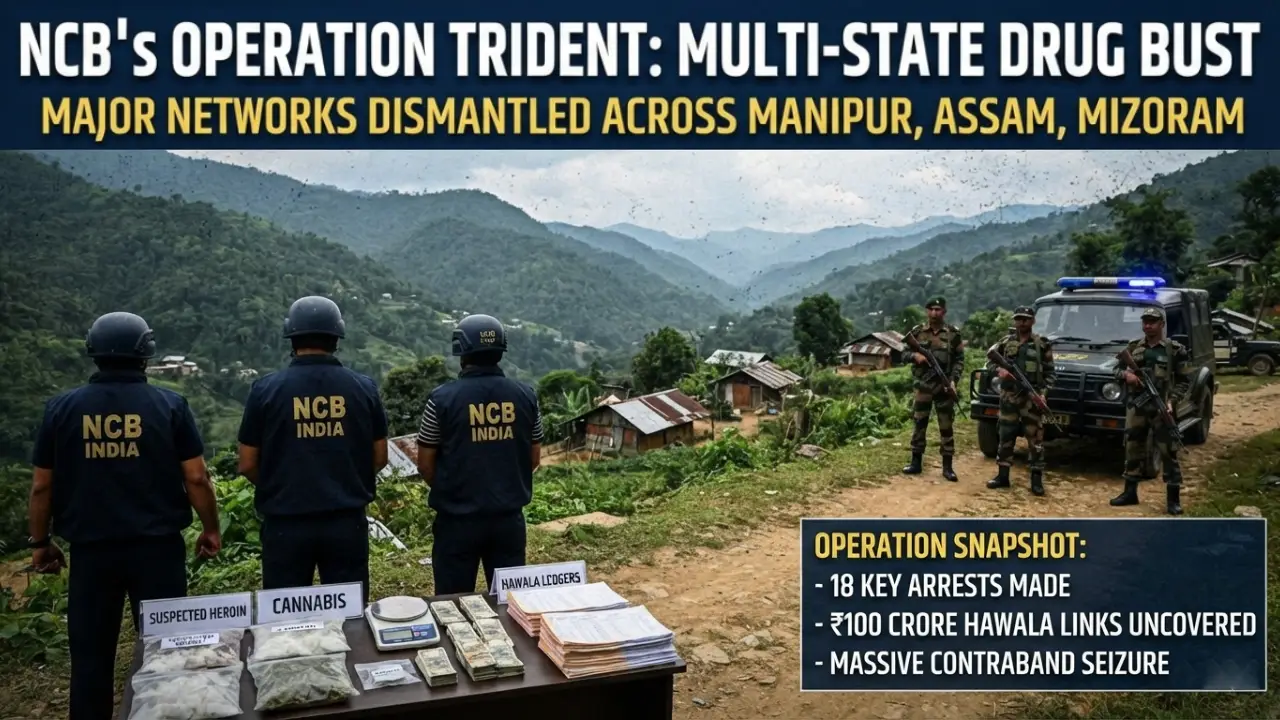
Imphal, Oct. 25: The Narcotics Control Bureau (NCB), in coordination with state police and other central agencies, launched a multi-state crackdown on an alleged transnational drug trafficking network across Assam, Mizoram and Manipur on October 23, deploying 38 teams simultaneously at 38 identified locations.
Union Home Minister Amit Shah said the operation, named Operation Trident, led to the arrest of 18 people and exposed hawala transactions worth nearly Rs 100 crore. Authorities also froze 1,424 bank accounts, attached properties valued at Rs 17.82 crore, and seized 500 detonators and Rs 12 lakh in cash, according to Shah.
The operation targeted the logistical and financial networks allegedly supporting cross-border narcotics trafficking. It involved coordinated action against suspected operatives, financial intermediaries and other links in the network across the three northeastern states.
In a post on X, Shah said the crackdown was part of the Union government's policy of zero tolerance towards drugs. He congratulated the anti-narcotics teams, central agencies and police forces of Assam, Mizoram and Manipur for their role in the operation.
Searches conducted across key locations
According to the operational details provided by the agencies, 38 multi-agency teams conducted simultaneous searches and enquiries at identified locations across the three states.
In Mizoram, the operation covered Aizawl, Champhai and Zokhawthar, a border trading town along the India-Myanmar frontier. Investigators also targeted linked operational bases in Churachandpur district of Manipur and the Cachar transit corridor in Assam.
The NCB spearheaded the operation in coordination with Mizoram Police and the Enforcement Directorate (ED). The agencies carried out intelligence-sharing, target identification and financial investigations before the coordinated searches.
The investigation focused on suspected drug transportation routes, financial transactions and the network of individuals allegedly involved in moving narcotics and transferring proceeds from illicit activities.
The simultaneous searches were intended to disrupt both the movement of drugs and the financial channels used by the alleged syndicate.
Myanmar-based alleged kingpin linked to trafficking network
The investigation stems from cases examined by the NCB, Mizoram Police and the ED to establish links between narcotics consignments, suspected traffickers and financial operators.
According to the investigation details, the network was allegedly led by Myanmar-based Thangcintuang, also known as Chintuang or Tluanga, who was wanted in more than 10 cases under the Narcotic Drugs and Psychotropic Substances (NDPS) Act registered by the NCB, Champhai Police and Mizoram Excise authorities.
Investigators alleged that the syndicate coordinated the movement of methamphetamine and heroin through routes connecting Myanmar, Mizoram, Manipur, Assam and Tripura, with onward trafficking into mainland India and Bangladesh.
The agencies had previously arrested several alleged members of the network during separate phases of the investigation.
Thangcintuang was arrested in Delhi following inter-state surveillance and follow-up operations, according to the case details provided by the agencies.
Vungkhanthawna, described as a key facilitator responsible for coordinating the movement and delivery of consignments originating in Myanmar, was also arrested and subsequently detained under the Prevention of Illicit Traffic in Narcotic Drugs and Psychotropic Substances (PITNDPS) Act.
Hawala transactions under investigation
Financial investigations identified Lalrampari as an alleged hawala operator linked to the network. The NCB arrested Lalrampari on August 8, 2024, and subsequent investigations reportedly traced nearly Rs 100 crore in suspected hawala transactions connected to the syndicate.
The findings prompted joint action with the ED to investigate the alleged proceeds of drug trafficking and identify assets suspected to have been acquired through illicit funds.
Another alleged operative, Abu Saleh, also known as Saifuddin, was arrested in Cachar district of Assam on November 20, 2025. Investigators described him as a key logistics operator responsible for coordinating narcotics transportation through the Assam corridor and linked him to multiple NDPS cases.
The agencies said financial profiling and digital forensic examinations conducted during the earlier investigations revealed additional suspected facilitators, shell entities and money mules. The findings led to the wider coordinated action under Operation Trident.
The latest operation's financial measures included the freezing of 1,424 bank accounts and attachment of properties worth Rs 17.82 crore, according to the figures shared by Shah. The agencies also seized 500 detonators, although the supplied details did not specify the locations where the items were recovered or their alleged intended use.
Focus shifts from seizures to financial disruption
Operation Trident is aligned with the Union government's Vision Document on Narcotics Control for 2026–2029, according to the operational briefing. The stated approach seeks to move beyond the seizure of narcotics towards dismantling the wider networks that facilitate trafficking and manage its proceeds.
The crackdown also reflects the security challenges posed by cross-border trafficking routes connecting parts of Northeast India with Myanmar and Bangladesh. Manipur and Mizoram, which share international borders with Myanmar, form part of the regional routes identified in the investigation.
Shah said the network operated through what he described as the “Death Triangle Corridor”, referring to routes used for trafficking narcotics across the borders of India, Myanmar and Bangladesh.
The government has set December 31, 2029, as the target date for eliminating drug networks under its stated anti-narcotics mission.
The agencies have not provided a complete state-wise breakdown of the 38 search locations, the 18 arrests or the seized materials in the information available for this report. Further details on the suspects' individual roles and the legal status of the cases were also not specified.