Thousands joined Manipur's October 23 sound protest across valley and hill districts, demanding action over continued killings, the NRC and the SoO agreement as police fired tear gas near Kangla.
Imphal, Oct. 24: Thousands of people across Manipur’s valley and hill districts took part in a coordinated sound protest on Friday evening, October 23, expressing anger over continued killings, the prolonged ethnic conflict and the failure to restore lasting peace in the state.
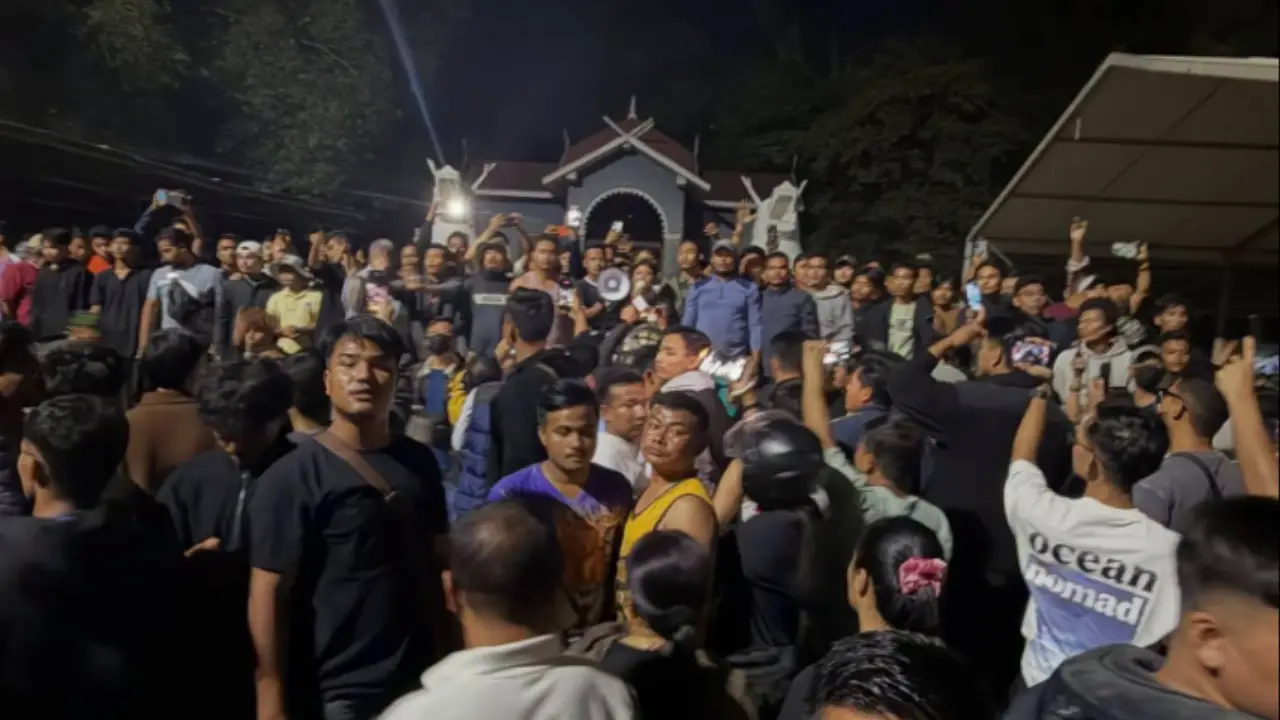
Responding to a call by the Federation of Haomee (FoH), residents banged metal utensils, beat drums, struck electric poles with hammers, sounded vehicle horns and sirens, and raised slogans between 7.30 pm and 8 pm. The protest was held across several localities, with a large gathering moving towards Kangla Fort in Imphal, where security forces deployed barricades and police fired tear gas shells as tensions rose near the historic complex.
The demonstration came amid public anger following the October 19 killing of three Meetei civilians at Sunulok Hill and the injury of three others in an armed attack. The killings were followed by protests and security operations in parts of the state, adding to demands for stronger action to protect civilians and address the continuing insecurity.
The sound protest was intended to make the grievances of the public heard by the state and Central governments. Organisers and participants raised concerns over the unresolved conflict, continued violence and what they described as the authorities’ failure to respond adequately to repeated appeals for peace and security.
Protest Spreads Across Valley and Hill Districts
The mobilisation was not confined to Imphal city. Reports said people participated in different localities across several valley and hill districts, while residents of Singjamei, the Assembly constituency of Chief Minister Yumnam Khemchand Singh, also joined the demonstration.
In neighbourhoods, people used whatever objects were available to produce loud sounds during the designated half-hour. The coordinated action brought together residents who wanted to express their frustration without relying solely on conventional rallies or speeches.
The Federation of Haomee had announced the programme earlier in the week through a video message from the western gate of Kangla Fort, appealing to people throughout Manipur to participate in the 30-minute demonstration.
Protesters Move Towards Kangla; Security Forces Set Up Barricades
Kangla Fort emerged as the principal focal point of the mobilisation in Imphal. Protesters marched towards the historic complex, which is close to Lok Bhavan and the Chief Minister's Secretariat.
Security forces stopped groups at Palace Compound, Moirangkhom and Keisampat junctions to prevent them from proceeding further. However, hundreds of demonstrators reached the Kangla gate, where security personnel prevented them from entering the fort premises.
The gathering near Kangla and Lok Bhavan became tense as more people assembled. Police subsequently fired several tear gas shells to disperse protesters gathered near Lok Bhavan and strengthened barricades along the approach to the high-security area.
Police used both tear gas shells and smoke bombs near Kangla's western gate as the crowd grew. It also reported traffic congestion on major roads as young people travelled by motorcycles and cars while sounding their horns.
No injuries or violence were reported during the protest. There was no immediate indication in the reports that any demonstrators had been detained in connection with the gathering.
NRC Implementation and SoO Abrogation Among Key Demands
The protest was directed not only against continued killings but also at wider security and political questions surrounding the crisis.
Among the demands reported were:
- Implementation of the National Register of Citizens (NRC) in Manipur.
- Identification of alleged illegal immigrants.
- Abrogation of the Suspension of Operations (SoO) agreement with armed groups.
- Action to resolve the prolonged ethnic conflict and restore normalcy.
- A response from the state and Central governments to repeated public appeals concerning civilian security.
The organisers called for an end to what they described as the Centre's “divide and rule” policy. These are demands and allegations raised by the protesters and organisers, rather than established findings.
The NRC demand reflects continuing concerns among sections of the state's population about documentation, migration and the identification of people considered to be residing in Manipur illegally. The call to abrogate the SoO agreement, meanwhile, places the protest within the continuing debate over arrangements governing armed groups and the state's security situation.
The Federation of Haomee also appealed for unity among Manipur's indigenous communities. In a separate programme at Sawombung Kabui Khunjao, participants used the traditional Kabui community call known as Khoang and the village call Pung-Jao to mobilise people and express their concerns. Federation leader Heera Kabui said collective action was needed to draw the attention of the state and Central governments to the prevailing situation.
Sunulok Hill Killings Intensify Public Anger
Friday's demonstration came four days after the October 19 attack at Sunulok Hill, where three Meetei civilians collecting firewood were killed and three others injured.
The incident prompted protests and demands for accountability, including calls for stronger security measures and action against those responsible. Demonstrations over the killings continued in the days leading up to Friday's sound protest.
The killings also became part of a wider sequence of public agitation over civilian safety, the continuing conflict and the lack of a durable resolution. The sound protest provided a coordinated platform for residents across the valley to express their anger at the same time.
The latest mobilisation coincided with intensified security operations in areas including S Phailengkot and Sinai Camp. Manipur Police subsequently reported the arrest of 17 individuals allegedly impersonating registered KNA and KLA cadres at Sinai Camp on October 23, along with the seizure of firearms, ammunition, explosives and communication equipment. The arrests are under investigation; no direct connection between the accused and the Sunulok Hill killings has been established publicly.
A Collective Message to the Governments
The Federation of Haomee presented the protest as a collective expression of public frustration and a demand for the authorities to respond to the crisis. The participation across multiple valley districts, followed by the march towards Kangla, brought together concerns over killings, security arrangements, the SoO agreement and the implementation of the NRC.
The events near Kangla also demonstrated the tension that can arise when large demonstrations approach sensitive government and security locations. Police used tear gas to disperse the gathering, while protesters sought to make their grievances heard.
The immediate demands raised during the protest were clear, but the demonstration did not itself produce a publicly reported government commitment to meet them. The central issues raised by the organisers and participants — civilian safety, accountability for killings, the future of the SoO arrangement and a lasting resolution to Manipur's ethnic conflict — remain matters for the authorities to address.