Camera traps in Kangkhui Khunou forest, Ukhrul, capture a female Red Serow with its offspring and a Barking Deer, documenting protected wildlife presence in Manipur.
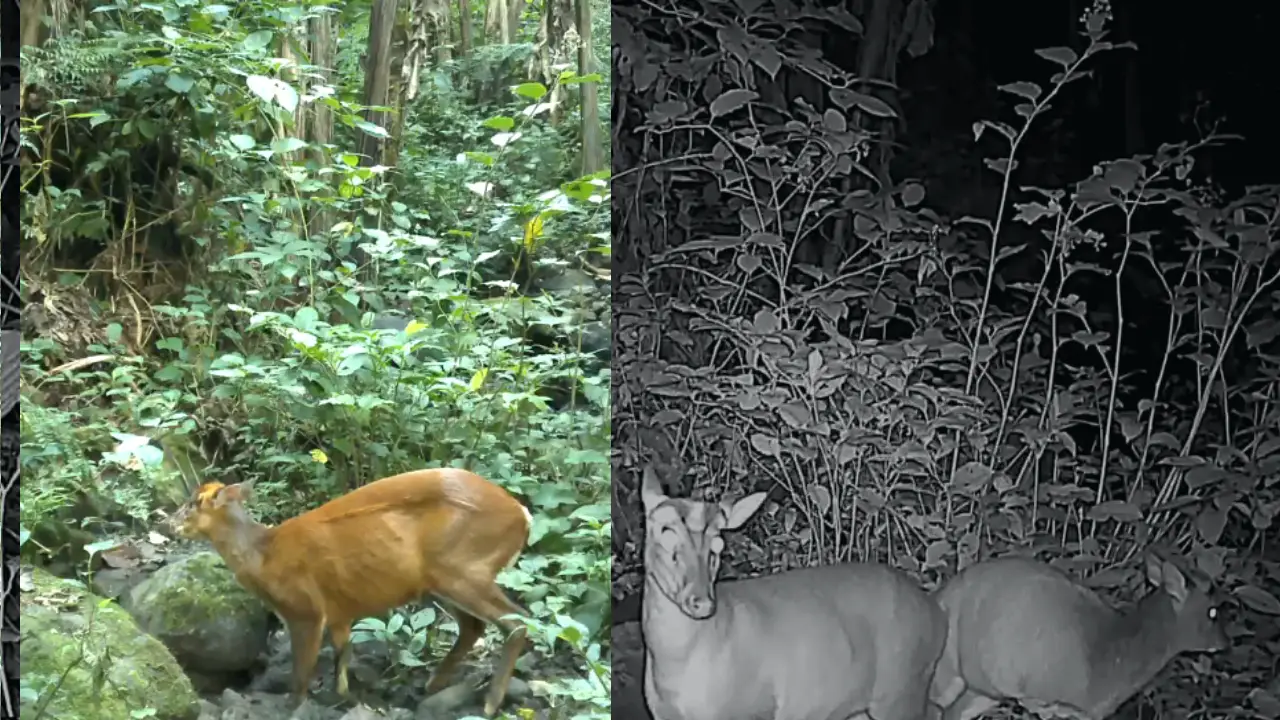
Ukhrul, Nov. 20: Camera traps installed by the Ukhrul Forest Division have recorded a female Red Serow (Capricornis rubidus) with its young offspring in the Forest Closure Area of Kangkhui Khunou in Ukhrul district, providing photographic evidence of breeding activity within the community-protected forest.
The cameras also captured a Barking Deer (Muntiacus vaginalis / Muntiacus muntjak) in the same forest area, documenting the presence of two protected wildlife species in the woodland.
The Forest Department, Government of Manipur, announced the findings on Friday, describing the sightings as an encouraging development for wildlife conservation and community-based forest protection in the district.
According to the Ukhrul Forest Division, motion-triggered cameras installed near a perennial forest stream recorded repeated visits by the female Red Serow and its offspring over a ten-day period. The animals were photographed on November 4, November 9 and November 14, 2026.
A camera trap image captured on November 9 at 6:52 PM showed the adult female moving through the forest with its young. Another photograph, taken on November 14 at 9:57 AM, documented a Barking Deer foraging along the forest floor.
The repeated appearance of the Red Serow pair near the same water source provides evidence of continued habitat use and possible breeding activity within the forest closure area. Such observations are considered useful indicators for assessing wildlife presence and habitat conditions in protected forest patches.
Divisional Forest Officer (DFO) of Ukhrul Forest Division, Smt. Laishram Gitla, IFS, said the recurring documentation of a mother Red Serow with its offspring was significant evidence of breeding activity in the Kangkhui Khunou closure area.
"This achievement reflects the positive conservation outcomes of sustained forest protection measures undertaken by the Ukhrul Forest Division in close collaboration with the local community," Gitla said.
She also stressed the importance of community participation in protecting sensitive wildlife habitats and maintaining the ecological condition of Ukhrul's hill forests.
The Red Serow, a goat-antelope species found across parts of Northeast India and neighbouring regions, is classified as Vulnerable on the International Union for Conservation of Nature (IUCN) Red List. Habitat fragmentation, hunting and pressures associated with shifting agricultural practices are among the threats affecting the species.
The animal is generally difficult to observe because it inhabits steep and densely forested landscapes. The photographic documentation of a female with its young in Kangkhui Khunou therefore provides useful information about the species' presence and habitat use in the area.
The conservation initiative at Kangkhui Khunou is being supported through the Community-Based Sustainable Forest Management for Water Resource Conservation in Manipur (COSFOM) Project, backed by the German Development Bank (KfW).
The project follows an integrated watershed management approach, focusing on the restoration of upper catchments, protection of village water sources and promotion of sustainable rural livelihoods.
At the village level, community mobilisation and participatory planning have been facilitated in collaboration with Environmental Force at Grass Root Level (ENFOGAL), an Ukhrul-based non-governmental organisation. The Manipur Forest Department provides technical guidance, supervision and institutional coordination for the initiative.
Under the forest closure model, village authorities and residents agree to restrict activities such as extraction of forest resources, grazing and hunting in designated ecologically sensitive areas. Particular attention is given to locations surrounding springs, streams and other important water sources.
The restrictions allow vegetation to regenerate and reduce human disturbance, creating conditions that can support wildlife by maintaining access to water, food and shelter.
The presence of the Red Serow and Barking Deer in Kangkhui Khunou also provides information about the condition of the forest habitat. The riparian vegetation along the stream is important for maintaining water resources while providing shelter and foraging areas for wildlife.
In its official communication, the Ukhrul Forest Division acknowledged the cooperation and commitment of Kangkhui Khunou residents in protecting the area's natural resources.
The division also stated that it would continue scientific wildlife monitoring through systematic camera trapping, strengthen habitat protection measures and expand community-based conservation partnerships across Ukhrul district.
The latest sightings highlight the role of village-level forest protection in conserving wildlife habitats beyond formally notified national parks and wildlife sanctuaries. The Kangkhui Khunou initiative combines watershed conservation with community participation, with the latest camera trap records providing further evidence of wildlife use of the protected area.