COCOMI questions the Manipur Government's SoO policy, seeks clarity on Kuki militant groups' status and raises constitutional concerns over the Separate Administration demand.
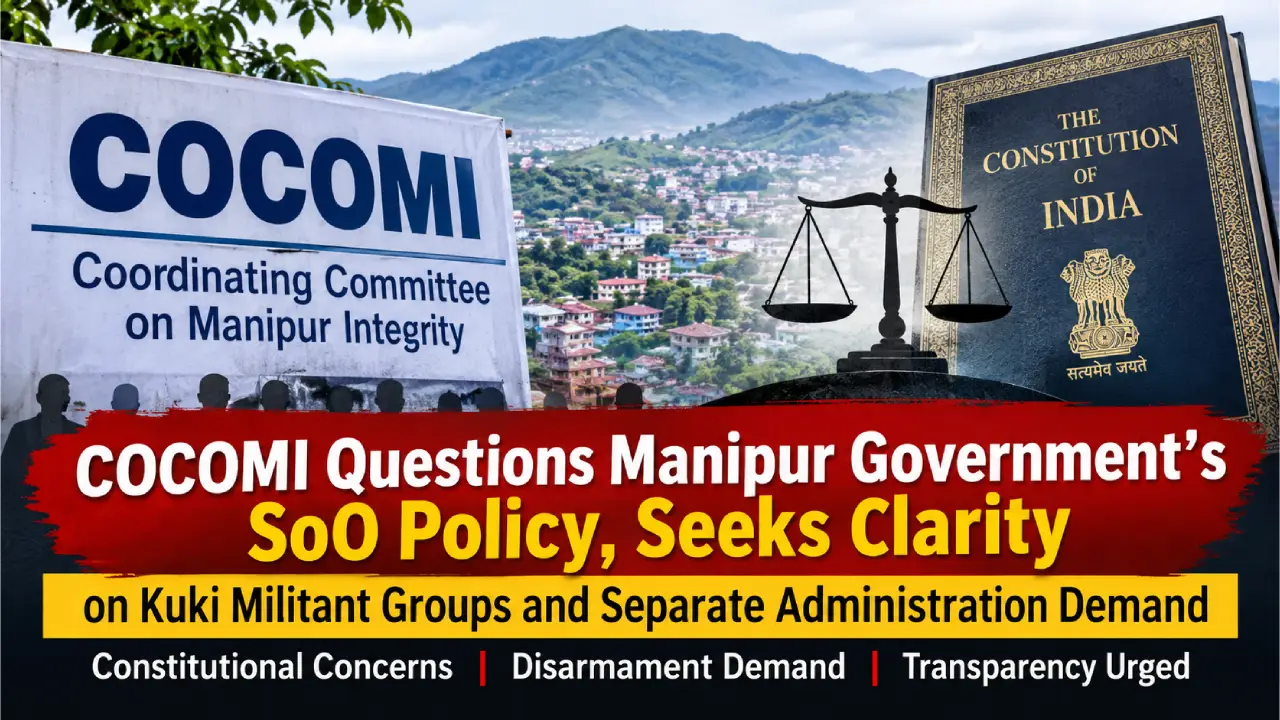
Imphal, Nov. 21: The Coordinating Committee on Manipur Integrity (COCOMI) has questioned the Manipur Government's position on the Suspension of Operations (SoO) agreement with Kuki militant groups, alleging inconsistencies between statements made by the State's Home Minister and representatives of the armed organisations. The committee has also expressed concern over discussions reportedly taking place on the demand for a Separate Administration for Kuki-Zo groups, calling for greater transparency and constitutional clarity.
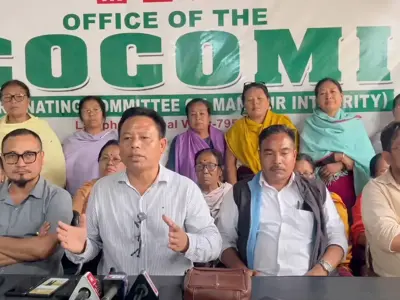
In a statement issued by Phijam Shyamchand, Convenor of COCOMI's IPR Sub-Committee, the organisation criticised a recent social media statement by Dr. Prasenjit Biswas, who reportedly said that the conflict in Manipur would end only if the Kuki demand for a Separate Administration was conceded.
COCOMI described the position as raising serious ethical, political and constitutional concerns. It argued that presenting the acceptance of a Separate Administration demand as the only condition for ending the conflict was neither an objective nor a responsible approach to resolving the crisis.
The committee expressed concern that such statements could legitimise a political demand being advanced amid prolonged violence and armed confrontation. It said Dr. Biswas, given his understanding of Manipur's historical and political complexities, should be mindful of the consequences of advocating such a position.
COCOMI further warned that statements of this nature could contribute to prolonging what it described as a proxy conflict in Manipur.
The organisation also raised questions over the actual status of the SoO agreement following its expiry on September 4.
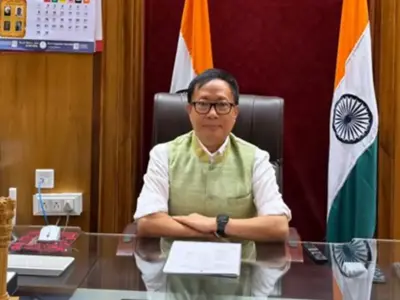
According to the statement, Manipur Home Minister Govindas Konthoujam reportedly informed the media at a recent programme in Imphal that the agreement with Kuki militant groups had not been extended after its expiry and was no longer in existence.
However, COCOMI pointed to a seemingly different position expressed by Sheilen Haokip, Chairman of the Kuki National Army (KNA) and spokesperson of the Kuki National Organisation (KNO).
Haokip reportedly stated that although the SoO agreement had not been formally extended, it continued to operate on the ground.
The SoO arrangement involves two umbrella organisations representing Kuki militant groups, the KNO and the United People's Front (UPF).
COCOMI said the differing statements raised fundamental questions about the agreement's actual status and the Government's policy towards the armed groups.
The committee questioned what measures had been taken since September 4 to ensure that the groups ceased their activities, surrendered their weapons or complied with the law, if the agreement had indeed ceased to exist.
It said the absence of visible enforcement measures raised concerns about the Government's commitment to ending armed activities in the State.
The organisation also questioned whether it was appropriate for the Home Minister, who is responsible for maintaining security and public confidence, to make statements that appeared inconsistent with the position articulated by the leadership of the armed organisations concerned.
According to COCOMI, such contradictions could create confusion among the public and undermine confidence in the Government's handling of the crisis.
COCOMI expressed particular concern over a reported statement by Sheilen Haokip: "We have full understanding with the security forces in the foothills."
The committee sought clarification on what the claimed understanding entailed and whether it indicated an informal operational arrangement between armed groups and security forces despite the reported expiry of the SoO agreement.
It questioned under whose authority such an arrangement, if it existed, was being maintained and within what legal and constitutional framework.
COCOMI said the Government must clarify the matter without ambiguity.
The organisation also objected to claims by armed group leaders that their cadres were protecting members of a particular community.
It maintained that no armed organisation could assume the functions of a parallel security establishment or claim exclusive responsibility for protecting a particular community within India's constitutional framework.
Such assertions, it said, required an unequivocal response from the Government.
The statement also questioned Dr. Biswas's reported assertion that the Government was continuously engaging in discussions with Kuki-Zo militant organisations on the demand for Separate Administration, as well as issues concerning land, forests and natural resources.
COCOMI sought transparency regarding the nature and scope of these discussions, particularly where they could have implications for Manipur's territorial integrity, administrative structure and ownership of natural resources.
The committee said the people of Manipur deserved to know the details of any negotiations that could affect the State's constitutional and administrative framework.
It further alleged that the situation had exposed unequal enforcement of law and order within a single constitutional State.
While the Government continued to appeal for public cooperation and peace, COCOMI said people were yet to witness sufficiently decisive action against armed groups and those responsible for perpetuating violence.
According to the committee, peace could not be restored through appeals and assurances alone but required consistent enforcement of the Constitution and the rule of law across all parts of the State.
Reiterating its position on the SoO arrangement, COCOMI maintained that disarmament of armed groups operating under the framework was an essential prerequisite for establishing lasting peace in Manipur.
It urged the Government to bring all such groups under effective legal and security scrutiny, secure their weapons and ensure that designated camps and cadres were subjected to applicable legal and security protocols.
The committee, however, emphasised that any enforcement operation must be lawful, impartial and consistent with constitutional safeguards.
It warned that selective enforcement or prolonged inaction would further deepen public mistrust and destabilise the State.
COCOMI also referred to the wider impact of the prolonged crisis on Manipur, stating that the State had suffered substantial losses across its economy, education system, social institutions and other vital sectors.
It said the crisis could not be resolved through political rhetoric or statements intended merely to reassure the public. Instead, the Government needed to demonstrate its commitment through measurable action, accountability and a clear roadmap for restoring normalcy.
The committee maintained that the Government would ultimately be judged by its actions rather than its statements.
Addressing Dr. Biswas's reported reference to Article 244A of the Constitution of India as a possible constitutional basis for creating a separate administrative arrangement, COCOMI said the provision had a specific geographical and constitutional scope.
The organisation pointed out that Article 244A empowers Parliament to provide for the formation of an autonomous State within Assam, comprising certain tribal areas specified in the Sixth Schedule. It also provides for the establishment of a legislature, a Council of Ministers or both for such an autonomous State.
COCOMI maintained that the provision was not a general constitutional mechanism that automatically extended to other States, including Manipur.
To support its position, the committee referred to the Ministry of Home Affairs' response to Rajya Sabha Unstarred Question No. 1810, answered on January 3, 2018.
According to COCOMI, the parliamentary response clarified the constitutional context of Article 244A and its provision for an autonomous State within Assam.
The organisation argued that any proposal to invoke or replicate such an arrangement in Manipur would require careful examination of the relevant constitutional provisions, legislative competence and applicable legal procedures.
It said the provision could not be presented as an automatic or straightforward constitutional entitlement for creating a separate administrative arrangement in Manipur.
In its concluding remarks, COCOMI maintained that proposals concerning Manipur's future administrative and territorial arrangements must be examined objectively, taking into account constitutional principles, historical realities, democratic aspirations and the rights of all communities living in the State.
It cautioned that proposals advanced without adequate constitutional scrutiny or an inclusive understanding of Manipur's historical and political context could aggravate existing divisions instead of contributing to a resolution of the conflict.
The statement was issued by Phijam Shyamchand, Convenor of the IPR Sub-Committee of COCOMI.