A Delhi court has directed police to give Bimol Akoijam seven days’ notice before arrest, while the Delhi High Court has stayed JNU’s dismissal order.
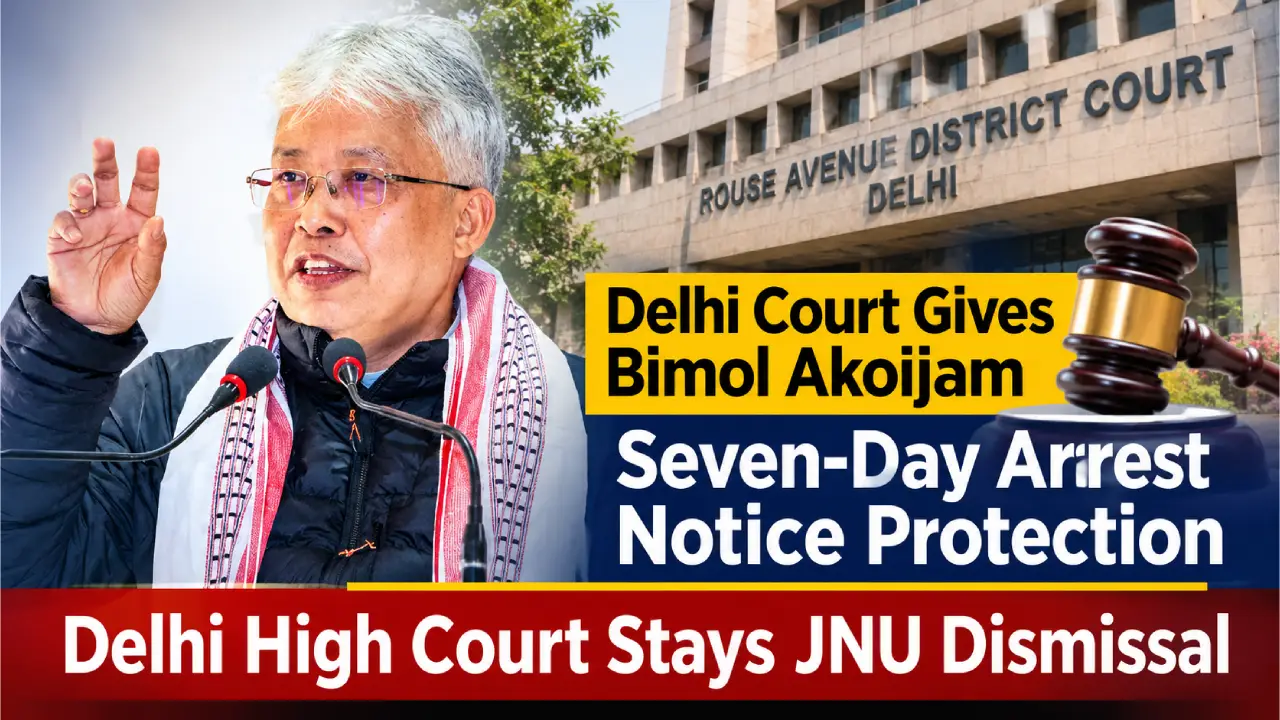
New Delhi, Nov. 5: A Delhi court on Thursday directed the Delhi Police to give Congress MP and Jawaharlal Nehru University (JNU) professor Angomcha Bimol Akoijam seven days’ prior notice before arresting him in a sexual harassment case, while disposing of his anticipatory bail plea. The development follows a separate order by the Delhi High Court on November 2 staying JNU’s decision to terminate his services and issuing notice to the university on his challenge to the dismissal.
The two judicial developments concern separate proceedings: one relates to the criminal investigation into allegations made against Bimol Akoijam, while the other concerns the legality of the university’s decision to dismiss him. Neither order amounts to a final determination of the allegations against him.
According to reports on Thursday’s proceedings, Special Judge Digvinay Singh of the Rouse Avenue Courts disposed of the anticipatory bail application after the Delhi Police indicated that there was no immediate plan to arrest Bimol Akoijam. The court directed the police to provide seven days’ notice if they decide that his arrest is necessary.
Delhi court disposes of anticipatory bail plea with protection against immediate arrest
Bimol Akoijam had approached the Rouse Avenue Courts seeking anticipatory bail after the Delhi Police registered a First Information Report (FIR) in connection with the allegations of sexual harassment.
On November 3, Special Judge Dig Vinay Singh had sought a response from the Delhi Police and directed that no coercive action be taken against the MP until the next hearing on November 5. The investigating officer was also directed to appear with the case file.
During the proceedings, the police informed the court that there was no immediate plan to arrest Bimol Akoijam. The court subsequently disposed of his plea and directed that he be given seven days’ notice before any arrest, according to reports of the hearing.
The distinction is important: the latest order provides protection against immediate arrest subject to the notice direction, rather than constituting an unconditional grant of anticipatory bail. The detailed court order was awaited in the initial reports, and the precise terms of the operative order should be checked against the written record.
The court also took note of the ongoing investigation and Bimol Akoijam’s cooperation with the investigating authorities. Reports said the complainants’ statements had yet to be recorded at the stage considered by the court. The police remain at liberty to approach the court for appropriate directions if Bimol Akoijam fails to cooperate with the investigation.
Bimol Akoijam had earlier secured transit anticipatory bail from a court in Manipur, which was subsequently extended by a Delhi court. His defence had also submitted that he had joined the investigation and was cooperating with the authorities.
Delhi High Court stays JNU’s dismissal order
The development in the criminal case came three days after the Delhi High Court intervened in the separate service-related proceedings.
On November 2, Justice Anup Jairam Bhambhani stayed JNU’s decision to terminate Bimol Akoijam’s services. The High Court also issued notice to the university on his petition challenging the dismissal, with the matter listed for further hearing in January 2027.
JNU had terminated Bimol Akoijam’s services with immediate effect on October 9 following an internal inquiry into allegations of sexual harassment made by female students.
In challenging the decision, Bimol Akoijam questioned the procedure followed by the university and argued that he had not been issued a notice before his termination. He also raised concerns about the disciplinary process, describing the dismissal as a politically motivated action.
The High Court’s interim order puts the termination decision on hold while the legal challenge is considered. It does not, by itself, decide whether the allegations against him are true or whether the university’s internal inquiry reached the correct conclusions.
The university’s termination order, signed by Vice-Chancellor Santishree D. Pandit, stated that its Internal Complaints Committee had conducted an inquiry and recommended disciplinary action based on its findings. JNU maintained in the order that the dismissal followed due process and consideration of the committee’s report.
FIR follows complaints by female students
The criminal proceedings stem from complaints made by female students of JNU in May 2026. Reports have cited at least 11 complainants, while some later coverage has referred to 16 students.
The allegations include claims that Bimol Akoijam invited students to his campus residence under the pretext of meetings or gatherings, made inappropriate or sexually suggestive remarks, and engaged in unwelcome conduct. Other allegations reported in connection with the university inquiry concern interactions during classes and viva examinations.
These remain allegations and have not been established by a criminal court.
According to reports, the university’s Internal Complaints Committee examined accounts from complainants, witnesses and defence witnesses, along with other material, before recommending disciplinary action. The findings of that internal process have also formed part of the material referred to in the police complaint.
The Delhi Police registered the FIR at Vasant Kunj North police station in October, following a complaint and documents submitted by JNU’s Chief Security Officer. Reports on the case have identified Section 75 of the Bharatiya Nyaya Sanhita (BNS), which deals with sexual harassment, among the provisions invoked.
The investigation remains ongoing. The police have been examining the material connected with the complaints and the university’s internal inquiry, according to reports submitted during the court proceedings.
Bimol Akoijam has denied the allegations and challenged the action taken against him by the university. The criminal investigation and his challenge to the dismissal will proceed through their respective legal channels.
Two separate legal proceedings remain pending
The orders from the two courts address different questions.
The Rouse Avenue court’s order concerns the police investigation and the conditions under which Bimol Akoijam may be arrested. The Delhi High Court’s interim order concerns JNU’s decision to terminate his employment and the procedural and legal issues raised in his petition.
The seven-day notice direction does not amount to a finding on the merits of the sexual harassment allegations. Similarly, the stay on dismissal does not establish that the allegations are false or determine the outcome of the university’s inquiry.
The Delhi High Court is scheduled to take up the service-related petition in January 2027. The criminal investigation remains separate, with the police continuing their inquiry into the allegations.
For Bimol Akoijam, the two orders provide interim relief in separate legal proceedings, but neither concludes the underlying disputes.