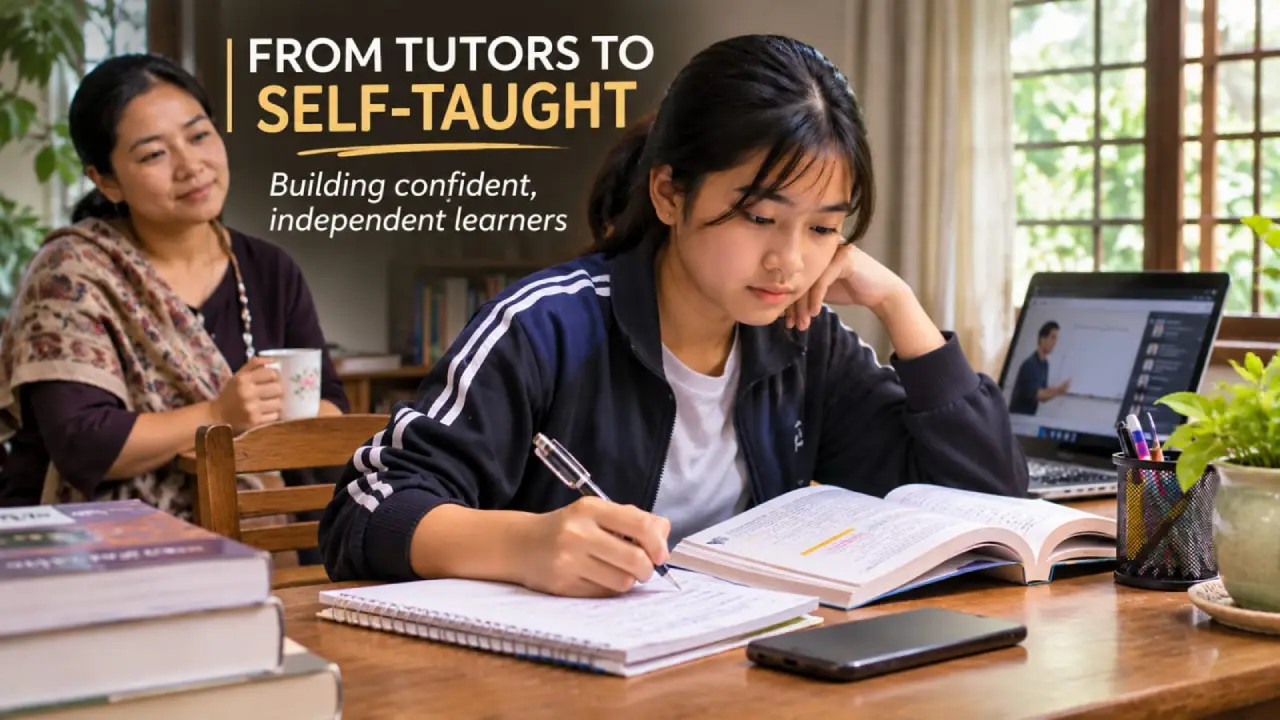
As digital resources reshape education, students can increasingly learn independently. The challenge is helping them move from tuition dependence towards guided, confident self-directed learning.
|
T |
here was a time when learning outside school usually meant finding a teacher. A student who could not understand mathematics looked for a mathematics tutor. A child struggling with English grammar joined another class. If examinations were approaching, tuition hours often increased. In many families, particularly in places where competition for good marks is intense, tuition became almost synonymous with serious education. That relationship is beginning to change.
A student today can watch a university lecture from another country, read an explanation of a difficult concept, practise through an interactive platform, ask an AI tutor for a simpler explanation, follow a programming course, participate in an online community and test their knowledge — often without leaving the study table.
The important question is not whether tutors will disappear. They will not, and they should not. The more important question is whether education can gradually move a child from needing someone to teach every step towards knowing how to learn the next step independently. That is a much bigger educational shift.
The internet has changed the meaning of “teacher”
For earlier generations, access to knowledge was limited. The teacher, textbook and library were the principal gateways to information. A student's learning depended considerably on the quality and availability of those gateways.
Today, information is abundant. A motivated learner can find introductory courses, demonstrations, simulations, lectures, practice exercises and explanations at different levels of difficulty. Platforms such as YouTube, online courses and open educational resources have created an enormous informal learning ecosystem.
But abundance brings a new problem: knowing what to learn, what to trust and how to organise it.
This is why simply giving children a smartphone or computer does not create independent learners. The OECD's recent research on digital technologies makes a similar point: technology can support personalised and self-regulated learning, but access to technology by itself does not guarantee educational improvement. Effective use depends on pedagogy and on students developing the ability to manage their own learning.
In other words, the digital revolution has not made teachers unnecessary. It has changed what we should expect teachers to do.
From explanation to guidance
A good tutor can explain a difficult mathematical equation. A better tutor can eventually help the student recognise how to approach the next unfamiliar equation without assistance. This distinction is crucial.
If a child constantly waits for an adult to explain every chapter, solve every difficult problem and decide what should be studied next, the child may perform well while the tutor is present but struggle when that external structure disappears.
Independent learning therefore should not mean abandoning students to themselves. It means transferring responsibility gradually.
At first, the adult may say, “Here is what you need to study.”
Later, the instruction becomes, “What do you think you need to study today?”
Eventually, the student should be able to say, “I do not understand this part. I have tried these two approaches. I think I need another explanation.”
That final stage represents a significant educational achievement.
The student is no longer merely receiving education. The student is managing learning.
Autonomy does not mean freedom without structure
There is sometimes a misunderstanding about self-directed learning. If students are told to “study independently” without a routine, goals or feedback, many will simply become distracted. Self-directed learning is not educational abandonment.
A 2026 second-order meta-analysis covering approximately 43,775 students found that self-directed-learning interventions produced positive effects not only on academic outcomes but also on self-regulation, skills and motivation. Importantly, the researchers emphasised that successful self-directed learning involves deliberately structured responsibility and support rather than unlimited freedom. This is particularly relevant for school-age children.
A student may need help creating a weekly plan. They may need someone to check whether the plan is realistic. They may need feedback after a test. They may need help identifying why they repeatedly make the same mistake.
But none of this requires an adult to sit beside them for every hour of study. The objective should be guided autonomy.
The tuition question in Manipur
This becomes complicated in Manipur, where tuition has become deeply embedded in the educational routine of many families.
Parents often have legitimate reasons for relying on tutors. School classrooms can be crowded. Teachers have limited time. Parents may not feel confident teaching every subject. Some homes are too busy or distracting for sustained study. Examination pressure also creates understandable anxiety. The answer, therefore, cannot simply be “stop tuition”. That would be unrealistic. The more useful question is: What should tuition accomplish?
If tuition merely becomes an extension of school — another adult explaining every lesson while the child passively copies notes — dependency may increase.
But if a tutor identifies weaknesses, teaches difficult concepts, provides feedback and then deliberately encourages the student to practise independently, tuition can become a bridge towards autonomy. The same principle applies at home.
Parents do not need to become full-time teachers. In fact, constantly hovering over a child's study can sometimes communicate an unintended message: You cannot manage this without me.
A better approach is to provide structure without taking ownership of the entire learning process.
Building a support system without constant tuition
A child learning independently still needs a support system. It simply looks different. One practical system could contain five elements.
First, a clear weekly target. Instead of saying “study science”, specify what should be understood by the end of the week.
Second, a learning resource. This might be a textbook, lecture, video, online course or carefully selected AI-assisted explanation.
Third, active practice. The student should solve problems, write explanations, create questions or demonstrate what they have understood.
Fourth, a progress record. A simple tracker can record what was completed, what remains unclear and what needs revision.
Fifth, periodic human feedback. A parent, teacher, tutor or older student can review the work without controlling every study session.
This creates something more sustainable than continuous supervision.
The student has a map, resources, a method of checking progress and access to help when genuinely necessary.
The new role of AI
Generative AI makes this transition even more interesting — and more complicated.
A student can now ask an AI system to explain photosynthesis in simpler language, generate practice questions, provide hints for a programming problem or challenge an answer with counter-questions.
But there is a serious trap.
If the student simply asks AI for the answer and copies it, technology has increased convenience without necessarily increasing learning. The OECD's 2026 Digital Education Outlook makes precisely this distinction: generative AI can support learning when guided by sound pedagogical principles, but outsourcing cognitive tasks to AI can improve task performance without producing corresponding learning gains.
So the best digital tutor should not always be the one that gives the fastest answer. Sometimes it should ask another question. Sometimes it should offer a hint. Sometimes it should say, “Try this first.” That is closer to the role of a good human teacher.
Learning to ask for help
There is another skill that independent learners must develop: knowing when they are stuck. Self-reliance does not mean solving everything alone.
A mature learner knows the difference between productive struggle and wasted frustration. They try, check resources, change their approach and then seek help when necessary. The ability to ask a precise question is itself an important learning skill.
Instead of saying, “I don't understand this chapter,” a student might say, “I understand how the formula is derived, but I don't understand why this value changes when the condition changes.” That question gives a teacher far more information. It also demonstrates that the student has already done some thinking.
This is one reason I have always found question-making useful in learning. When students formulate their own questions from a lesson, they reveal both what they understand and where their understanding breaks down. The goal is not fewer teachers. It is less dependency.
There is a danger in presenting independent learning as a technological replacement for teachers. That is the wrong direction.
The teacher's role may actually become more valuable in a world overflowing with information. Students need people who can help them distinguish reliable knowledge from misinformation, understand difficult ideas, interpret feedback, develop intellectual discipline and maintain perspective.
The OECD's PISA 2025 framework places self-regulated learning at the centre of learning in the digital world, including the ability to monitor and control cognitive, behavioural, motivational and emotional processes while learning. That is a much richer definition of education than simply completing a syllabus.
The ultimate measure of a successful teacher may therefore be found partly in what happens when the teacher is no longer there.
Can the student begin?
Can the student plan?
Can the student search?
Can the student question?
Can the student recognise an error?
Can the student try another method?
Can the student ask for help intelligently?
And, perhaps most importantly, can the student continue learning after the examination has ended?
These are the habits that turn schooling into education.
The transition from tutor-dependent learning to self-directed learning should therefore not be understood as a sudden rejection of teachers, tuition or parental guidance. It is a gradual transfer of responsibility.
We begin by holding the child's hand. We then walk beside the child. Eventually, we allow the child to choose the direction while remaining close enough to offer help when the road becomes difficult. That is not the disappearance of guidance. It is the purpose of guidance.
A good education does not make a child dependent on a better teacher. It helps the child become a better learner.
(Keithellakpam Manikanta Meetei is a seasoned journalist and a former educator. He also writes under his pen name Keicha Chingthou Mangang instead of his actual name. You can contact him at chingthouheiya@gmail.com)