Google releases Gemini 4 Carbon, Decision 1 and Hydrogen in November 2026, introducing advanced reasoning, multimodal decisions, faster coding and AI automation.
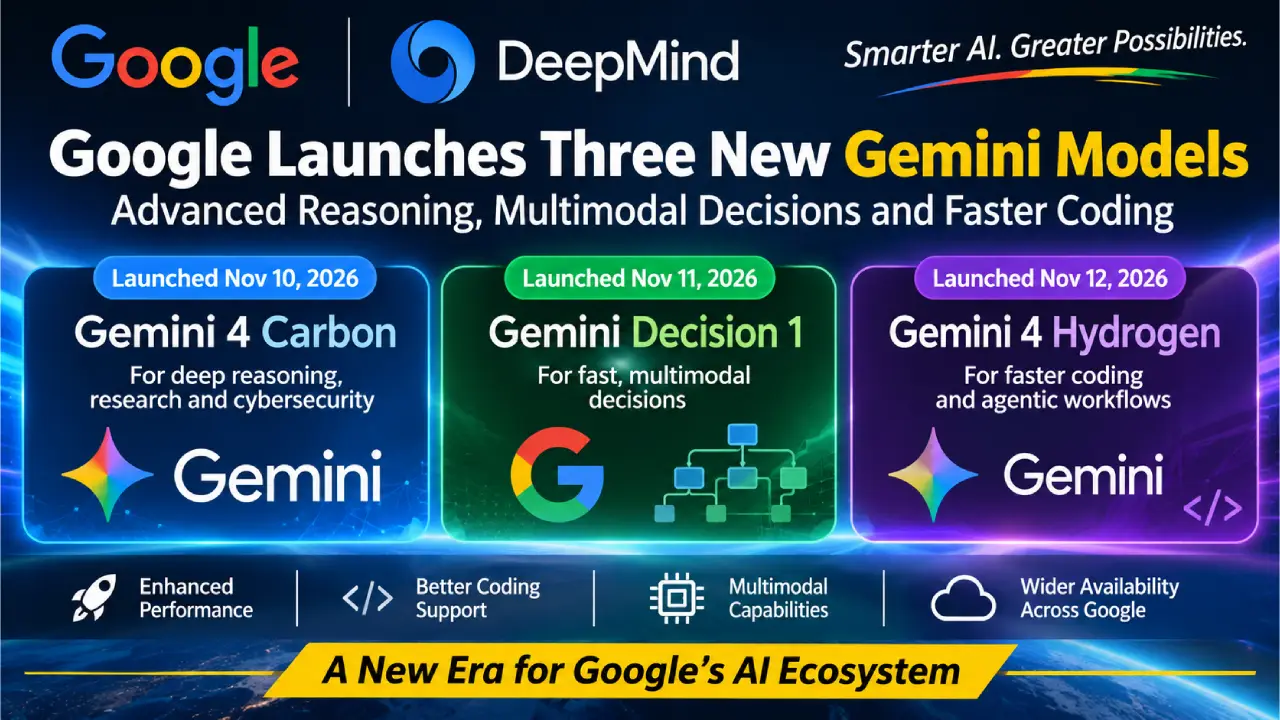
Imphal, Nov. 15: Google has introduced three new artificial intelligence models within its Gemini ecosystem over three consecutive days, expanding its capabilities in advanced reasoning, scientific research, software development, multimodal analysis and automated decision-making.
The releases include Gemini 4 Carbon on November 10, Gemini Decision 1 on November 11 and Gemini 4 Hydrogen on November 12, 2026. Developed by Google DeepMind, the three models are designed for different workloads, ranging from complex research and cybersecurity to rapid coding and high-volume automated decisions.
The announcements reflect Google's approach of developing specialised AI models rather than relying on a single system for every task. While Carbon is positioned as the company's most capable model for demanding reasoning and extended agentic workflows, Hydrogen focuses on speed and execution. Decision 1, meanwhile, introduces a separate system designed to evaluate multiple choices and return confidence scores without generating conventional text responses.
Gemini 4 Carbon: Advanced reasoning, cybersecurity and scientific research
Launched November 10, 2026
Google announced the general availability of Gemini 4 Carbon on November 10, describing it as its strongest model for complex knowledge work, software engineering, cybersecurity and scientific reasoning.
According to Google DeepMind, Carbon is designed for tasks that require extensive analysis, multiple reasoning stages and repeated verification. These include complex coding projects, debugging across large software systems, legal and financial research, and scientific investigations involving large datasets.
Unlike models optimised primarily for quick responses, Carbon can use more computational resources and tokens to explore difficult problems, evaluate alternative approaches and verify results before completing a task.
Google reported that Carbon ranked first in three independent workflow evaluations: CursorBench 4.0, Perplexity's WANDR and Zapier's AutomationBench. The company also said the model achieved these results at more than twice the cost efficiency per task compared with the next-best external model in those evaluations.
Cybersecurity capabilities
Cybersecurity is one of the major areas of development in Gemini 4 Carbon.
Through its Fairwind programme, Google has been testing the model's ability to identify software vulnerabilities, assess how security weaknesses can be exploited and generate patches addressing the underlying problems.
The company reported that Carbon achieved 100% recall in vulnerability scanning and 95% precision in triage on an internal benchmark used by Google's Project Fortify.
Google also cited testing by its Cloud Vulnerability Research team, which used Carbon to demonstrate that two bugs in an open-source software project were exploitable vulnerabilities. The findings helped maintainers reclassify the issues as critical and issue a patch following the responsible disclosure process.
The company said Carbon's cybersecurity capabilities are being made available through controlled access arrangements for security researchers and defenders.
Scientific and research applications
Carbon is also designed to support scientific research involving physics, mathematics and life sciences.
Google said the model can analyse experimental data, identify patterns, test hypotheses and work through complicated scientific problems.
One example cited by the company involved protein research. In collaboration with other AI systems, Carbon helped researchers identify previously overlooked evolutionary relationships among proteins. Google reported an average 40-fold increase in the number of homologs retrieved across seven low-homolog protein families from the CASP17 blind test set.
The company also described research applications involving enzyme assays, experimental data analysis and mathematical verification of software security protocols.
Availability and pricing
Gemini 4 Carbon is available through the Gemini API in Google AI Studio and Gemini for business for paying developers and enterprise customers.
It is also being offered to Google AI Ultra subscribers through the Gemini app, AI Mode in Google Search, Google Antigravity and AI Studio.
The introductory API price is US$2 per million input tokens and US$10 per million output tokens through November 30, 2026. Google stated that the public-access model's pricing will subsequently increase to US$4 per million input tokens and US$20 per million output tokens.
Gemini Decision 1: AI designed to make faster decisions
Launched November 11, 2026
On November 11, Google introduced Gemini Decision 1 alongside a new developer interface called the Gemini Decisions API.
Unlike conventional generative AI models that produce responses by generating text token by token, Decision 1 is designed to evaluate a set of predefined options and return probabilities and confidence scores.
The model is intended for applications where software needs to make rapid, bounded decisions rather than generate lengthy explanations.
These include selecting the appropriate AI model for a task, determining which tool should be used, checking policy compliance, classifying information and evaluating content against predefined criteria.
According to Google DeepMind researchers Min Choi and Felix Yu, the system can process one shared input and evaluate up to 1,000 independent questions in a single request.
Multimodal decision-making
One of Decision 1's main features is its ability to process multiple types of information within the same request.
It supports:
Text and documents.
Images and photographs.
Audio recordings.
Video files.
PDF documents.
The system supports a context of up to 256,000 tokens and can evaluate three types of questions.
The first is a yes-or-no assessment, which estimates the probability that a particular condition is true.
The second is multiple-choice evaluation, where the model selects from between two and 255 possible options and provides probabilities for the alternatives.
The third is rubric-based scoring, which evaluates material against an ordered set of predefined criteria.
Each response includes a confidence score between zero and one, allowing software systems to identify uncertain results and refer them to another model or a human reviewer.
Speed and pricing
Google reported an end-to-end response time of approximately 150 to 250 milliseconds for the model, with median computational processing time of 50 to 100 milliseconds.
The company said the latency remains relatively stable when the number of questions increases from one to 100 within the tested context range.
The pricing is also different from conventional generative models. Google has set the price at US$0.10 per million input tokens, with no charge for output tokens.
The company said this makes Gemini Decision 1 nearly five times cheaper across its shared benchmark suite than Gemini 3.5 Flash-Lite used through the Interactions API. This comparison is based on Google's published evaluation.
Applications across Google's products
Google is already using the Decisions API in several of its products.
In Gemini Notebook, the system can route incoming queries to an appropriate model and reasoning level, with Google reporting latency reductions of up to 40% for everyday queries.
Its Stitch design platform uses the API to generate interactive wireframes and apply changes through voice or touch.
Google's CC application also uses it to select emoji reactions from a large collection, while Search uses the technology as an additional safety layer for identifying adversarial behaviour involving external tools.
Developers can access Gemini Decision 1 through the Gemini API in Google AI Studio. Google also announced integrations with platforms including OpenRouter, LangChain, Vercel, LiteLLM, Pydantic AI, Pipecat, LiveKit and OpenCode, with further support planned for Gemini in Google Cloud.
Gemini 4 Hydrogen: Faster coding and agentic workflows
Launched November 12, 2026
Google introduced Gemini 4 Hydrogen on November 12, positioning it as a faster and more cost-efficient model for everyday coding, software development and agentic workflows.
While Carbon is intended for demanding reasoning and long-running tasks, Hydrogen is designed to execute work quickly, including writing code, running tests, debugging applications and verifying changes.
Google said Hydrogen is adapted from Gemini 4 Carbon and is intended to operate independently or alongside more powerful models in workflows involving multiple AI agents.
The company reported that Hydrogen completes tasks 2.5 times faster than Gemini 3.8 Flash at its default high-thinking setting. Its Terminal-Bench 4.1 score reached 57%, compared with 18.2% for Gemini 3.8 Flash. Google also reported that the model reduces fabricated claims by more than five times compared with its predecessor.
Four configurable reasoning levels
Gemini 4 Hydrogen introduces four thinking levels, allowing users to balance response speed, reasoning depth and computational costs.
These include:
Low: For quick responses and straightforward tasks.
Medium: For a balance between speed and reasoning.
High: The default setting for more demanding everyday work.
Xhigh: For tasks requiring additional reasoning capacity.
Google said the different settings allow users to choose the level of computational effort required for a particular task.
At the default high setting, Hydrogen scored 51 on the Artificial Analysis Intelligence Index, compared with 50 for Gemini 4 Argon. Its score increased to 54 at the xhigh setting.
Coding, research and multimodal capabilities
Hydrogen is designed to handle software development tasks involving large repositories, including identifying bugs, modifying code, testing applications and navigating complex software projects.
Google said the model can process multiple file-reading and search operations in parallel, reducing the time required to examine large codebases.
It also supports multimodal knowledge work, allowing users to combine text, images, audio, video and documents in a single workflow.
Its context window supports up to one million input tokens and up to one million output tokens through background long decoding, according to Google's published announcement and model documentation.
The company said these capabilities can be used to analyse dense PDFs, spreadsheets, charts, recorded videos and audio files, producing structured reports and other professional documents.
Hydrogen is also designed for web development and rapid prototyping, including building interactive applications and converting design concepts into working interfaces.
Integration with Google Search and Gemini
The Hydrogen release also brought an upgrade to Google Search, which the company described as its biggest model upgrade to the platform.
The updated Search experience is designed to understand more complicated, multi-part questions, conduct searches across related topics simultaneously and provide more relevant links.
Google also said responses would become more visual, incorporating images, comparison tables and customised tools where appropriate.
The upgraded experience was announced for global availability across Google Search.
Within the Gemini app, Hydrogen is intended to improve writing, research, document preparation and interactions with connected applications such as Gmail and Google Drive.
Orchestrator and multi-model collaboration
Another development associated with Hydrogen is Orchestrator, a feature introduced in Google's Antigravity development platform.
It allows an AI system to switch between different models during a task rather than depending on a single model from beginning to end.
For example, Carbon can handle architectural planning and complex reasoning, while Hydrogen can perform coding, testing and verification.
Google reported that Orchestrator achieved task-completion rates close to Carbon on Terminal-Bench 4.0 while consuming 24% less quota and completing tasks 19% faster on average.
The system also supports multiple agents working simultaneously in separate environments, allowing different stages of a software project to be handled in parallel.
Availability and pricing
Hydrogen is being rolled out across Google's consumer, developer and enterprise platforms.
It is available through Google AI Studio, the Gemini API, Android Studio, Gemini for business, the Gemini app and Google Search. Paid Google AI Pro and Ultra subscribers can also access it through Google Antigravity.
The model's API pricing is US$1.50 per million input tokens and US$7.50 per million output tokens across its one-million-token context window.
Free Gemini app users can access Hydrogen through automatic model selection when Google determines it is appropriate for their requests.
Three models, three different roles in Google's AI strategy
The three releases represent different approaches to improving the performance and practical use of artificial intelligence.
|
Model |
Release date |
Primary purpose |
|
Gemini 4 Carbon |
November 10, 2026 |
Advanced reasoning, scientific research, cybersecurity and complex agentic work |
|
Gemini Decision 1 |
November 11, 2026 |
Fast multimodal decisions, classification and confidence scorinG |
|
Gemini 4 Hydrogen |
November 12, 2026 |
Faster coding, research, multimodal work and agentic execution |
Rather than treating all AI tasks as generative conversations, Google is expanding its ecosystem to include models that can reason through complex problems, execute technical work and make rapid decisions based on predefined criteria.
The approach also allows different models to work together. Carbon can plan and coordinate complex projects, Hydrogen can execute and verify tasks, while Decision 1 can help determine which model or action is appropriate at different stages.
For developers and businesses, this could provide greater flexibility in selecting AI systems according to the complexity, speed and cost requirements of their applications.
However, the performance figures and comparisons cited in the announcements are based largely on Google's own evaluations and should be distinguished from independently verified results.