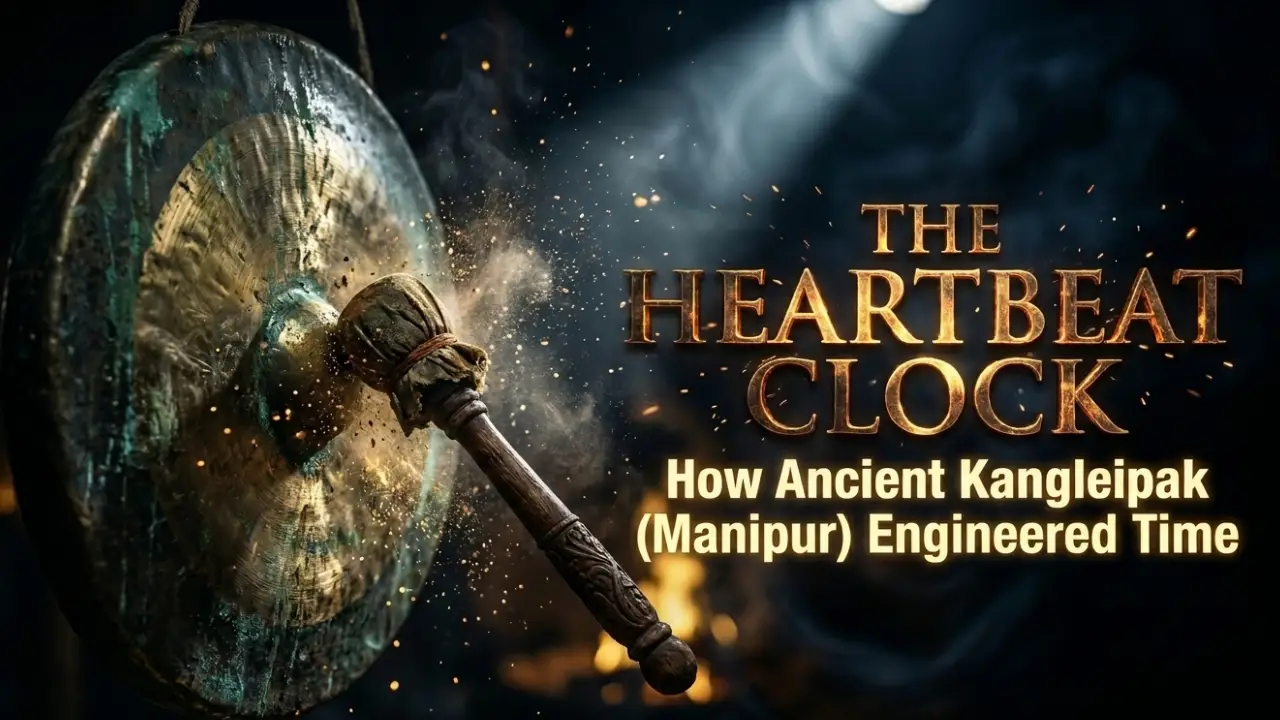
Ancient Kangleipak divided a day into 64 time units and eight watches, using water clocks, gong rhythms, octal system and clan-based duties to regulate time.
|
T |
he ancient kingdom of Kangleipak, the traditional name of Manipur, had an elaborate system of measuring and regulating time that combined mathematical divisions, water-clock mechanisms, prescribed gong rhythms and a system of responsibilities assigned to different clans. According to traditional accounts and ancient Meetei manuscripts (puyas), a complete day was divided into 64 units called pung, grouped into eight periods known as yuthak, with each period entrusted to a designated Salai or clan.
The system was administered through an institution known as the Tanyeishang, which was responsible for maintaining the timekeeping mechanism, observing the prescribed cycles and announcing important transitions through the striking of gongs. The gong signals, collectively associated with the term punglon, regulated the timing of state activities and other affairs of the kingdom.
Each pung represented approximately 22.5 minutes, while eight pung constituted one yuthak, equivalent to approximately three modern hours. Consequently, eight yuthak completed a 24-hour day. The arrangement was not merely a method of calculating the passage of time; it was also connected with the administrative, ceremonial and social organisation of the kingdom.
Several ancient manuscripts preserve details of this tradition, although references to different aspects of the system are often scattered across separate sections. Among the principal texts identified as dealing with the reckoning of pung, the calculation of yuthak, gong-beating practices and the sequence of timekeeping cycles are Salai Pungluplon, Amam Nonglon and Tanyeilon.
According to oral traditions and ancient manuscripts, the institutionalised system of punglup, or the regulation and reckoning of time, dates back to the reign of King Iningthou Ibungo Leinung Lonja Ariba, whose period is traditionally placed before the reign of Nongda Lairen Pakhangba.
The historical accounts attach considerable importance to the uninterrupted maintenance of time. Any disruption in pungja, the reckoning of time, or punglon, the prescribed rhythm of gong-beating, was regarded as a disturbance of the cosmic and social order governing the Leima (Queen), the Ningthou (King) and the subjects of the kingdom.
This understanding placed timekeeping within a broader framework of governance and traditional cosmology. The accurate observance of time was considered an institutional responsibility rather than an individual activity. The Tanyeishang therefore occupied an important position in maintaining the prescribed order of the kingdom.
One of the distinctive features of the Kangleipak timekeeping tradition was the allocation of the eight daily yuthak to eight different clans. This arrangement, described as Salai Pungchatlon, ensured that the responsibility for observing time was distributed among the recognised Salai.
The eight periods covered both night and day. Each consisted of eight pung, and each clan was assigned a specific period during which it was responsible for maintaining the timekeeping duties.
· Kha-Nganba clan: The first night yuthak began with the striking of the dusk gong, known as Yachang pung.
· Luwang clan: The second night yuthak was entrusted to the Luwang clan, covering the period up to midnight (nongyai).
· Leishangthem clan: The third yuthak began at midnight and continued for eight pung.
· Haorok Konthou: The fourth nocturnal period followed the completion of the post-midnight yuthak and continued until the dawn gong, known as Nonganpung.
· Mangang clan: The first daytime yuthak began with the dawn gong (Nonganpung).
· Moirang clan: The next yuthak continued until noon, marked by Numit Yungba.
· Angom clan: The Angom clan assumed responsibility for the period immediately following noon.
· Khuman clan: The final daytime yuthak continued until dusk, when the Yachang pung was sounded.
The four nocturnal time stations were known as Tanthong Mayung, while the four daytime stations were called Lemthong Maphei. Together, they formed the complete eight-period cycle of the day.
The technical operation of the system is described in detail under Punglon gi Kanglon, which deals with the rules governing the passage of each pung, the completion of a yuthak and the prescribed methods of striking the gong.
According to the traditional account, the Tanyeishang housed two sacred entities known as Mabudhou Yangdouba and Mabendhou Yangdoubi. Eight kangkhils, described as markers or counters, were arranged along a central line between them, with each marker representing one position in the counting sequence.
The mechanism also involved a water-clock device called punglup tengkot. The completion of one cycle, marked by the sinking of the perforated bowl into water, was counted as one punglup. In everyday abbreviated usage, one punglup was referred to as one pung.
After each completed punglup, Mabudhou Yangdouba was advanced by one kangkhil towards Mabendhou Yangdoubi. The movement continued through all eight positions. When the eighth marker was reached and the two entities met, one complete yuthak was considered finished. This process was known as punglup-pungchatlon.
The mechanism provided a systematic way to count smaller units and determine when one larger period had been completed. The use of a water-clock device alongside a physical counting arrangement indicates that the system involved both time measurement and a prescribed method of recording its progression.
The gong was central to the operation of the timekeeping system. It communicated the passage of designated periods and marked four important transitions during the day. These four stations, collectively known as Pungpham 4, were Nonganpung (dawn), Numit Yungba pung (noon), Yachang pung (dusk) and Nongyai pung (midnight).
The gong was not struck arbitrarily. Each station had a prescribed rhythmic sequence, and the rules were maintained by the Tanyeishang.
The dawn and dusk gong signals followed the same rhythm. The sequence began with Dang-Da-Dang-Da, repeated three times, and concluded with Dang-Dang-Dang-Dang. Maintaining this sequence without interruption was an essential part of the prescribed practice.
The midnight and noon signals followed another pattern. The sequence consisted of Dang-Dang, repeated successively 31 times, before concluding with three strikes, Dang-Dang-Dang, on the 32nd count.
These rhythmic arrangements, known as punglon, served as audible signals marking the prescribed stations of the daily cycle. Their detailed preservation in Tanyeilon suggests that gong-beating was governed by established rules rather than informal convention.
The duties associated with the mechanism were carried out by rotating teams of three men, equipped with two pungyei-chei, or gong-striking mallets. Their responsibilities included calculating the punglup, maintaining the yuthak, sounding the prescribed gong rhythms and managing the water level according to seasonal requirements in winter and summer.
The Kangleipak system did not begin and end with the division of a day into 64 pung. Its traditional calculations extended from smaller units associated with bodily rhythms to the measurement of days, months and years.
This arrangement established a systematic progression from smaller units to larger periods. A punglup was the principal unit used in the daily timekeeping mechanism, while eight such units completed one yuthak. Eight yuthak then constituted a complete day.
The same system extended to the calculation of the solar and lunar calendars. A solar month, called Thabi tha, consisted of 30 or 31 days, and 12 such months made one solar year, known as Cheihei or Numitki cheihei. The lunar calendar followed a different calculation. Thirty lunar days constituted one Thacha or Thaja, and 12 lunar months made one Kumcha or Kumja, also known as Thagi kumja.
The distinction between the two calendars was important because the lunar year, comprising 12 lunar months, was shorter than the solar year. According to the traditional account, the difference was addressed through the insertion of an additional month of Sajibu, the first month of the Meetei lunar calendar corresponding broadly to March–April. In the intercalary arrangement, two Sajibu months were observed to reconcile the lunar cycle with the solar calendar.
This reflects an awareness of the need to coordinate two different astronomical cycles for the purposes of calendar maintenance and the regulation of seasonal activities.
· 8 Meehul make 1 Ningsha.
· 8 Ningsha make 1 Mitkup.
· 8 Mitkup make 1 Nahum.
· 8 Nahum make 1 Punglup.
· 8 Punglup make 1 Yuthak.
· 8 Yuthak, or 64 Punglup, make 1 day.
· 30 or 31 Numit (days) make 1 Thabi tha (solar month).
· 12 Thabi tha make 1 Cheihei (solar year).
· 30 lunar days make 1 Thacha or Thaja (lunar month).
· 12 Thaja make 1 Kumcha or Kumja (lunar year).
Another notable feature of the traditional system was the commencement of the daily punglup count immediately after Nongyai, or midnight.
The traditional account regards this arrangement as comparable to the midnight-based division of the modern civil day. It also draws a comparison with the historical Jewish system of reckoning time, although the latter's traditional day boundary is generally associated with sunset rather than 6 am.
The division of a 24-hour day into eight equal yuthak, each lasting approximately three hours, and their further subdivision into 64 pung provided a consistent framework for measuring the passage of time.
The use of a water-clock mechanism, a physical counting arrangement and prescribed auditory signals also demonstrates that the system relied on several complementary methods of timekeeping.
The traditional explanation of the terms Cheihei and Chahi, both associated with the measurement of a year, is connected with an older practice of counting days using sticks.
According to this explanation, the timekeeping institution represented each completed day with a single chei, or stick. After seven days, the seven sticks were gathered and tied into a bundle. This bundle was called cheiyom, also described as yomsillaba chei.
The term is associated with the concept of a week, and its pronunciation is believed to have gradually changed from Cheiyom to Chayol.
A similar explanation is offered for the word Cheihei. The completion of a full cycle of time calculated using chei was expressed through the term mahei, meaning result or outcome. The combination of chei and mahei produced Cheihei, interpreted as the result of calculating time through the counting of sticks.
Over generations, the pronunciation is said to have undergone linguistic changes, eventually producing the present-day term Chahi, meaning year.
Taken together, the descriptions of Salai Pungluplon, Amam Nonglon and Tanyeilon present a timekeeping tradition that extended beyond the simple measurement of hours. It combined mathematical divisions, a water-clock mechanism, physical counters, prescribed gong rhythms, seasonal adjustments and a rotational system of institutional responsibilities.
The eight-clan arrangement connected the daily cycle with the social organisation of the kingdom, while the four principal gong stations provided audible markers for important transitions. The calendar calculations further linked daily timekeeping with the lunar and solar cycles.
The significance of this tradition also lies in the preservation of technical and institutional knowledge through ancient Meetei manuscripts and oral accounts. Its various components offer valuable material for understanding how time was measured, organised and incorporated into the administration of premodern Kangleipak.
A systematic study of the relevant puyas, including the terminology, mechanisms and calendar calculations described in them, could contribute to a clearer understanding of the historical development of timekeeping in Manipur. It would also help distinguish documented manuscript descriptions, oral traditions and later interpretations of the system.
The traditional account presents the Tanyeishang as an institution where the measurement of time was treated as a regulated public responsibility. Its elaborate divisions and prescribed practices form an important part of the intellectual and institutional heritage of Kangleipak.
Disclaimer: This article was derived from an article in Manipuri language compiled and written by Prof. (Retd.) Ng. Kangjia Mangang.
(Keithellakpam Manikanta Meetei is a seasoned journalist and a former educator. He also writes under his pen name Keicha Chingthou Mangang instead of his actual name. You can contact him at chingthouheiya@gmail.com)