Manipur’s Central Forest Division and The Indian Orient 2025 sign an MoU for a five-year springshed restoration project to improve freshwater security in the Imphal Valley.
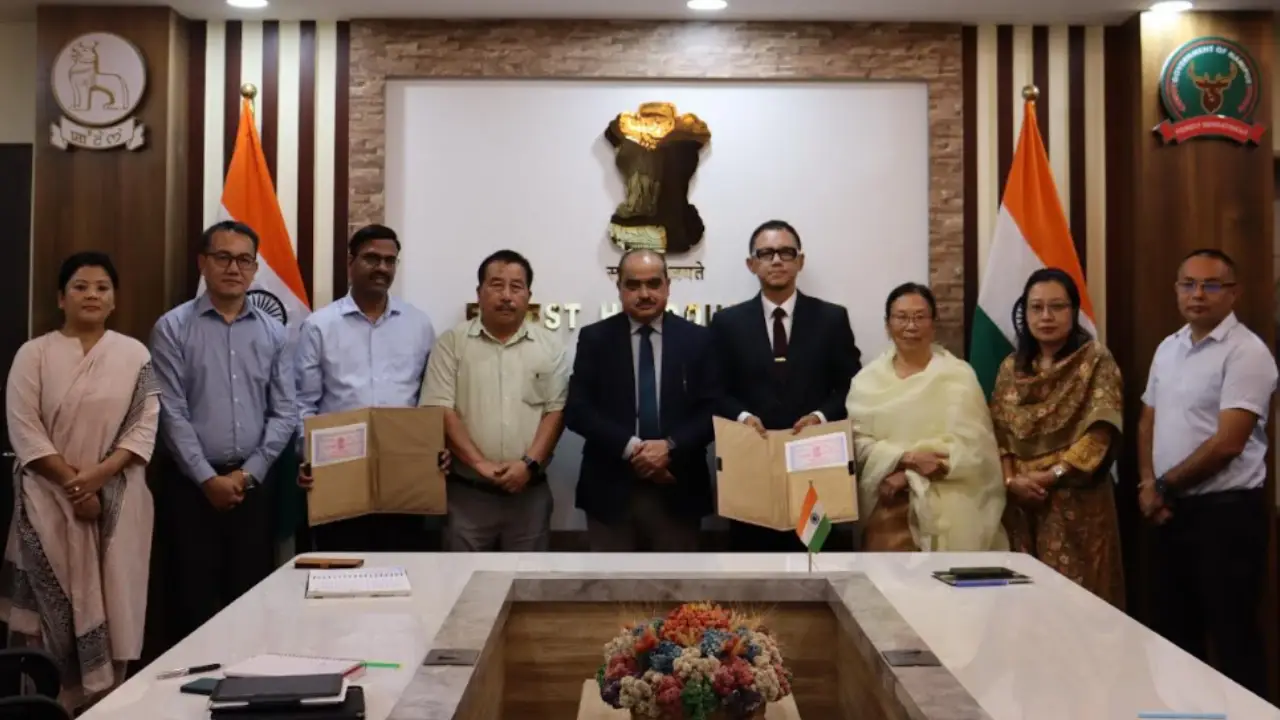
Imphal, Nov. 1: The Central Forest Division of Manipur’s Forest Department and Manipur-based non-profit organisation The Indian Orient 2025 have signed a memorandum of understanding (MoU) to implement a five-year pilot project aimed at restoring freshwater sources, rehabilitating degraded forest catchments and improving long-term water security in the Imphal Valley.
The MoU for the ReTreeFy Project Manipur was signed on October 30 in the presence of Principal Chief Conservator of Forests and Head of Forest Force (PCCF & HoFF) and Additional Chief Secretary Anurag Bajpai, according to a press release issued by the Divisional Forest Officer, Central Forest Division.
The initiative seeks to address the deterioration of springs and freshwater systems through scientific assessment, forest restoration and community participation. It will focus on identifying, protecting and restoring critical springsheds that supply water to the Imphal Valley.
Under the partnership, the Forest Department will provide technical and institutional guidance, while The Indian Orient 2025 will lead project implementation, scientific investigations and restoration interventions. Community mobilisation and resource mobilisation will also form part of the programme under the Forest Department’s guidance.
Bajpai emphasised that the initiative should be community-led, with local residents involved from the planning stage rather than brought in only during implementation.
Ajay Chanam of The Indian Orient 2025 highlighted the need to address the decline of springs and freshwater systems linked to forest and catchment degradation. He also pointed to altered groundwater recharge, increased surface runoff, flooding and seasonal water scarcity as concerns the project seeks to address.
Scientific Assessment and Forest Restoration
The five-year pilot will begin with the identification and mapping of springs and their catchments. Activities will include preparing inventories and geographic information system (GIS) maps, assessing groundwater recharge zones and measuring spring discharge.
The project will also introduce soil and water conservation measures, including contour trenches and bunds, to help improve water retention and reduce runoff. Riparian afforestation and plantations of native tree species will form part of the ecological restoration work.
Scientific monitoring will be carried out periodically to assess changes in water availability and ecological conditions.
The project is designed to combine forest conservation with freshwater management, recognising the role of healthy catchments in sustaining springs and supporting water security. Its focus on scientific assessment is intended to guide restoration work according to the specific conditions of individual springsheds.
Community Participation and Green Livelihoods
Community involvement will be a central component of the initiative. The programme plans to establish local Water Resource and Conservation Committees to strengthen community-based water governance.
Their formation and participation will be guided by the principles of Free, Prior and Informed Consent (FPIC), according to the press release.
Village nurseries will be developed, with local residents involved in producing saplings, planting trees and maintaining and protecting plantations. These activities are also intended to create opportunities for green livelihoods.
The project’s springshed management methods will be aligned with the ACWADAM approach, which focuses on understanding and managing springs and their recharge areas. Implementation will follow applicable environmental and forest regulations and the technical guidance of the Forest Department.
The pilot aims to establish a scientifically informed and community-owned model that can be replicated in other areas, integrating forest conservation, freshwater security, local stewardship and livelihood generation.
Part of a Longer-Term Ecological Vision
The five-year pilot forms part of ReTreeFy Manipur’s broader 70-year vision, covering 2025 to 2095, conceived by The Indian Orient 2025.
The long-term initiative seeks to promote ecological regeneration through indigenous, fruit-bearing and flowering trees. Its wider objectives include protecting rivers, generating sustainable income for local communities and supporting nature-based tourism.
The outcome of the pilot will be important in determining how the proposed approach to springshed restoration, community participation and ecological regeneration can be applied more widely.