Manipur High Court quashes remand in a 67.19-kg meth case, ruling that the constitutional 24-hour arrest deadline begins at actual detention, not formal arrest.
Imphal, Nov. 19: The High Court of Manipur has quashed a judicial remand order and directed the release on bail of an accused in a 67.19-kg methamphetamine seizure case, ruling that the constitutional 24-hour deadline for producing an arrested person before a magistrate begins from the moment of actual detention and curtailment of personal liberty, rather than the time of formal arrest recorded by investigating authorities.
The ruling was delivered by Justice Ahanthem Bimol Singh in Tinneihing Khongsai v. Narcotics Control Bureau (Criminal Petition No. 17 of 2026). The High Court applied the principles laid down by the Supreme Court in Sri Sujit Das & Ors. v. Union of India (2026 INSC 1195), decided on November 5, 2026.
The judgment makes clear that investigating agencies cannot exclude the period during which a person is already under effective restraint from the constitutionally mandated 24-hour period merely by describing it as investigative detention before a formal arrest is recorded.
NCB Seizes 67.19 Kg of Methamphetamine in Chandel
The case originated from NCB Crime No. 10/NCB/IMP/2025, registered by the Imphal Zonal Unit of the Narcotics Control Bureau under Sections 8(c), 22(c), 25 and 29 of the Narcotic Drugs and Psychotropic Substances (NDPS) Act, 1985.
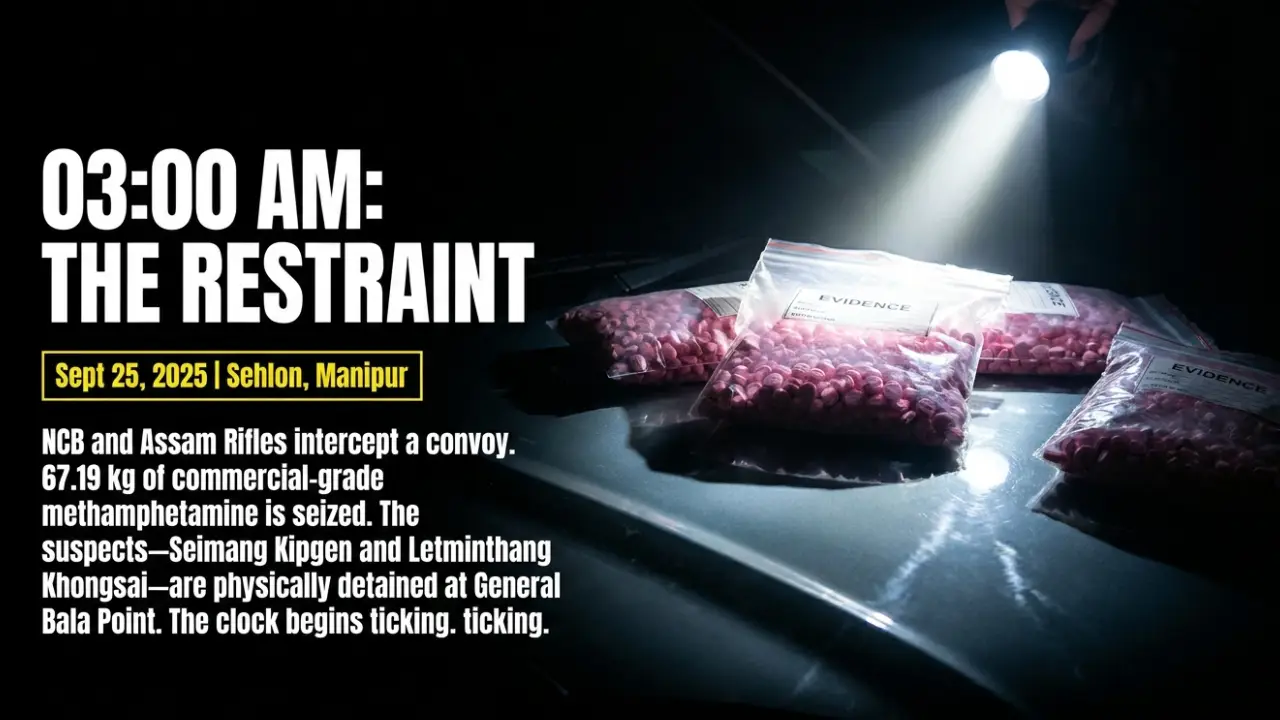
According to the NCB's affidavit, the agency received specific intelligence on September 24, 2025, that two individuals were transporting suspected methamphetamine, commonly known as WY tablets, in a white Maruti Gypsy accompanied by an escort motorcycle.
Acting on the directions of NCB Superintendent Aram Anth, an operational team led by Sub-Inspector Prashant Kumar Yadav joined personnel of the 1st Assam Rifles, Chandel, under Assistant Commandant RNG Shungwar.
At around 3 am on September 25, 2025, the joint team established a checkpoint at General Bala Point, Aibol Joupi, Sehlon, where they intercepted a black Kenbo motorcycle and the Maruti Gypsy.
The drivers were identified as Seimang Kipgen, who was driving the Gypsy, and Letminthang Khongsai, who was operating the escort motorcycle.
During the subsequent search of the Gypsy, security personnel recovered three white sacks from the rear seat containing 29 packets of pink tablets. Field testing confirmed the presence of methamphetamine.
The total weight of the seized substance was recorded at 67.19 kg, falling within the commercial quantity category under the NDPS Act. The search and seizure operation was completed at approximately 6.30 am on September 25.
Accused Challenges the Timing of Formal Arrest
Following the seizure, the NCB issued notices under Section 67 of the NDPS Act, recorded statements and arranged medical examinations of the accused at District Hospital, Chandel.
The agency formally recorded the arrest of Letminthang Khongsai at 1.30 pm on September 25, 2025, through an arrest memo.
The accused were produced before the Special Judge (ND & PS), Chandel, on September 26, following which they were remanded to judicial custody.
Challenging the remand, Khongsai's wife, Tinneihing Khongsai, approached the High Court under Section 528 of the Bharatiya Nagarik Suraksha Sanhita (BNSS), seeking to quash the remand order and secure her husband's release.
Advocate Serto T. Kom, appearing for the petitioner, argued that Khongsai had effectively been detained from 3 am on September 25, when the NCB intercepted and restrained him at the checkpoint.
The petitioner contended that Article 22(2) of the Constitution of India requires every arrested and detained person to be produced before the nearest magistrate within 24 hours of arrest, excluding only the time necessary for travelling from the place of arrest to the court.
According to the argument, the constitutional deadline expired at 3 am on September 26. Since the accused was produced before the court during regular working hours later that day, the petitioner maintained that the mandatory period had been exceeded.
The petition also invoked Articles 21 and 22(2) of the Constitution, arguing that the continued detention and subsequent judicial remand were unconstitutional.
NCB Defends Formal Arrest Timeline
Opposing the petition, Senior Panel Central Government Counsel W. Darakishwor argued that the 24-hour period should be calculated from the time of formal arrest recorded in the arrest memo, which was 1.30 pm on September 25.
The NCB maintained that the preceding hours were required for investigation-related procedures, including interception, search, testing of the seized substance, preparation of seizure documentation and questioning of the suspects.
The agency argued that these activities constituted lawful investigative procedures under the NDPS Act and did not amount to formal arrest or custodial detention for the purpose of calculating the constitutional deadline.
To support its position, the NCB relied on earlier High Court decisions, including Kannan v. State of Tamil Nadu of the Madras High Court and Arun K. Thomas v. NCB of the Kerala High Court, both delivered in 2026.
These judgments had supported the position that the period spent on search, seizure and related investigative procedures before formal arrest did not necessarily trigger the 24-hour constitutional requirement.
High Court Applies Supreme Court's Ruling in Sri Sujit Das Case
Justice Ahanthem Bimol Singh observed that the legal issue had already been addressed by the Supreme Court in Sri Sujit Das & Ors. v. Union of India, decided on November 5, 2026.
The Supreme Court had clarified the interpretation of Article 22(2), holding that the constitutional 24-hour period begins when a person's liberty is actually curtailed through detention, rather than from the subsequent recording of a formal arrest.
The Supreme Court ruling laid down several principles governing the production of arrested persons before magistrates.
First, the 24-hour period must be calculated from the actual time of detention and restraint of personal liberty. The formal preparation of an arrest memo cannot be used to postpone the commencement of the constitutional timeline.
Second, the only period that can be excluded from the calculation is the actual time required to travel from the place of arrest to the magistrate. Other investigative procedures cannot be used to extend the permissible period of detention without judicial production.
Third, the Supreme Court declared conflicting interpretations adopted in earlier High Court decisions, including Aryaman Pattnayak of the Orissa High Court, Kannan of the Madras High Court and Arun K. Thomas of the Kerala High Court, to be incorrect.
The Supreme Court also emphasised that a breach of the mandatory 24-hour requirement entitles the detained person to immediate release, as continued custody without compliance with the constitutional safeguard becomes illegal.
Remand Order Quashed, Bail Directed
Applying the Supreme Court's interpretation to the facts of the case, the Manipur High Court held that Khongsai's detention effectively began at approximately 3 am on September 25, 2025, when the NCB team intercepted and restrained him.
Consequently, the 24-hour constitutional period expired at 3 am on September 26, 2025.
The accused, however, was produced before the Special Judge later that day, after the constitutional deadline had already passed.
The High Court therefore concluded that the detention had violated the mandatory requirement under Article 22(2) and that the subsequent judicial remand order could not be sustained.
Justice Bimol Singh accordingly quashed the Special Judge's remand order dated September 26, 2025, and directed that Khongsai be produced before the Special Court within seven days for his release on bail.
The judgment reiterates that constitutional safeguards governing personal liberty apply from the moment a person is actually deprived of freedom, irrespective of the terminology or procedural records subsequently used by investigating agencies.