Manipur’s draft electoral rolls show 55,437 more women than men among 19.94 lakh voters, with sharp constituency-level differences in voter composition and representation.
Imphal, Nov. 12: The Office of the Chief Electoral Officer (CEO), Manipur, on Thursday published the Draft Photo Electoral Rolls for all 60 Assembly Constituencies in the state, recording a total of 19,94,357 registered electors ahead of the 2027 electoral cycle.
The publication marks the beginning of the Special Summary Revision of electoral rolls, with January 1, 2027, set as the primary qualifying date for determining voter eligibility. The exercise will allow eligible citizens to enrol themselves as voters, seek corrections in existing entries, raise objections to incorrect registrations and request the deletion of names wherever necessary.
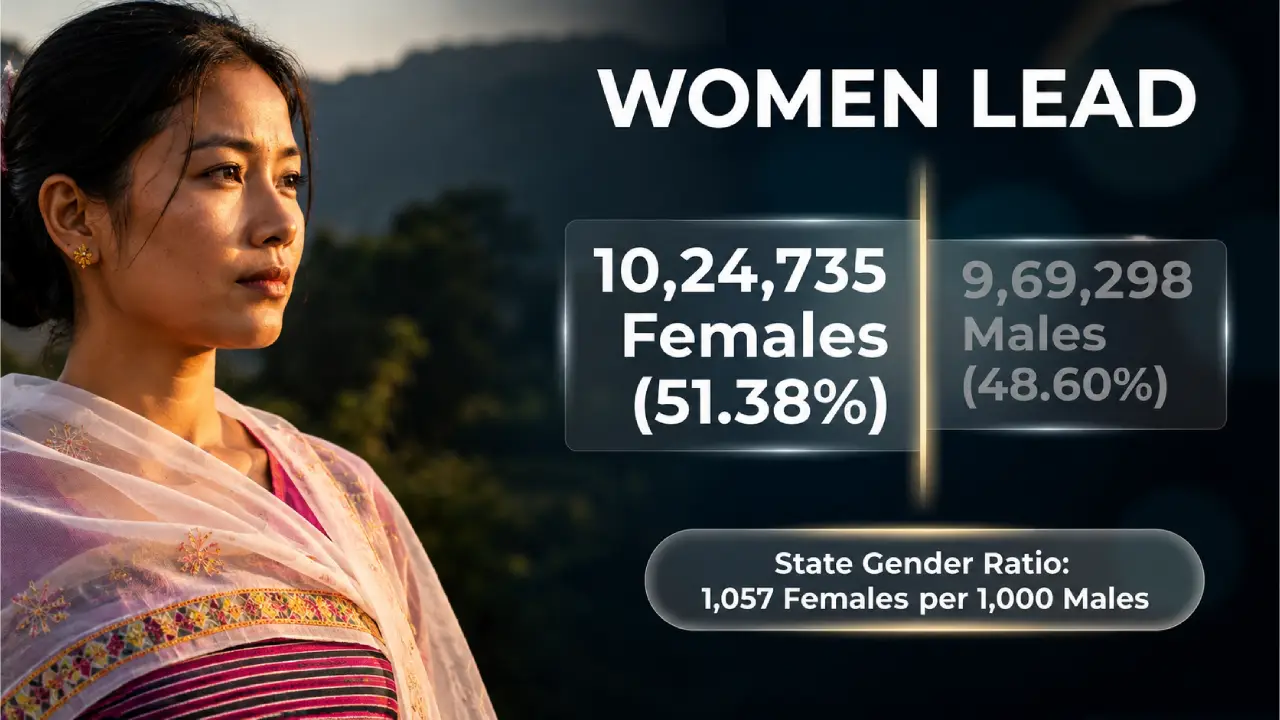
According to the figures released by the election authorities, women continue to constitute the larger share of Manipur's electorate, outnumbering male voters by 55,437. The draft electoral rolls contain 10,24,735 female electors, 9,69,298 male electors and 324 third-gender electors.
The overall electoral gender ratio stands at 1,057 females for every 1,000 males, while the state's Elector-to-Population (EP) ratio has been recorded at 52.9.
The publication follows instructions issued by the Election Commission of India (ECI) through Notification No. 23/2026-ERS dated October 15, 2026. The revision process will continue through December, with the final electoral rolls scheduled for publication on January 4, 2027.
Joint Chief Electoral Officer Lokeshor Brahmacharimayum issued the information concerning the publication of the draft rolls and the arrangements for the revision exercise.
The election authorities have opened a 30-day period for filing claims and objections, beginning November 12 and ending December 11, 2026. Applications received during this period will be examined and disposed of by December 28, after which the final rolls will be prepared.
Nearly 20 lakh electors registered across 60 constituencies
The draft electoral rolls show that Manipur has 19,94,357 registered electors distributed across its 60 Assembly Constituencies.
Of the total electorate, female voters account for approximately 51.38 per cent, while male voters constitute around 48.60 per cent. Third-gender electors account for 324 registrations, representing a small but officially recognised segment of the electorate.
The numerical difference between female and male voters is 55,437. This gives Manipur an electoral gender ratio of 1,057, meaning there are 1,057 registered female voters for every 1,000 male voters.
The female majority is reflected across a substantial number of constituencies, although the extent of the difference varies considerably between individual Assembly segments.
The largest numerical difference in favour of female voters among the highlighted constituencies is found in Churachandpur, where 33,743 women are registered compared with 29,506 men. The constituency has a total electorate of 63,251, including two third-gender electors.
Khurai also records a considerable female majority, with 19,328 female voters against 17,041 male voters. Its total electorate stands at 36,401, including 32 third-gender electors.
In Patsoi, the draft roll records 19,937 female electors and 17,664 male electors, while Khetrigao has 19,665 female voters against 17,597 male voters.
Saikot, another constituency with a sizeable electorate, has 29,066 female electors and 26,877 male electors. Its total voter count stands at 55,946.
These figures indicate that the female-majority trend is not confined to a particular Assembly segment but is reflected across constituencies in different parts of the state.
However, eight constituencies have recorded more male electors than female electors.
They are Sugnoo, Jiribam, Karong, Tadubi, Kangpokpi, Nungba, Tipaimukh and Thanlon.
Jiribam has 14,485 male electors and 13,961 female electors, resulting in a difference of 524 in favour of men. Karong has 23,132 male voters against 22,713 female voters, while Tadubi records 23,119 male electors and 22,731 female electors.
In Kangpokpi, the difference is comparatively narrow, with 14,176 male voters and 14,137 female voters. Sugnoo has 14,508 male electors against 14,458 female electors.
Nungba, Tipaimukh and Thanlon also have slightly higher male elector counts.
The figures provide a constituency-level picture of the distribution of registered voters ahead of the next electoral cycle.
Churachandpur largest constituency, Thanlon smallest
The constituency-wise data reveal substantial differences in the size of electorates across Manipur.
Churachandpur Assembly Constituency, numbered 58, has the largest electorate in the state, with 63,251 registered voters. This is followed by Saikot, AC No. 59, which has 55,946 electors.
Mao, AC No. 48, has the third-largest electorate with 48,369 voters, followed by Chingai, AC No. 45, with 47,811 electors.
Tadubi, AC No. 49, has 45,850 registered voters, while Karong, AC No. 47, has 45,845. Saitu, AC No. 51, records 45,787 electors.
Other constituencies with relatively large electorates include Ukhrul with 41,747 voters, Moirang with 41,411, Tengnoupal with 41,204 and Tamei with 40,991.
Chandel has 39,432 electors, while Khangabok records 38,505. Patsoi and Saikul have 37,620 and 30,928 electors, respectively.
At the other end of the distribution, Thanlon Assembly Constituency, AC No. 56, has the smallest electorate in Manipur, with 13,074 registered voters. Of these, 6,566 are male and 6,508 are female.
Tipaimukh, AC No. 55, is the second-smallest constituency by electorate size, with 16,689 registered voters, including 8,386 men and 8,303 women.
Singjamei, AC No. 13, has 20,531 electors, making it another constituency with a comparatively smaller voter base. Singhat, AC No. 60, has 20,800 electors, while Thanga, AC No. 28, records 22,243.
The difference between the largest and smallest constituencies is substantial. Churachandpur has nearly 4.84 times the number of registered electors recorded in Thanlon.
The variation in electorate size across the 60 constituencies provides an important administrative consideration for the election authorities, particularly in planning voter registration activities, field verification and the management of polling arrangements.
The figures also demonstrate why constituency-wise scrutiny is necessary during the revision exercise rather than relying solely on statewide totals.
Electoral gender ratio varies across constituencies
Although women outnumber men in the overall state electorate, the constituency-wise figures show that the gender distribution is not uniform.
Churachandpur has one of the highest female-to-male electoral ratios among the constituencies, with 33,743 female voters compared with 29,506 male voters. The resulting ratio is approximately 1,144 female electors per 1,000 male electors.
Khurai records a ratio of approximately 1,134, with 19,328 women and 17,041 men. Patsoi follows closely, with a ratio of around 1,129, while Khetrigao has approximately 1,118 female electors per 1,000 male electors.
Saikot also records a female-majority electorate, with a gender ratio of approximately 1,081.
In Chingai, the female electorate stands at 24,535 compared with 23,276 male voters, producing a ratio of approximately 1,054.
These figures are above the statewide ratio of 1,057 in some constituencies and below it in others, reflecting differences in the composition of individual electorates.
Among the male-majority constituencies, Jiribam records the lowest female-to-male electoral ratio at approximately 964 females per 1,000 males.
Karong has a ratio of around 982, while Tadubi records approximately 983. Nungba has a ratio of 985, followed by Tipaimukh at 990 and Thanlon at approximately 991.
Sugnoo and Kangpokpi have ratios of approximately 997.
The constituency-wise figures are relevant to the ongoing revision because they provide electoral registration officials with a detailed picture of voter distribution. However, the draft figures alone do not establish the reasons behind the differences in gender composition.
Third-gender electors recorded in 44 constituencies
The draft electoral rolls have recorded 324 third-gender electors across Manipur.
The constituency-wise distribution, however, shows considerable variation. Several constituencies have recorded registrations, while 16 Assembly segments have reported zero third-gender electors.
Khurai has the highest number, with 32 registered third-gender voters. Bishenpur follows with 20, while Patsoi has 19.
Lamsang has 17 third-gender electors, and Khundrakpam records 14.
Other constituencies with registrations include Khetrigao with 10, Andro with 10, Wangkhei with eight, Thongju with eight and Konthoujam with eight.
Thoubal has three, while Jiribam has one third-gender elector. Tamei also records one.
The data show that five constituencies alone account for 103 of the state's 324 third-gender electors. These are Khurai, Bishenpur, Patsoi, Lamsang and Khundrakpam.
Together, they represent approximately 31.8 per cent of the total third-gender registrations in Manipur.
In contrast, the draft rolls show no third-gender electors in 16 constituencies: Chandel; Phungyar, Ukhrul, Chingai, Saikul, Karong, Mao, Tadubi, Kangpokpi and Saitu; and Tamenglong, Nungba, Tipaimukh, Thanlon and Henglep.
The absence of recorded registrations in these constituencies does not, by itself, establish whether eligible third-gender residents are absent or remain unregistered. The revision process provides an opportunity for eligible citizens to seek inclusion in the electoral rolls.
The district-level help desks established by the election authorities are expected to provide assistance to people requiring support with registration and other electoral services.
Claims and objections open until December 11
With the publication of the draft rolls, the CEO's office has initiated the statutory process for receiving claims and objections.
The period for filing applications began on November 12 and will remain open until December 11, 2026.
During this period, electors can examine the draft entries and submit applications for inclusion, deletion, correction or transfer of their voter registration, depending on their requirements.
The election authorities have prescribed different statutory forms for these purposes.
Form 6 is used by eligible Indian citizens seeking inclusion of their names in the electoral rolls. The form is also relevant for those who have become eligible to register as voters but are not included in the draft list.
Form 6A is prescribed for the inclusion of overseas Indian electors.
Form 7 is used to submit objections to proposed inclusions or request the deletion of an existing entry from the electoral roll.
Form 8 is intended for corrections in existing electoral entries, shifting of residence, replacement of Elector Photo Identity Cards (EPIC) and requests for marking persons with disabilities.
The use of the appropriate form is necessary to ensure that applications are processed under the relevant electoral procedures.
The current revision uses January 1, 2027, as its primary qualifying date. Citizens who attain the age of 18 by that date and satisfy the other eligibility requirements can apply for registration.
The revision arrangements also accommodate subsequent qualifying dates during 2027.
Eligible citizens who will attain 18 years of age by April 1, July 1 or October 1, 2027, can submit advance applications during the current revision period in accordance with the applicable ECI guidelines.
This arrangement allows prospective electors to apply in advance rather than waiting for an entirely separate revision exercise.
Following the completion of the claims and objections period on December 11, election officials will examine the applications and complete the disposal process by December 28.
The final electoral rolls are scheduled to be published on January 4, 2027.
Online and offline facilities available for voters
The CEO's office has made provisions for citizens to access the draft electoral rolls and submit applications through both physical and digital channels.
Electors can inspect the draft rolls at the offices of Electoral Registration Officers (EROs), Assistant Electoral Registration Officers (AEROs) and through Booth Level Officers (BLOs).
Applications can also be submitted through these election administration channels.
For online services, voters can use the Election Commission of India's Voter Service Portal at voters.eci.gov.in or the ECINET mobile application.
The digital platforms provide facilities for electoral registration and other voter-related services. Applications submitted online can be authenticated through Aadhaar-enabled electronic signatures, as provided under the applicable system.
To improve access, dedicated help desks have been established across all 16 districts of Manipur.
These facilities are intended to assist vulnerable and marginalised sections of the population, including people who may face difficulties accessing the registration process or completing the prescribed forms.
Voters seeking assistance can also contact the Election Commission's national helpline at 1950.
The ECINET application provides an additional facility called 'Book a Call with BLO', through which electors can seek guidance from their assigned Booth Level Officers.
The availability of physical and online channels is intended to make the revision process accessible to voters across the state, including those in areas where direct access to election offices may be difficult.
Public disclosure of claims and objections
The revision process also includes provisions for public disclosure of applications received during the exercise.
Lists relating to claims and objections filed through the prescribed forms will be made available through statutory public notices.
These include Forms 9, 10, 11, 11A and 11B.
The lists will be displayed on notice boards at the offices of Electoral Registration Officers and published through the official CEO Manipur website.
The public notice arrangements are intended to provide transparency in the processing of applications and allow stakeholders to examine the claims and objections received by the election authorities.
The publication of these lists also forms part of the administrative process for handling objections and maintaining the accuracy of electoral records.
Political parties briefed on revision exercise
On November 12, the Office of the Chief Electoral Officer, Manipur, also convened a meeting with recognised national and state political parties to brief them about the Special Summary Revision.
Representatives of the political parties were informed about the revision schedule and the procedures governing the submission and disposal of claims and objections.
The political parties were requested to appoint Booth Level Agents (BLAs) for every polling station.
These agents are expected to coordinate with Booth Level Officers during the revision process and assist in examining electoral entries at the polling station level.
As part of the arrangements for transparency and stakeholder participation, recognised national and state political parties were provided one printed copy and one soft copy of the draft electoral rolls covering all 60 Assembly Constituencies.
The soft copies were supplied without photographs.
The involvement of political parties through their Booth Level Agents is part of the electoral administration's mechanism for facilitating scrutiny of the draft rolls during the claims and objections period.
Appeal mechanism available against electoral registration decisions
The electoral framework also provides a legal mechanism for individuals who are dissatisfied with decisions taken by Electoral Registration Officers.
Under Section 24 of the Representation of the People Act, 1950, an individual aggrieved by an order or decision of an ERO can appeal to the District Magistrate under Section 24(a).
A further appeal against the decision of the District Magistrate can be submitted to the Chief Electoral Officer, Manipur, under Section 24(b), in accordance with Rule 27 of the Registration of Electors Rules, 1960.
The two-tier appeal mechanism provides a statutory avenue for addressing disputes concerning the inclusion or deletion of names and other decisions related to electoral registration.
The availability of this process is particularly relevant during the claims and objections period, when the draft rolls are open to public scrutiny and applications are being examined by election officials.
Final electoral rolls scheduled for January 4, 2027
The publication of the draft electoral rolls marks the beginning of a time-bound exercise to update Manipur's voter database ahead of the next electoral cycle.
The statewide electorate currently stands at 19,94,357, with women accounting for the larger share of registered voters. The constituency-wise figures also reveal considerable differences in electorate size, gender composition and third-gender registrations.
The coming weeks will provide eligible citizens an opportunity to verify their details, seek inclusion if their names are missing, correct inaccurate entries and raise objections where necessary.
The election authorities have set December 11 as the deadline for receiving claims and objections, with their disposal scheduled by December 28.
The final electoral rolls for all 60 Assembly Constituencies are expected to be published on January 4, 2027, following the completion of the revision process.
For voters, the immediate task is to check their names and personal details in the published draft rolls and approach the concerned election officials if any correction or addition is required.
The CEO's office has made available district-level assistance, online application facilities and statutory appeal mechanisms as part of the exercise.
The accuracy of the final rolls will depend on the verification and disposal of applications received during the prescribed period.