Manipur observed National Press Day 2026 with journalist awards and a workshop examining responsible reporting, misinformation, press freedom and verification in the digital age.
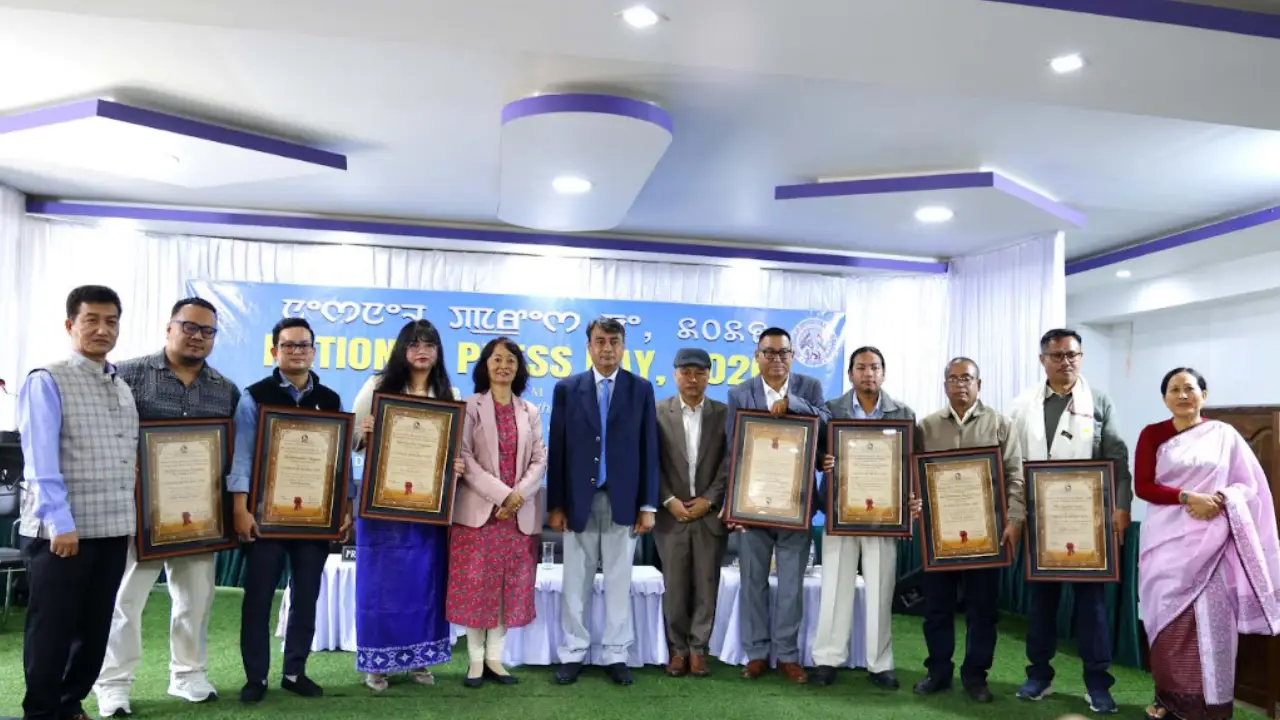
Imphal, Nov. 16: The Directorate of Information and Public Relations (DIPR), Government of Manipur, observed National Press Day 2026 with a programme and workshop on the theme “Journalism: Populist or Responsible” at the DIPR Auditorium Complex, Nityaipat Chuthek, Imphal, on Monday.
The programme featured the presentation of the Manipur State Journalist Awards 2026 and financial assistance to beneficiaries under the Manipur State Working Journalists Welfare Scheme (MSJWS). The workshop examined the challenges facing journalism in the digital age, particularly the spread of misinformation and the need for verification, accuracy and accountability.
Chief Secretary Rajeev Singh Thakur, IAS, attended as the chief guest, while Secretary (IPR) Neeta Arambam, IAS, presided over the programme. Director (IPR) Dr Th. Charanjeet Singh, MCS, was the guest of honour.
Addressing the gathering, Thakur said press freedom had become increasingly important in an era when news travels rapidly through social media and electronic platforms. He stressed the need for transparency, accuracy and integrity in reporting and called on the government, concerned authorities and media organisations to work together responsibly.
Referring to the prevailing situation in Manipur, the Chief Secretary said collective efforts were necessary to build and sustain peace and promote harmony among communities. He urged journalists and media professionals to reaffirm their commitment to press freedom and their responsibilities towards society.
Secretary (IPR) Neeta Arambam spoke about the significance of National Press Day and this year's theme, emphasising the need to balance public appeal with factual and credible reporting.
She acknowledged the media's role in keeping people informed and bringing public concerns to the attention of the government. She also referred to government initiatives for the welfare and recognition of working journalists, including the Manipur Working Journalists Welfare Scheme and the State Journalist Awards 2026.
Congratulating the award recipients, Neeta Arambam appreciated the contribution of journalists and called for stronger cooperation between DIPR and the media fraternity.
Director (IPR) Dr Th. Charanjeet Singh said National Press Day was observed to recognise press freedom and the responsibilities associated with it.
He noted that freedom of the press was guaranteed under Article 19(1)(a) of the Constitution of India as part of the fundamental right to freedom of speech and expression. Describing the media as the fourth pillar of democracy, he said press freedom was important for strengthening and safeguarding democratic institutions.
However, he cautioned that no freedom could be absolute. While exercising press freedom, journalists must also uphold their responsibilities and ensure that it was not used in ways that could undermine national integrity and security, incite violence or create public disorder.
Referring to the reasonable restrictions provided under Article 19(2) of the Constitution, he urged media professionals to exercise their freedom responsibly and maintain the values of truth, integrity and accountability.
Eight State Journalist Awards presented
The Manipur State Journalist Awards 2026 were presented to journalists from different media organisations for their contributions across various reporting categories.
Hemchandra Shagolsem, reporter of Sanaleibak Daily, received the award for Science and Technology Reporting. Khshetrimayum Meghajit Meitei, staff reporter of Sangai Express, was recognised for Reporting with Special Reference to Women and Children.
Hiyaileima Ningombam of Wayel Kati received the award for Arts and Culture Reporting, while Gyanand Naorem, special correspondent of Hueiyen Lanpao, was honoured for Sports Reporting.
Kshetrimayum Premchand, chief reporter of SK TV, received the award for Public Health and Hygiene Reporting. Moirangthem Khagemba Meitei of Sangai Express was recognised for Rural Reporting.
Khshetrimayum Meghajit Meitei of Sangai Express also received the award for Parliamentary Reporting. The Best Editor Award for National Integration and Communal Harmony was conferred upon Ningombam Hemantakumar, chief editor of Wayel Kati.
The awards comprised a cash prize, citation and shawl.
Financial assistance was also distributed to seven beneficiaries under the Manipur State Working Journalists Welfare Scheme.
Workshop examines verification and misinformation
Following the award presentation, a workshop was held on the theme “Journalism: Populist or Responsible”. Senior journalist and editor of Imphal Review of Arts and Politics, Pradip Phanjoubam, moderated the session.
The resource persons were Rupachandra Yumnam, chief editor of Impact TV, and K. Sarojkumar Sharma, senior journalist. An interactive session and discussion were also held.
In his paper titled “Journalism: Populist or Responsible — Viral First or Verified First?”, Yumnam Rupachandra Singh, Editor-in-Chief of Impact TV and Secretary General of the Editors Guild Manipur, examined the challenges newsrooms face when dealing with videos and claims circulating on social media.
He argued that journalists should establish the origin of material, speak to the person who recorded it where possible, and determine what can be confirmed through independent reporting before publishing. He cautioned that once a video or claim is published with a media organisation's logo, audiences may assume that its caption and details have been verified.
The paper also drew attention to the importance of accuracy in headlines, television tickers, graphics and social media thumbnails. It noted that audiences may encounter only a headline or visual without watching or reading the full report, making precise wording essential across all formats.
Rupachandra referred to a captioning error in the Editors Guild of India's 2023 fact-finding report on media coverage of the Manipur conflict. A photograph published with the caption identifying a building as a Kuki house was later acknowledged by the Guild to have shown a Forest Department beat office at Mata Mualtam in Churachandpur district. The report's revised version recorded the correction.
Using the example, he stressed the need to verify the identity and location of buildings, dates and other details before publication, particularly in reports concerning sensitive incidents. He also pointed to the importance of preserving distinctions between direct observation and information received from others when translating statements or preparing subtitles.
The paper proposed several newsroom practices, including tracing the original source of user-generated material, independently checking serious allegations, publishing confirmed information while other details are still being verified, and issuing corrections through the same channels where the original error appeared.
Rupachandra also suggested that editors should be able to hold sensitive headlines and graphics until the information has been checked. He said newsrooms could maintain brief records of who had confirmed a claim and which details remained unverified, without necessarily requiring a separate fact-checking department.
The second paper, presented by Kongbrailatpam Sarojkumar Sharma, Associate Editor of The Morning Bell, examined the influence of social media, audience competition and commercial pressures on journalism.
Sarojkumar observed that mobile phones and social media had enabled ordinary people to share information, report events and participate directly in public discussions. However, he noted that the rapid circulation of content could also spread misinformation, disinformation and manipulated material, particularly when there was no editorial scrutiny.
Referring to Manipur's experience following the outbreak of violence in May 2023, he recalled the prolonged internet shutdown imposed by the government to curb fake news, misinformation, disinformation and hate speech on social media.
He also discussed the pressure on media organisations to secure audience reach, click-through rates, television rating points and advertising revenue. According to the paper, these commercial considerations can influence how news is selected and presented, sometimes encouraging sensational headlines, speculation and dramatic treatment at the expense of accuracy and public interest.
Sarojkumar further referred to changes in television advertising regulations following the removal of the earlier 12-minute advertisement cap, as well as the practice of placing large advertisements on newspaper front pages after editorial teams have finalised page layouts. He said such developments could create tensions between management and editorial departments.
The paper also highlighted the growing challenges posed by deepfake videos, manipulated audio and images, and false claims circulating on social media. It referred to the launch of the DIPR Manipur Fact Check Facebook page on April 30 this year as an initiative to verify government orders, notices, circulars and other documents.
Sarojkumar cited examples of misinformation-related incidents in Manipur and elsewhere in India to explain how false claims and rumours could contribute to public panic, communal tensions and violence. He also referred to fact-checking platforms such as Alt News, Social Media Hoax Slayer and Snopes.
Distinguishing between populist and responsible journalism, the paper argued that public appeal and professional responsibility need not be contradictory. It maintained that user-generated content could serve a public purpose when it was accurate and presented with due consideration of its consequences.
The paper called for journalists, media organisations, digital platforms and individuals sharing information to uphold verification, fairness, accuracy, independence and accountability. It also emphasised the need to distinguish facts from opinions and allegations, respect privacy and human dignity, provide adequate context and correct errors promptly.
The workshop concluded with an interactive discussion among participants on the responsibilities of journalists and the media in maintaining a credible information environment.