Nationwide natural birthing walks at JNIMS and RIMS in Imphal raise awareness about informed childbirth choices and concerns over rising Caesarean deliveries.
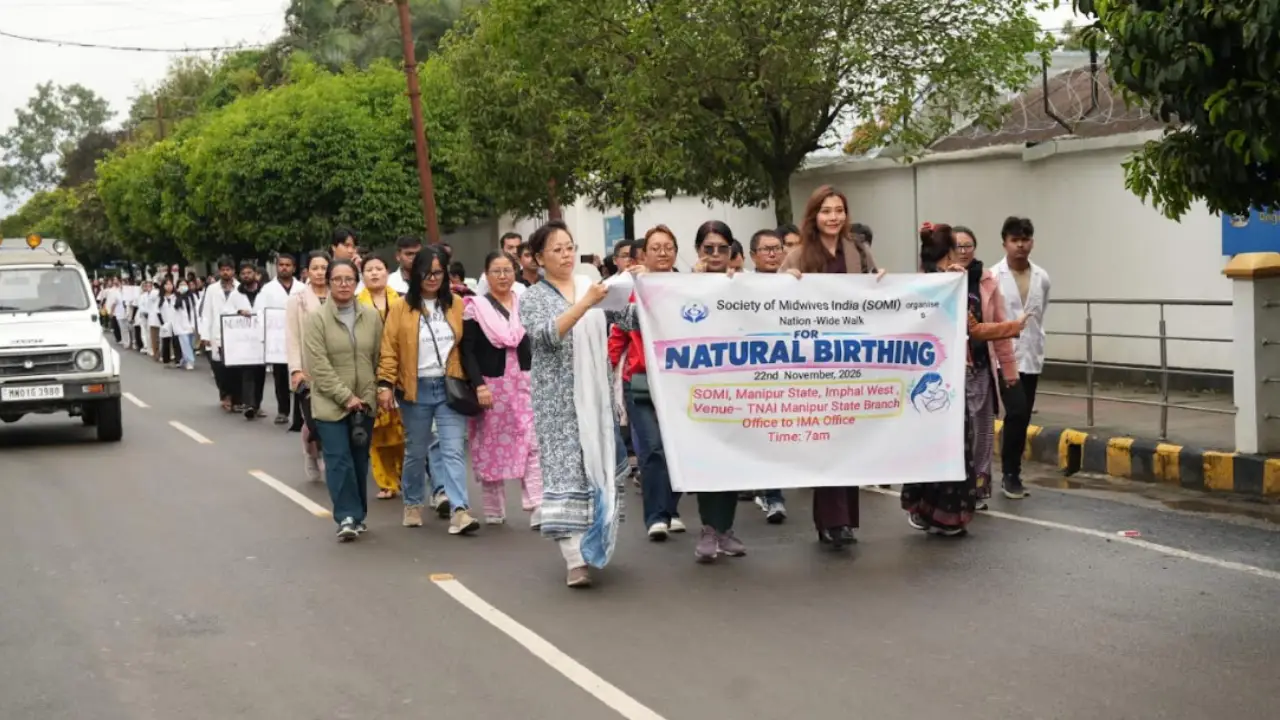
Imphal, Nov. 22: Awareness rallies promoting natural childbirth and encouraging informed maternity care were organised at two major medical institutions in Imphal on Saturday, with healthcare professionals, nursing students and volunteers calling for greater awareness of the benefits of natural birthing and the need to reduce unnecessary Caesarean section deliveries.
The initiatives were held at the Jawaharlal Nehru Institute of Medical Sciences (JNIMS), Porompat, and the Regional Institute of Medical Sciences (RIMS), Imphal, as part of a nationwide campaign led by the Society for Midwives India (SOMI) and other healthcare organisations.
At JNIMS, a one-day nationwide walkathon titled "Joining Hands" was organised around the hospital complex at Porompat. The programme was jointly organised by the Trained Nurses' Association of India (TNAI), Manipur State Branch; Society for Midwives India; Federation of Obstetric and Gynaecological Societies of India (FOGSI); and the Department of Obstetrics and Gynaecology, JNIMS.
The rally, which saw the participation of numerous nursing students, aimed to encourage expectant mothers to consider natural childbirth wherever medically appropriate rather than opting for surgical delivery without a medical necessity.
Speaking on the occasion, JNIMS Medical Superintendent Dr Kameshwar said the initiative sought to address the declining rate of natural childbirth and the increasing number of Caesarean deliveries.
Referring to World Health Organization (WHO) guidance, he said the recommended population-level Caesarean section rate was around 15 per cent. However, he claimed that the rate across India had largely crossed 50 per cent, with private healthcare facilities also reporting high proportions of surgical deliveries.
At JNIMS, the Caesarean delivery rate stood at 50 per cent in 2025, he said, adding that several factors had contributed to the decline in natural births.
Dr Kameshwar observed that some women opted for surgical delivery because of fear of labour pain or the belief that a Caesarean section would make childbirth easier and reduce risks to the baby.
He said such perceptions needed to be addressed through proper awareness and counselling. While Caesarean delivery remained essential in cases where natural childbirth was medically impossible or unsafe, he stressed that surgery should not be chosen merely out of fear or unfounded anxiety about labour and childbirth.
Explaining the physiological differences between the two methods of delivery, he said the onset of labour played an important role in preparing the baby for life outside the womb.
According to him, the natural process of labour provides signals that help the baby's body prepare for breathing after birth. He contrasted this with surgical delivery, in which the baby is extracted without the same progression of labour.
He maintained that the walkathon was intended to promote awareness of natural childbirth and encourage women to make informed decisions about delivery methods in consultation with medical professionals.
Separately, the Society for Midwives India organised a nationwide walk for natural birthing at Jubilee Hall, RIMS, Imphal, as part of its campaign to raise awareness about natural childbirth and address the increasing rate of Caesarean section deliveries.
The walk was flagged off by Strela Thounaojam Luwang, a model, in the presence of RIMS Director Professor G. Sunil Kumar Sharma and RIMS Medical Superintendent Professor N. Sanjib Singh.
The procession started from the TNAI Manipur State Branch Office, proceeded towards the Indian Medical Association (IMA) Office and concluded at Jubilee Hall, RIMS, Imphal.
Addressing the gathering, RIMS Director Professor G. Sunil Kumar Sharma expressed concern over the rising number of Caesarean deliveries, particularly at tertiary healthcare institutions.
He said Caesarean sections accounted for nearly 40 to 50 per cent of assisted deliveries at such centres and called for greater awareness among young people about childbirth and maternity care.
He particularly urged people in the 18–35 age group, including men, to support natural birthing and recognise that positive childbirth experiences involved shared responsibility within families and communities.
The SOMI initiative focused on sensitising young people about natural childbirth and informed maternity choices. The organisation emphasised that Caesarean sections remained necessary when medically indicated but expressed concern over their increasing use.
Healthcare professionals, nursing students, volunteers, mothers, families and members of the public participated in the walk, which also promoted midwifery-led care, quality maternal healthcare and informed decision-making throughout pregnancy, childbirth and the postnatal period.
The organisers stated that the programme was conducted peacefully without sound amplification or commercial activities.
SOMI reaffirmed its commitment to strengthening midwifery in maternal and newborn healthcare, promoting natural childbirth where appropriate and encouraging safe, respectful and woman-centred maternity services.