NFHS-6 data reveals falling fertility rates, improved maternal healthcare and strong digital inclusion in Northeast India, while malnutrition and lifestyle diseases remain concerns.
Imphal, May 30: The latest round of the National Family Health Survey (NFHS-6) for 2023-24 presents a picture of a Northeast region undergoing rapid social and demographic change. The findings point to improvements in maternal and child healthcare, expanding digital access among women, rising financial inclusion and declining fertility rates across several states. At the same time, the survey highlights persistent challenges related to child malnutrition, substance use, lifestyle diseases and early marriage.
The survey provides updated health and demographic indicators for Arunachal Pradesh, Assam, Meghalaya, Mizoram and Nagaland. Data for Sikkim and Tripura was not included in the available survey documents, while Manipur was excluded from the exercise. Though the reason for exclusion of Manipur was not mentioned in the document, Manipur was experiencing the worst ever conflict during the survey year, which is 2023-24.
Taken together, the figures suggest that the Northeast is moving through a demographic and public health transition that differs in several respects from the rest of India. While concerns regarding nutrition and health risks remain, the survey points to growing access to healthcare, stronger institutional support systems and increasing participation of women in the digital and financial sectors.
One of the most notable trends emerging from the survey is the continued decline in fertility across the region.
Arunachal Pradesh recorded a Total Fertility Rate (TFR) of 1.5, while Assam and Mizoram each reported a TFR of 1.6. Nagaland stood at 2.0 and Meghalaya at 2.2. Except for Meghalaya, all surveyed northeastern states have either reached or fallen below the replacement fertility level of 2.1 children per woman.
Demographers often view declining fertility as an indicator of broader social transformation. Smaller family sizes are usually associated with increased educational attainment, better access to reproductive healthcare, greater participation of women in decision-making and changing economic aspirations.
The trend also reflects growing acceptance of family planning and improved access to maternal and reproductive health services.
Despite these gains, early marriage continues to affect parts of the region. Assam reported that 25.3 percent of women aged 20-24 were married before the age of 18. Although this represents an improvement from 31.8 percent recorded in NFHS-5, the figure remains significantly higher than those recorded in Mizoram and Nagaland, where the rates stand at 6 percent and 10.2 percent respectively.
Arunachal Pradesh recorded an early marriage rate of 17.3 percent among women aged 20-24.
The survey points to steady improvements in maternal healthcare indicators across the region.
Institutional deliveries have become increasingly common. Arunachal Pradesh reported that 88.7 percent of births took place in healthcare facilities, while Assam recorded 87.6 percent. These figures are approaching the national average of 90.6 percent.
Public health facilities continue to play a particularly important role in the Northeast. In Arunachal Pradesh, 83 percent of institutional births occurred in public facilities, significantly higher than the national average of 58.6 percent. Assam also reported a strong reliance on government health institutions, with 75.6 percent of births taking place in public facilities.
The increasing preference for institutional deliveries reflects improved healthcare outreach and greater confidence in health services. Public health experts generally associate institutional births with lower maternal and infant mortality risks because skilled personnel are available to manage complications.
The survey also documents substantial progress in antenatal care and nutritional interventions for pregnant women.
One of the strongest improvements was recorded in Assam, where adherence to iron-folic acid supplementation increased sharply. The proportion of mothers consuming iron-folic acid tablets for at least 180 days rose from 18.5 percent in NFHS-5 to 44 percent in NFHS-6.
Health experts consider this indicator particularly important because maternal anaemia remains one of India's major public health concerns. Better compliance with iron supplementation can improve maternal health outcomes and reduce risks associated with pregnancy and childbirth.
While maternal healthcare indicators have improved, the survey also reveals concerns regarding caesarean-section deliveries, particularly in private healthcare facilities.
In Assam, the overall C-section rate stood at 22.9 percent. However, the disparity between public and private healthcare facilities was striking. While public facilities recorded a C-section rate of 17.4 percent, the figure reached 81.4 percent in private hospitals.
A similar pattern was observed in Arunachal Pradesh, where private facilities reported a C-section rate of 62.1 percent compared to 16.7 percent in public institutions.
The findings may prompt further scrutiny of delivery practices in private healthcare settings. Public health specialists have long debated whether high surgical delivery rates in private facilities are driven entirely by medical necessity or whether other factors may influence decision-making.
Despite improvements in healthcare access, child nutrition continues to present challenges across the Northeast.
Meghalaya recorded the highest prevalence of stunting among children under five at 36.8 percent. Assam followed with 30.3 percent. Stunting is widely used as an indicator of chronic undernutrition and can affect physical growth, cognitive development and long-term productivity.
Assam also reported the highest prevalence of underweight children at 30.7 percent.
By contrast, Nagaland performed comparatively better on several nutrition indicators. The state reported childhood wasting of 8.9 percent and underweight prevalence of 12.2 percent, among the lowest in the region.
Arunachal Pradesh presented a different picture. While rates of stunting, wasting and underweight children were lower than national averages, the state recorded an unusually high proportion of overweight children under five at 8.8 percent, compared to the national average of 1.3 percent.
The figures suggest that some parts of the Northeast may be facing a double burden of malnutrition, where undernutrition and excessive weight gain coexist within the same population.
The survey recorded notable improvements in childhood immunisation coverage.
Assam emerged as the best-performing state among those surveyed, with 81.7 percent of children aged 12-23 months receiving full vaccination coverage. Arunachal Pradesh recorded 75.9 percent coverage, followed by Meghalaya at 75.3 percent, Mizoram at 72.1 percent and Nagaland at 64.3 percent.
Compared to NFHS-5, all states reported improvements.
Assam also registered a major increase in rotavirus vaccination coverage. The proportion of children receiving all three doses rose from 45.4 percent to 87.4 percent.
Similarly, coverage of the second dose of the measles-containing vaccine increased from 35.5 percent in NFHS-5 to 68.1 percent in NFHS-6.
These gains indicate stronger implementation of routine immunisation programmes and improved outreach by frontline health workers.
Perhaps the most transformative trend captured by NFHS-6 is the growing digital and financial inclusion of women.
The survey introduced new indicators related to digital literacy, internet usage and financial transactions.
Arunachal Pradesh emerged as one of the strongest performers. More than 73 percent of women reported having used the internet, while 90.3 percent owned a mobile phone for personal use.
The figures indicate that digital connectivity is increasingly becoming a tool for accessing information, government services and financial opportunities even in remote and geographically challenging areas.
Women's financial inclusion was also remarkably high across the region.
The proportion of women actively operating their own bank accounts reached 93.6 percent in Mizoram, 91.7 percent in Assam and 91.2 percent in Arunachal Pradesh.
These figures reflect the growing reach of financial inclusion initiatives and direct benefit transfer programmes.
The survey also found that approximately 87 percent of currently married women in both Arunachal Pradesh and Assam participated in major household decisions, suggesting relatively high levels of decision-making autonomy.
While infectious diseases and maternal health remain important concerns, NFHS-6 highlights the growing burden of non-communicable diseases.
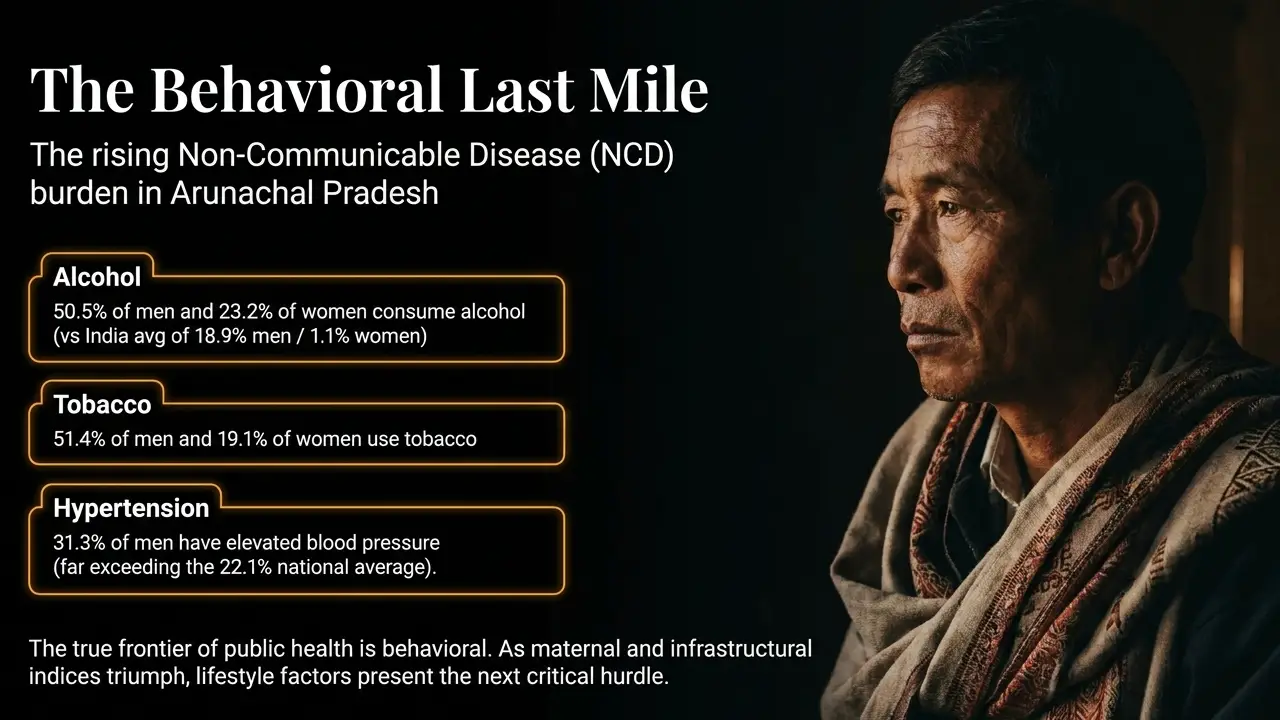
In Arunachal Pradesh, hypertension affected 24.2 percent of women and 31.3 percent of men aged 15 years and above. The prevalence among men was significantly higher than the national average of 22.1 percent.
Elevated blood sugar levels were also reported among adults, indicating a gradual rise in lifestyle-related health risks.
The survey further points to widespread tobacco and alcohol consumption in parts of the region.
Arunachal Pradesh recorded tobacco use among 51.4 percent of men and 19.1 percent of women. Alcohol consumption was reported by 50.5 percent of men and 23.2 percent of women.
These figures are substantially higher than national averages and may contribute to the increasing burden of chronic diseases in the future.
The NFHS-6 findings portray a Northeast that is changing rapidly. Fertility rates are falling, institutional births are increasing and child vaccination coverage is improving. Women are becoming more connected to financial systems and digital technologies, while public healthcare infrastructure continues to expand its reach.
At the same time, significant challenges remain. Child malnutrition persists in several states, early marriage has not been fully addressed and lifestyle-related diseases are emerging as a major public health concern.
The survey suggests that the next phase of development in the Northeast may depend not only on expanding healthcare services but also on improving nutrition, promoting healthy lifestyles and ensuring that the benefits of digital and financial inclusion reach every section of society.
As policymakers examine the findings, NFHS-6 offers both a measure of progress achieved and a roadmap for addressing the region's remaining health and social challenges in the years ahead.