A May 7 anti-drug operation led to the arrest of a former Kuki Women Union (KWU) leader and seizure of 1.14 kg of brown sugar, triggering a public relations crisis while KWU GHQ and KWU Saikul Block issued conflicting statements over her past association with the organization.
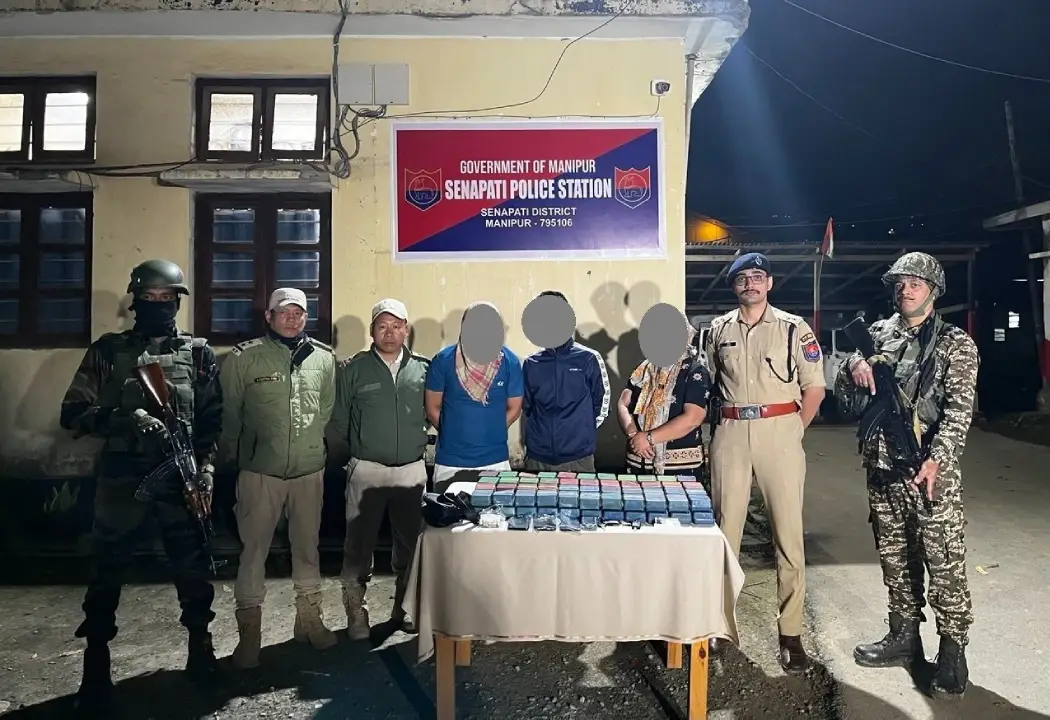
A routine security operation at the T Khullen checkpoint in Senapati district on May 7, 2026, led to the arrest of three individuals and the seizure of approximately 1.140 kilograms of brown sugar — but it was the identity of one of the arrested persons that quickly transformed a narcotics case into a full-blown institutional crisis for the Kuki Women Union (KWU). Security forces intercepted two vehicles and detained a woman identified in social media circles as a former leader of the KWU, triggering a race to protect the union's reputation through conflicting official statements.
Security forces attached to the Senapati Police Station halted a convoy comprising a Mahindra Bolero (registration NL07C-5762) and a Maruti Swift (registration AS04E-3344) at the T Khullen checkpoint. The operation yielded a significant haul of suspected narcotics: 99 soap cases containing brown sugar weighing approximately 1.140 kg. In addition to the illicit drugs, police seized Rs 30,300 in cash and four mobile phones from the occupants.
Three individuals were taken into custody:
|
Name |
Age |
Residence |
|
Nemneilhing Haokip (alias Neinu Haokip) |
42 |
Saikul Bazar, Kangpokpi district |
|
Hengkhomang Haokip |
47 |
Saikul Bazar, Kangpokpi district (husband of above) |
|
K Dovile |
42 |
Laii village, Senapati district |
Official police communications released following the May 7 arrest made no mention of any organizational affiliation for the suspects. However, users on X (formerly Twitter) rapidly identified Nemneilhing Haokip as the General Secretary of the KWU Saikul Block, attaching her formal title to the narcotics arrest. The identification spread widely, transforming a law enforcement matter into a reputational emergency for one of the region's prominent women's organizations.
ALSO READ: The Industrialization of Illicit Economies: A Strategic Assessment of Manipur’s Narcotics Landscape
The speed of social media outpaced the union's internal communication channels. By the time the KWU began formulating an official response, the narrative that a sitting KWU leader had been arrested in a major drug seizure had already taken root in public discourse. This dynamic — where public memory outlives official administrative records — forced both the KWU General Headquarters and the local Saikul Block into a reactive, defensive communications posture.
By May 9, 2026 — two days after the arrest — the Kuki Women Union General Headquarters (GHQ), based in Bijang, Lamka, issued an official statement (Ref No. 003/KWU/GHQ/0526) taking a firm stance of total dissociation. The GHQ strongly denounced the arrest and declared that Nemneilhing Haokip has "no connection" with the Kuki Women Union. The statement branded any claims identifying her as General Secretary as "unauthorized and false," demanded that authorities verify her identity and affiliations before taking further action, and appealed to the public to disregard statements made in her name.
However, a separate clarification circulated by the KWU Saikul Block — the local sub-unit directly relevant to the suspect — told a markedly different story. Rather than denying any connection, the Saikul Block's statement confirmed that Nemneilhing Haokip had indeed served as the Secretary of the KWU Saikul Block from 2022 until March 2026, a four-year tenure in a senior leadership role.
The Saikul Block clarified that a new executive body was elected in March 2026 for the 2026–2029 term, with Khupjanei Lupheng assuming the role of President and Lamkhonei Singsit becoming General Secretary. The local unit asserted that labeling Haokip as a current KWU leader was a deliberate attempt to tarnish the organization's image. Critically, however, neither the GHQ nor the Saikul Block statement addressed whether she had formally resigned her general membership of the union — a distinction that left the organization's position legally and reputationally ambiguous.
|
|
The GHQ strongly denounced the arrest and clarified that the individual has "no connection" with the Kuki Women Union — yet the Saikul Block simultaneously confirmed she served as Secretary for four years until March 2026, barely 60 days before the arrest. |
The timing of the arrest has placed the KWU in a particularly exposed position. The suspect's departure from office in March 2026 and the narcotics interception in May 2026 represent a gap of barely 60 days — a window too narrow for public perception to have decoupled her identity from the organization she led for four years. The KWU's failure to issue a unified response has compounded the damage.
The GHQ's sweeping claim of "no connection" directly contradicts the Saikul Block's detailed historical account, creating a narrative inconsistency that is more damaging than either statement alone. In crisis communications, contradictions between an organization's own units are frequently perceived as evidence of a cover-up rather than a genuine distancing effort. The KWU's divergent responses have thus undermined its credibility at precisely the moment when a clear, unified, and factually accurate account was most needed.
Furthermore, the KWU's focus solely on Haokip's leadership status, without addressing whether she remains an active member of the union, leaves a significant unanswered question. Membership and office-bearing are distinct organizational statuses; the absence of clarity on the former continues to provide grounds for linking the suspect to the KWU beyond the title that has been publicly disputed.
As criminal proceedings continue, the KWU has reaffirmed its commitment to the welfare of the Kuki community and urged public cooperation in maintaining the integrity of the organization's representation. The legal case will focus on the 1.140 kg brown sugar seizure, the two vehicles, and the activities of the three detainees. But the institutional case of how community organizations manage reputational crises rooted in the actions of former members remains wide open.