What has been happening in Manipur for the past three years is not a random series of riots. It is, they say, a planned campaign to break apart the state and push out its original inhabitants.
AT A GLANCE
Organiser: Coordinating Committee on Manipur Integrity (COCOMI)
Venue: Iboyaima Shumang Leela Shanglen, Imphal
Date: May 3, 2026 (Third anniversary of the conflict)
Presiding Officer: YK Dhiren, COCOMI Convenor
Resolutions Passed: Six (6)
Key Warning: Possible three-part breakup of Manipur within three months
New Observance: May 3 declared 'Anti-Narco-Terrorism Day'
1. WHAT HAPPENED — THE CONVENTION IN PLAIN LANGUAGE
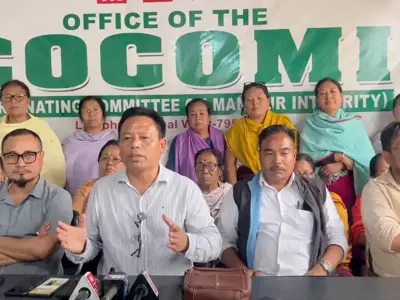
On May 3, 2026 — exactly three years after violence first erupted — thousands of people gathered in Imphal for the Manipur People's Convention. The event was organised by COCOMI, one of the most prominent civil society bodies in the state. The message from speakers was blunt: what has been happening in Manipur for the past three years is not a random series of riots. It is, they say, a planned campaign to break apart the state and push out its original inhabitants.
The day produced six formal resolutions, a set of demands to both the Manipur government and the Government of India, and a new date on the calendar — May 3 is now declared 'Anti-Narco-Terrorism Day.' Leaders also announced plans to send a People's Delegation to meet directly with the Chief Minister and central leaders in New Delhi.
2. THE BIGGEST WARNING — A STATE THAT COULD SPLIT IN THREE MONTHS
The sharpest moment of the convention came from RK Nimai, a retired IAS officer who once served as Secretary to the Governor of Manipur. Drawing on decades of administrative experience, he issued a stark warning:
"A situation involving the breakup of Manipur into three parts is certain to emerge within the next three months."
In simple terms: he believes Manipur is close to losing its shape as a single, unified state. He did not describe exactly what those 'three parts' would look like — and that uncertainty is itself part of the danger, since unclear boundaries invite further violence and chaos.
His deeper point was about strategy. He argued that the forces working against Manipur have had a clear, long-term plan from the very beginning, since the 60s. The indigenous response, by contrast, has been reactive — people protest after an attack, then go home. Nimai called for a shift: instead of responding emotionally to each new incident, communities need to build organised, intellectual resistance, including teams of young researchers and analysts who can understand and counter the bigger plan being executed against them.
3. NARCO-TERRORISM — WHAT IT MEANS AND WHY IT MATTERS
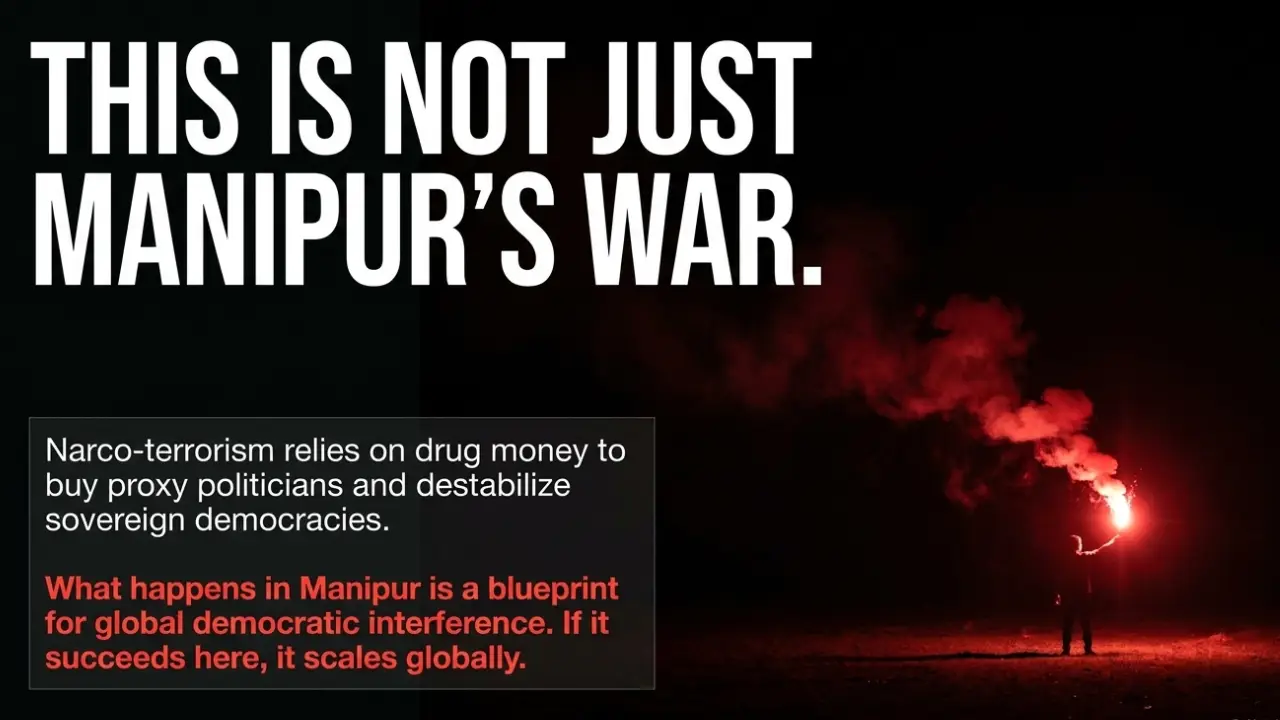
A term used repeatedly throughout the convention was 'Narco-Terrorism.' It sounds technical, but the idea is straightforward: drug money is being used to fund armed groups, which then use violence to destabilise a region for political purposes. And this is not an allegation against any community but armed groups who thrives in illicit narcotic trades and carry out terror acts.
ALSO READ: The Industrialization of Illicit Economies: A Strategic Assessment of Manipur’s Narcotics Landscape
According to speakers, this is exactly what is happening in Manipur. The mechanism works in three steps:
• Poppy fields in the hills generate large amounts of illegal drug money.
• That money buys weapons, pays fighters, and funds political campaigns — including, it was alleged, the election of politicians who act as agents for these networks.
• The violence and political interference then makes normal life impossible for indigenous communities, slowly pushing them out.
The convention framed this not as a Manipur-only problem but as a global threat given the expanding network and geography of Golden Triangle, which has now become the top global source of narcotics. Drug networks that can influence elections and destabilise governments, they argued, are a danger to any democracy. Given the situation COCOMI plans to petition the United Nations to recognise May 3 as International Anti-Narco-Terrorism Day.
4. TRONGLAOBI AND T.M. KASOM
The convention did not speak only in abstract terms. Speakers specifically condemned two recent incidents of violence that have shocked communities across Manipur.
In Tronglaobi, two children were murdered and their mother was left critically injured in a RPG attack. In T.M. Kasom, two Tangkhul civilians including an ex-armyman were killed in targeted attacks. These incidents were described as acts of calculated terror — designed not just to kill, but to break the social fabric of communities by targeting the most defenceless, strategically after each trip of the Chief Minister's reachout plan to hill districts.
Adding to the outrage, three civilians were killed by the Central Reserve Police Force (CRPF) during a follow-up protest against the Tronglaobi murders and perceived inaction of the CRPF camp stationed in the vicinity. For many at the convention, this was not seen as a mistake by security forces — it was seen as evidence that the central government's forces are protecting the wrong side. The convention demanded a full judicial inquiry into the CRPF killings and the immediate arrest of those responsible for the atrocities in both villages.
5. THE 'PROXY WAR' ACCUSATION — WHAT COMMUNITIES BELIEVE
The most politically charged charge made at the convention was this: the Government of India is, through its policies and actions, effectively waging a proxy war against the indigenous people of Manipur. This is a serious allegation, and it was made openly and on record.
"The Manipur Government must courageously stand up and stop the proxy war being waged by the Government of India to eliminate the indigenous people of Manipur."
~ Resolution text
The belief behind this allegation is that the central government has been too lenient toward Chin-Kuki militant groups, allowing them to operate under the cover of a Suspension of Operations (SoO) agreement — essentially a ceasefire that critics say acts as a shield for criminal and violent activities. The convention demanded this agreement be cancelled immediately.
Whether one agrees or disagrees with the characterisation, the political weight of such a statement — coming from organised civil society, former senior officials, and community leaders across ethnic lines — cannot be ignored. It represents a profound breakdown of trust between the state's indigenous population and the national government.
6. THE NAGA FACTOR — WHEN THE CONFLICT EXPANDS BEYOND ONE COMMUNITY
A critical development highlighted at the convention was the voice of NG Akhui, Convenor of the Foothills Naga Coordination Committee (FNCC). His presence and remarks were significant — they signalled that the conflict is no longer confined to tensions between the Meetei and Kuki communities.
"The time has come for us indigenous communities to unite and confront them... We must save Manipur by uniting as one."
Akhui pointed out that Naga communities are now also being targeted by the same networks. This matters for two reasons. First, it confirms that the strategy being employed is not about any single ethnic grievance — it is about clearing indigenous communities more broadly. Second, it creates the possibility of a unified indigenous front that cuts across the historic divisions between the Meetei and Naga communities, something that has rarely occurred in Manipur's political history.
7. THE SIX RESOLUTIONS — WHAT WAS FORMALLY DECIDED
The convention formally adopted six resolutions. Below is a plain-language summary:
|
Resolution |
What It Means |
|
First |
Reaffirm all past COCOMI positions since May 2023 and mobilise local clubs and Meira Paibis for continued democratic action. |
|
Second |
Condemn the Tronglaobi and T.M. Kasom killings; demand arrests and a judicial inquiry into the CRPF deaths. |
|
Third |
Intensify non-stop democratic movements against what is described as continuous Chin-Kuki narco-terrorist attacks. |
|
Fourth |
Formally present seven specific demands to the Manipur and central governments. |
|
Fifth |
Form a People's Delegation of experts, community leaders, and displaced persons to meet the Chief Minister and central leaders. |
|
Sixth |
Declare May 3 as Anti-Narco-Terrorism Day; petition the United Nations to adopt it as an international observance. |
8. THE SEVEN DEMANDS — WHAT IS BEING ASKED OF THE GOVERNMENT
Speakers described the government's response on April 25 — the last formal feedback before this convention — as 'unsatisfactory.' The convention therefore formalised seven demands:
1. Stop the Proxy War — The Manipur government must resist policies that, in the view of indigenous communities, are working to eliminate them.
2. Eradicate Narco-Terrorism — Take comprehensive action to dismantle Kuki narco-terrorist networks operating in the state.
3. Legal Justice — Immediately arrest and prosecute those responsible for the murders in Tronglaobi and T.M. Kasom.
4. CRPF Accountability — Launch a judicial inquiry into the killing of three civilians by the CRPF and take action against those found guilty.
5. Resettlement of Displaced Persons — Set a fixed, binding timeline for the safe return of Internally Displaced Persons (IDPs) to their homes.
6. Cancel the SoO — Immediately abrogate the Suspension of Operations agreement with Kuki militant groups.
7. NRC and Deportations — Implement the National Register of Citizens and deport those found to be illegal immigrants.
9. WHAT COMES NEXT
The convention was not simply a memorial. It was a pivot point. The mood in the hall was one of controlled urgency — a community that has exhausted its patience with both spontaneous protest and government promises.
Three things are expected to follow:
• The People's Delegation will seek direct talks with the Chief Minister of Manipur and leaders in New Delhi, bringing with them the formal resolutions passed on May 3.
• COCOMI will mobilise local clubs, Meira Paibis (women's civil society groups), and regional bodies to sustain continuous democratic pressure.
• An international campaign will be launched to raise awareness at the United Nations and among global bodies about the role of narco-money in destabilising democratic states.
Whether these steps will be enough to prevent the administrative fracture that experts warn about depends, ultimately, on whether the government in New Delhi is willing to listen — and act — before the three-month window closes.
— Report compiled from proceedings of the Manipur People's Convention, May 3, 2026