ANSAM rejects the Kuki-Zo Council's apology over the killing of six Naga hostages, calling it insincere and demanding prosecution of those responsible.
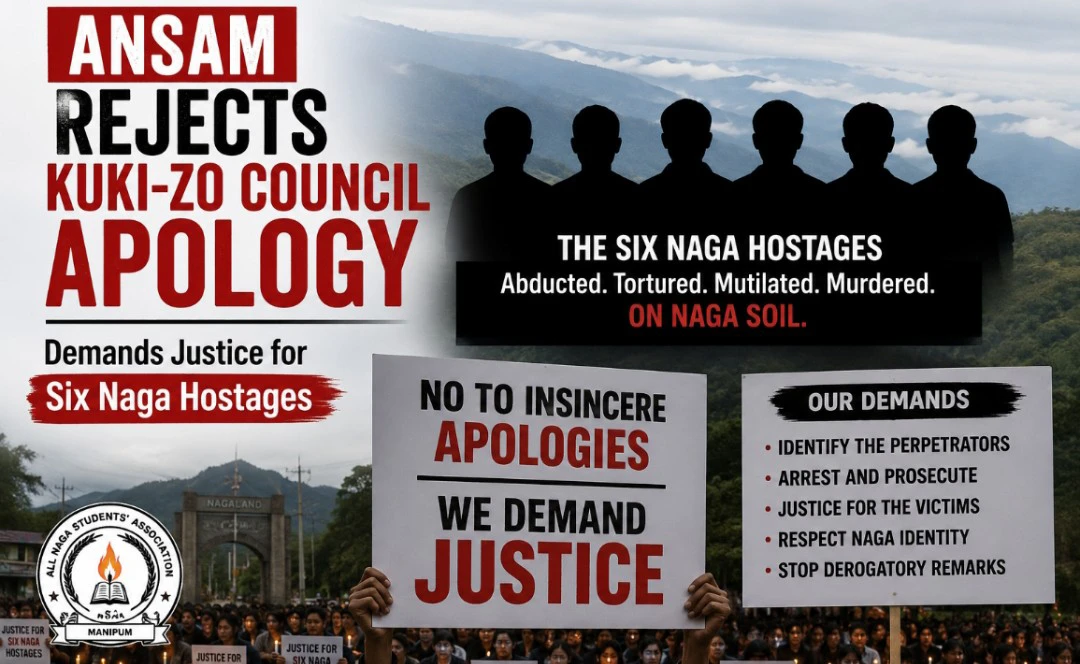
Imphal, June 26: The All Naga Students' Association, Manipur (ANSAM) has strongly rejected the apology recently issued by the Kuki-Zo Council (KZC) over the killing of six Naga civilians, describing it as insincere, offensive and devoid of accountability. The student body said the statement failed to acknowledge the gravity of the crime and instead aggravated the pain of the Naga community through what it called derogatory references and the absence of any commitment to justice.
In a press release issued on Thursday, ANSAM said the apology by the KZC leadership, which followed the killing of six Naga hostages abducted on May 13, neither amounted to a genuine apology nor an admission of responsibility for what it described as an "unlawful and inhumane crime."
The association alleged that members of KNF(P) along with residents of Leilon Vaiphei Kuki village were responsible for the abduction and killing of the six Naga civilians. It maintained that the victims were abducted, held captive, tortured and later killed within what it described as ancestral Naga territory.
The latest statement comes days after Kuki-Zo Council chairman Henlianthang Thanglet publicly apologised for the killings, saying the incident was driven by emotion and occurred amid heightened tensions following the killing of three Thadou Baptist Church leaders earlier the same day. The council had also appealed for reconciliation between the two communities.
RELATED NEWS: KZC Chairman Apologises for Killing of Six Naga Hostages, Says Act Was Driven by ‘Emotion’
However, ANSAM said the apology failed to meet even the basic standards of accountability.
According to the association, no apology can be considered credible until those directly responsible for the abduction, torture and killing of the six victims are identified, arrested and prosecuted under the law.
"The rule of law cannot be replaced by carefully worded public statements," the association said, asserting that justice must precede reconciliation.
Objection over terminology
A significant portion of the ANSAM statement criticised the terminology used in the KZC apology, particularly the reference to "Katcha Nagas."
The association described the expression as historically untenable, deeply offensive and disrespectful to the identity and dignity of the Naga people. It argued that such language reflected continued prejudice rather than genuine remorse.
ANSAM further alleged that the terminology amounted to an insult directed at the Naga community even while expressing regret over the killings.
The association also questioned why an organisation representing various Kuki and Zomi groups would choose to use language that, in its view, undermined the sincerity of its own apology.
Questions over the council's mandate
Beyond rejecting the apology, ANSAM sought clarification regarding the authority of the Kuki-Zo Council itself.
It questioned whether the council had issued the apology on behalf of those directly involved in the killings or whether its leaders themselves bore responsibility or association with the incident.
The association also asked whether the council possessed any legitimate mandate to represent all communities grouped under the Kuki-Zo identity and whether Zomi organisations formally recognised or endorsed the statement.
Rejects allegations over church leaders' killing
ANSAM also reiterated that the Naga community had no involvement in the killing of three Thadou Baptist Church leaders, an incident that preceded the abduction and killing of the six Naga civilians.
The association stated that the church leaders were reportedly killed between Kotzim and Kotlen Kuki village areas, where, according to ANSAM, Nagas neither exercise control nor have influence.
It maintained that any attempt to implicate Nagas in that incident was baseless and intended to fuel communal misunderstanding.
Appeal to governments
Calling for immediate legal action, ANSAM urged both the Government of Manipur and the Government of India to ensure that all those responsible for the abduction and killings are brought to justice without delay.
The association warned that any delay in prosecuting the accused would represent a failure of constitutional governance and the rule of law.
It also urged authorities to seriously consider the charter of demands submitted by the United Naga Council, saying symbolic gestures could not substitute for justice and accountability.
Reconciliation requires accountability
Concluding its statement, ANSAM expressed solidarity with the families of the six victims and reaffirmed its commitment to pursuing truth and justice.
The association maintained that meaningful reconciliation between communities would only be possible through accountability, acknowledgement of historical facts, respect for identity and the proper administration of justice.
The killing of the six Naga civilians on May 13 has further strained already fragile relations between Naga and Kuki-Zo groups in Manipur, with competing narratives continuing to emerge over the sequence of events that unfolded that day. While the Kuki-Zo Council has sought forgiveness and called for reconciliation, ANSAM has made it clear that any reconciliation process must begin with criminal accountability and justice for the victims.