India launched E85 fuel at 48 retail outlets, with plans to expand to 5,000 outlets by 2027, boosting ethanol use and supporting flex-fuel vehicles.
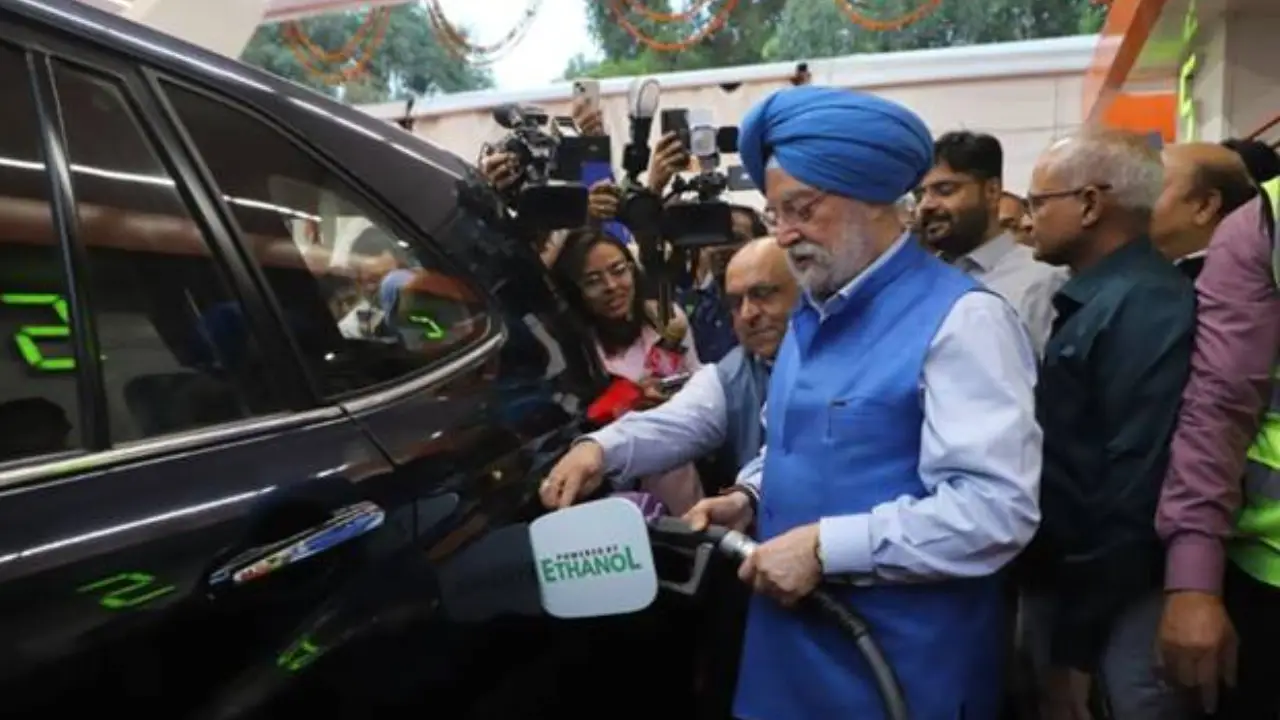
New Delhi, June 5: Union Minister for Petroleum and Natural Gas Hardeep Singh Puri on Friday launched E85 fuel at an IndianOil retail outlet in New Delhi on the occasion of World Environment Day 2026, marking another milestone in India's push towards cleaner and more sustainable transportation.
Senior officials from the Ministry of Petroleum and Natural Gas and chairpersons and managing directors of public sector oil marketing companies (OMCs) were present during the launch.
E85 is a high-ethanol blended fuel containing 80 to 85 per cent ethanol and 14 to 19 per cent petrol, specifically developed for use in flex-fuel vehicles (FFVs). These vehicles are designed to operate on a range of ethanol blends from E20 to E100, providing consumers with greater fuel flexibility while reducing dependence on conventional fossil fuels.
The rollout of E85 fuel has commenced through 48 public sector OMC retail outlets across the country. According to the government, the initiative will be gradually expanded to 500 retail outlets by December 2026 and approximately 5,000 outlets by December 2027.
Officials said the expansion is expected to support the growth of India's flex-fuel ecosystem and help raise the country's aggregate ethanol blending levels to nearly 26 per cent by 2030-31.
Speaking at the event, Puri said India has successfully balanced what he described as the energy trilemma of availability, affordability and sustainability while maintaining stable fuel supplies and shielding consumers from global energy market volatility.
The Minister noted that India's ethanol blending programme has recorded significant progress over the past decade. Ethanol blending in petrol has increased from 1.53 per cent in 2014 to 20 per cent in 2026, achieving the national target five years ahead of schedule.
RELATED NEWS: Maruti Suzuki launches India's first flex fuel car: How It Works and Why It Matters
According to the Minister, the programme has helped save more than Rs. 1.84 lakh crore in foreign exchange while replacing nearly 302 lakh metric tonnes of crude oil imports. He credited Indian farmers for playing a central role in the achievement, stating that they have evolved from being the country's "Annadatas" to becoming "Urjadatas" through their contribution to biofuel production.
Highlighting the consumer benefits of E85, the government stated that the fuel is priced nearly Rs. 20 per litre lower than conventional petrol. The pricing strategy is intended to ensure that the economic advantages of domestically produced ethanol are passed on directly to consumers.
The Ministry also pointed to the environmental advantages of higher ethanol blends. Flex-fuel vehicles operating on E85 can reduce lifecycle greenhouse gas emissions by approximately 61 per cent compared to conventional petrol-powered vehicles.
In addition, ethanol has a Research Octane Number (RON) of around 108, providing greater resistance to engine knocking and enabling engines to operate at higher compression ratios. Officials said this can improve engine performance and efficiency.
Higher ethanol blends also promote cleaner combustion, resulting in significantly lower particulate emissions and contributing to improved urban air quality.
Puri said a wider transition to flex-fuel vehicles could generate substantial economic and environmental gains. According to government estimates, if 50 per cent of newly sold two-wheelers and four-wheelers adopt flex-fuel technology, demand for ethanol could exceed 312 crore litres annually.
Such a shift, he said, could result in nearly Rs. 12,403 crore flowing directly to farmers while generating annual foreign exchange savings of around Rs. 15,151 crore. The transition could also reduce carbon dioxide emissions by approximately 66.4 lakh metric tonnes each year.
The Minister noted that India's flex-fuel programme draws inspiration from successful international models, particularly Brazil, where flex-fuel technology has been widely adopted over several decades. He observed that more than 80 per cent of Brazil's light vehicle fleet currently operates on flex-fuel systems.
Puri said the recent introduction of flex-fuel compatible two-wheelers, passenger vehicles and E85 fuel signals India's transition from pilot projects to a structured national flex-fuel ecosystem. He urged state governments to support the initiative through favourable taxation policies for both E85 fuel and flex-fuel vehicles.
Addressing concerns surrounding ethanol-blended fuels, the Minister clarified that E85 is intended exclusively for specially designed flex-fuel vehicles and should not be used in standard petrol vehicles.
He further stated that since E20 became the standard fuel across the country, there has been no reported case of engine failure or vehicle breakdown attributable to ethanol blending. He also said E20-compatible vehicles offer improved acceleration and driving performance, particularly in urban conditions, and that the use of E20 fuel does not affect vehicle insurance validity.
Comparing flex-fuel vehicles with electric vehicles, Puri said FFVs remain competitive because of their lower purchase costs and their ability to use the country's existing fuel infrastructure. Unlike electric vehicle technologies that depend heavily on imported batteries and critical minerals, he noted that E85-powered vehicles run on ethanol produced domestically by Indian farmers.
Concluding the event, the Minister said every litre of ethanol helps reduce dependence on imported fossil fuels and contributes to the vision of an Atmanirbhar Bharat through cleaner, domestically produced energy.