Three civilians were killed and seven houses burnt in an early morning attack on Loibol Khullen village in Kangpokpi district, triggering widespread condemnation and demands for justice.
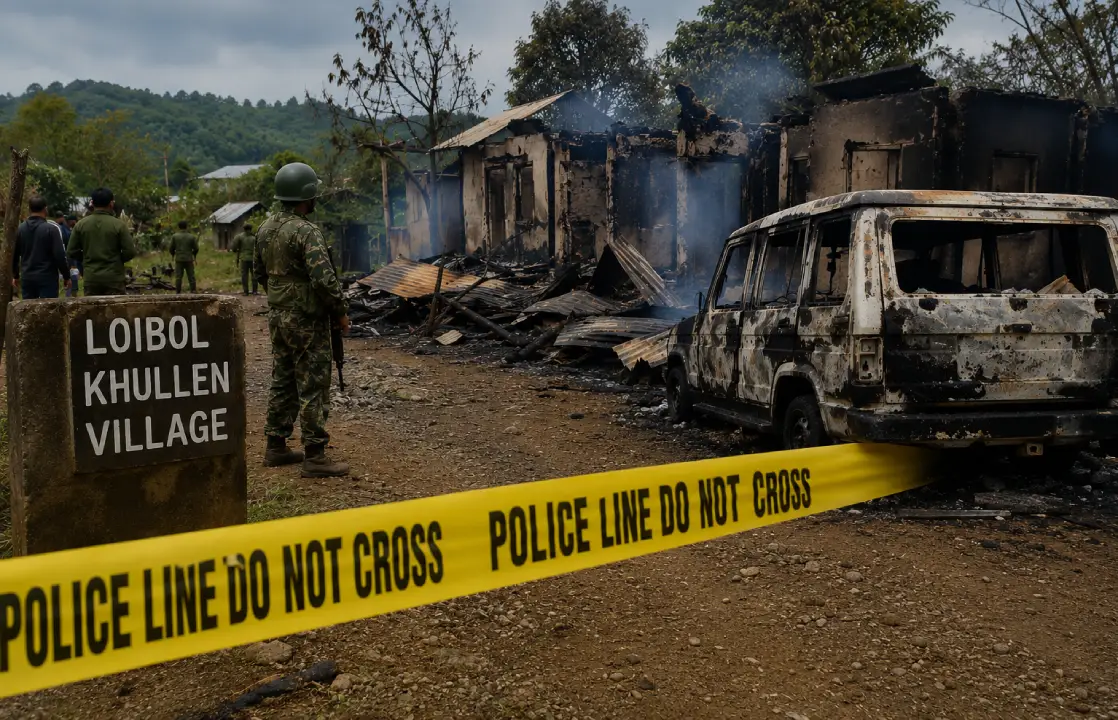
Imphal, June 5: Three civilians, including a woman, were killed and several houses were set ablaze after heavily armed unidentified assailants attacked Loibol Khullen village in the New Keithelmanbi area of Kangpokpi district early Friday morning, triggering widespread condemnation from Kuki-Zo civil society organisations and renewed concerns over security in Manipur's hill districts.
According to reports and police sources, the attack occurred at around 4 am when armed men entered the village and opened fire. The assailants allegedly advanced into residential areas, firing indiscriminately and setting houses and vehicles on fire before fleeing the scene.
The deceased were identified as Letkhongam Haokip (34), son of Manglung Haokip; his wife Tinmary Haokip (25); and Jangminlal Haokip (30), son of Seikhohao Haokip. All three reportedly died on the spot after sustaining gunshot injuries during the attack.
In addition to the killings, around seven houses were reportedly burnt down. Police sources said a Gypsy vehicle and a Mahindra Bolero pickup truck parked in the village were also set ablaze.
The attack forced residents to flee their homes and seek safety elsewhere. Villagers reportedly abandoned the settlement amid fears of further violence as gunfire echoed through the area during the early hours of the morning.
Security personnel from the Kangpokpi district police and central armed forces rushed to the village after receiving information about the incident. Search operations were launched in and around the area, but no arrests had been reported at the time of filing this report.
Police have registered a case in connection with the attack and initiated an investigation.
RELATED NEWS: CM, Deputy CM and Kangpokpi MLAs Denounce Loibol Khullen Attack, CM Orders Crackdown
The incident has sparked strong reactions from Kuki-Zo organisations across Manipur, many of which condemned the killings and demanded immediate intervention from the Government of India and security agencies.
The Kuki Inpi Manipur (KIM), the apex body of the Kuki tribes, strongly condemned the attack, describing it as a barbaric act of violence against unarmed civilians.
In a statement, KIM alleged that cadres belonging to the National Socialist Council of Nagalim-Isak-Muivah (NSCN-IM) and its alleged proxy outfit ZUF (K) were responsible for the assault. The organisation said the attack constituted a grave violation of human rights and human dignity.
KIM expressed solidarity with the bereaved families and said the killings had plunged the Kuki-Zo community into mourning. The organisation urged authorities to launch a comprehensive investigation, identify those responsible and ensure that justice is delivered without delay.
The organisation also called for stronger security arrangements in vulnerable villages and warned that continued failure to ensure accountability could have serious consequences.
RELATED NEWS: NSCN/GPRN Rejects KIM Allegations Over Loibol Khullen Attack, Calls Claims ‘Baseless’
The Committee on Tribal Unity (CoTU) also issued a strong condemnation, describing the attack as a calculated act aimed at provoking retaliation and destabilising the fragile security environment in the hill districts.
According to CoTU, the incident raises serious concerns about the continued operation of armed groups in the region despite repeated demands for stronger enforcement measures. The committee urged the Government of India to act swiftly against those responsible and prevent further attacks on civilians.
The organisation warned that recurring incidents of violence, combined with the absence of visible accountability, risk undermining public confidence in ongoing peace and security efforts.
The Sadar Hills Chiefs' Association (SAHILCA) similarly condemned the killings, calling them a brutal assault on innocent villagers.
The chiefs' body linked the Loibol Khullen incident to a series of recent violent episodes reported from different parts of the hill districts, including the killing of three church leaders in May and the burning of houses in Kharam Vaiphei village.
According to SAHILCA, the succession of attacks reflects a deteriorating security situation that requires urgent intervention from authorities. The organisation cautioned that continued violence could adversely affect peace, stability and inter-community relations in the region.
Adding an international human rights perspective to the growing criticism, the Kuki Organisation for Human Rights Trust (KOHUR) described the incident as a massacre and expressed concern over what it characterised as a recurring pattern of violence targeting Kuki-Zo civilians.
KOHUR alleged that the Loibol attack was part of a wider sequence of incidents reported during 2026, including killings, arson attacks and assaults on villages in different hill districts.
The organisation expressed concern over what it termed a culture of impunity, arguing that repeated incidents have occurred despite police cases being registered and demands being raised by civil society groups.
KOHUR called for a probe by the National Investigation Agency (NIA) into the Loibol killings as well as other recent incidents of violence. The organisation also demanded enhanced security deployment in vulnerable villages and action against alleged illegal armed camps operating in the state.
Women's organisations also joined the chorus of condemnation.
The Kuki Women Organisation for Human Rights (KWOHR) and the Kuki Women Union (KWU) issued separate statements expressing alarm over the killings and calling on the government to fulfil its responsibility of protecting civilians.
Both organisations stressed the need for immediate justice for the victims and warned that continued inaction could embolden perpetrators and place more lives at risk.
The Hill Tribal Council, Moreh, demanded a thorough and impartial judicial inquiry into the incident and sought stronger security measures for vulnerable settlements.
In its statement, the council described the attack as a barbaric act committed at a time when authorities were attempting to restore peace and stability in the state. It argued that repeated attacks on civilians could further aggravate tensions and deepen insecurity among affected communities.
The council also extended condolences to the bereaved families and expressed solidarity with the residents of Loibol Khullen.
The Kuki Inpi South-West Sadar Hills (KI-SWSH) and the Kuki Students' Organisation South-West Sadar Hills (KSO-SWSH) likewise condemned the attack and called for immediate action against those responsible.
Several organisations questioned the timing of the assault, noting that it occurred amid heightened tensions in parts of the hill districts and during a period of ongoing political discussions involving Kuki-Zo representatives and the Government of India.
The Kuki-Zo Council (KZC) also strongly condemned the killings and the destruction of homes.
In a statement, the council alleged that militants belonging to NSCN-IM and ZUF (Kamson) carried out the attack. It noted that seven houses were burnt and several families were left homeless following the incident.
KZC described the attack as the latest in a series of violent episodes affecting Kuki-Zo communities and expressed concern over what it called growing threats to the safety and security of the community.
The council appealed to Indian security forces to provide adequate protection to vulnerable villages and prevent further attacks on civilians.
It also reiterated that Kuki-Zo representatives remain engaged in dialogue with the Ministry of Home Affairs regarding their political demands and stated that the community remains committed to pursuing its aspirations through democratic and constitutional means.
According to KZC, recurring incidents of violence reinforce concerns regarding the security and future of Kuki-Zo communities in Manipur. The council urged the Government of India to expedite efforts toward a political solution that would allow people to live in peace, security and dignity.
While the various organisations differed in emphasis, a common demand emerged from their statements: a prompt investigation into the attack, arrest of those responsible, enhanced security deployment in vulnerable areas and accountability for repeated attacks on civilians.
Friday's incident has once again drawn attention to the fragile security situation in parts of Manipur's hill districts, where intermittent violence continues to generate fear and uncertainty among residents.
As investigations begin and security agencies continue search operations, the attack at Loibol Khullen is likely to intensify calls for stronger measures to protect civilian populations and prevent further escalation of violence.
For many residents of the affected village, however, the immediate reality remains one of grief and displacement. Three lives have been lost, homes have been destroyed, and a community has once again been left grappling with the consequences of violence that continues to cast a long shadow over parts of the state.